All About RAM (6) — HBF, a New Tier That Stacks NAND Next to HBM (in Korean)
At its earnings call on September 30, 2026, Micron forecast that memory supply constraints will be much tighter in 2027 and 2028 than in 2026. It added that it is still hard to predict when supply and demand will come back into balance.
In the same call, Micron said more than 75% of its 2027 output is already under contract, and that customers have committed $32 billion (₩44.8 trillion) to secure volume. That is the evidence that the price rise covered in Part 3 is not a short-term blip but is turning into multi-year contracts.
 Micron logo — Source: Micron
What the earnings report said
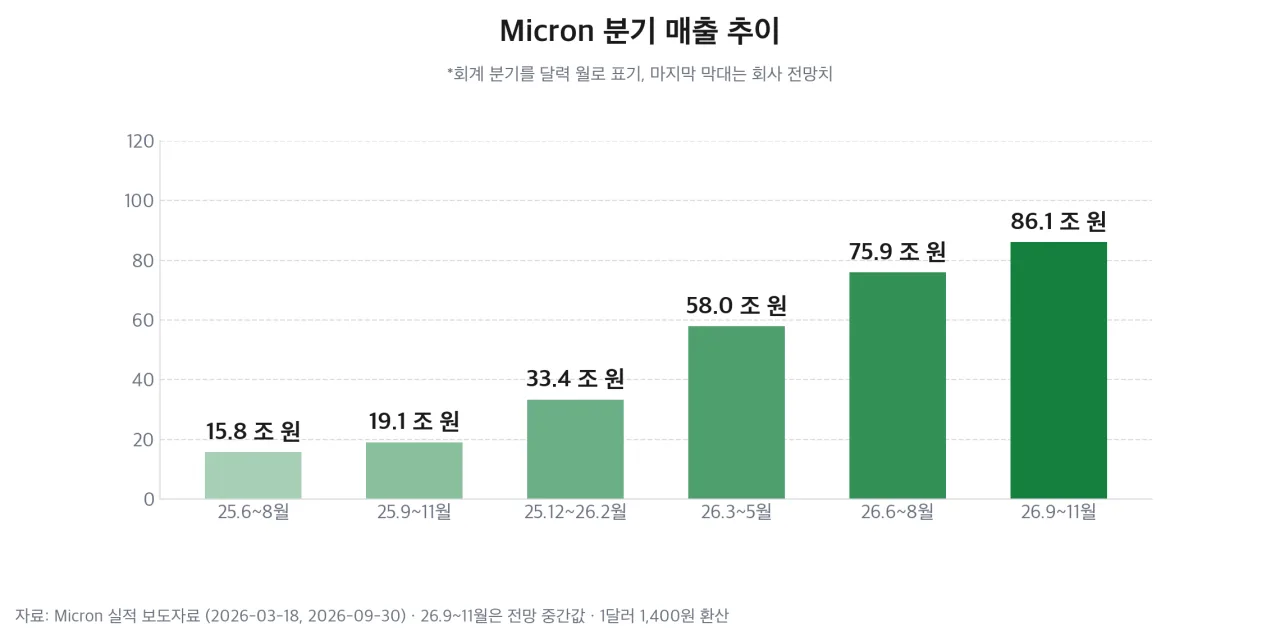 Chart of Micron quarterly revenue — Source: self-rendered from Micron earnings releases
Micron’s revenue for fiscal Q4 2026 (June–August 2026) was $54.23 billion (₩75.9 trillion), 4.8 times the $11.32 billion (₩15.8 trillion) of the same quarter a year earlier. Full fiscal-year revenue was $133.19 billion (₩186.5 trillion), 3.6 times fiscal 2025’s $37.38 billion (₩52.3 trillion).
- DRAM revenue $39.8 billion (₩55.7 trillion), 73% of the total
- Quarter-over-quarter, DRAM prices rose in the high teens and NAND prices about 30%
- NAND revenue $14.1 billion (₩19.7 trillion), 6.3 times a year earlier
- Gross margin 87.0% (non-GAAP)
- Revenue guidance for September–November 2026: $61.5 billion (₩86.1 trillion), ± ₩2.1 trillion
The Mobile and Client Business Unit (MCBU), which handles memory for PCs and smartphones, also posted a 90% gross margin. It is not only data center memory — memory that goes into consumer devices is selling at the same margins.
Supply and demand outlook for 2027–2028
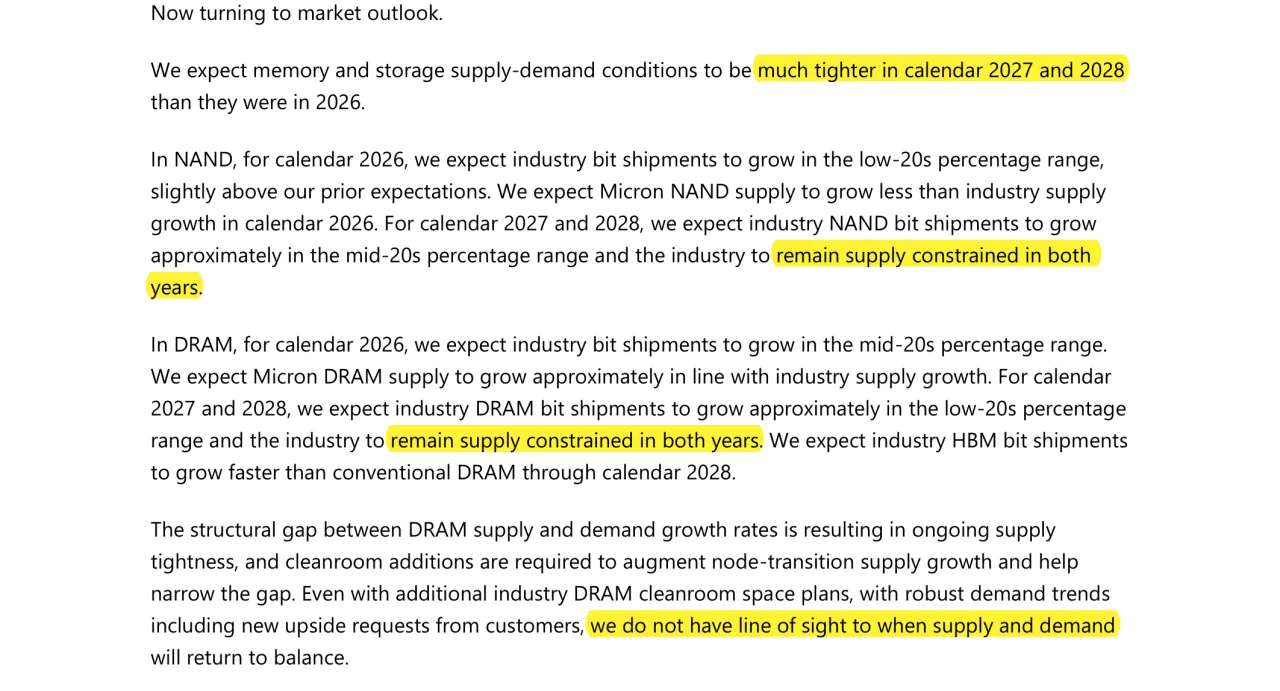 Paragraph on the 2027–2028 supply outlook from Micron’s prepared remarks — Source: Micron FY2026 Q4 prepared remarks
Micron’s outlook is framed in terms of industry bit shipment growth — the growth rate of the total memory capacity the whole industry ships.
| 2026 | 2027–2028 | |
|---|---|---|
| DRAM bit shipment growth | mid-20s % | low-20s % |
| NAND bit shipment growth | low-20s % | mid-20s % |
| Supply situation | Shortage | Supply-constrained in both years |
For DRAM, supply growth actually slows from 2027. Micron explained that node migration alone can only add so much supply, and the gap narrows only when new cleanrooms are built — and that even accounting for the cleanroom expansions the industry has planned, demand is growing faster.
It also forecast that HBM bit shipments will grow faster than conventional DRAM through 2028. As covered in Part 3, HBM uses more wafers than conventional DRAM for the same capacity, so the larger HBM’s share, the fewer wafers are left for PC and smartphone DRAM.
We do not see when supply and demand will return to balance (Micron, 2026.9.30)
How Strategic Customer Agreements (SCA) work
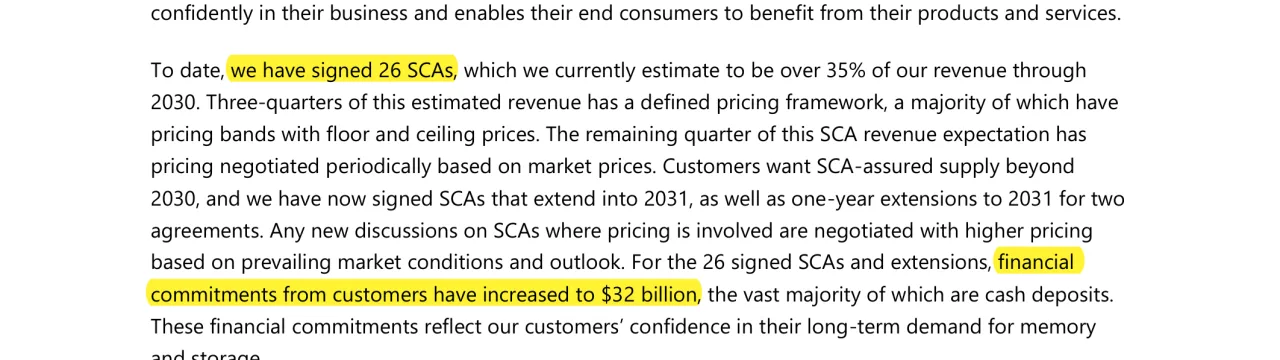 Paragraph on strategic customer agreements from Micron’s prepared remarks — Source: Micron FY2026 Q4 prepared remarks
Since June 2026, Micron has been signing multi-year contracts called SCAs (Strategic Customer Agreements). They are take-or-pay: the customer pays even if it does not take the committed volume. Terms are usually five years, 2026–2030; automotive customers sign for three.
| Item | June 2026 | September 2026 |
|---|---|---|
| Agreements signed | 16 | 26 |
| Customer funding commitments (₩ trillion) | 30.8 | 44.8 |
| Remaining performance obligations, RPO (₩ trillion) | about 140 | about 210 |
| Longest agreement | 2030 | 2031 |
As of the June call, most large agreements were struck within a price band — capped at the Q2 2026 market price, with a separate floor. As of September, three quarters of expected SCA revenue has a fixed pricing mechanism, most of it band-type with a cap and floor; the remaining quarter is reset periodically at market prices.
Micron said new agreements under negotiation are being signed at higher prices reflecting current market conditions. It added that even selling at the floor price would yield margins above the peak of any past boom.
The $32 billion (₩44.8 trillion) in customer funding commitments is mostly cash deposits, and $12.3 billion (₩17.2 trillion) was deposited in the June–August 2026 quarter alone.
Fab expansion schedule
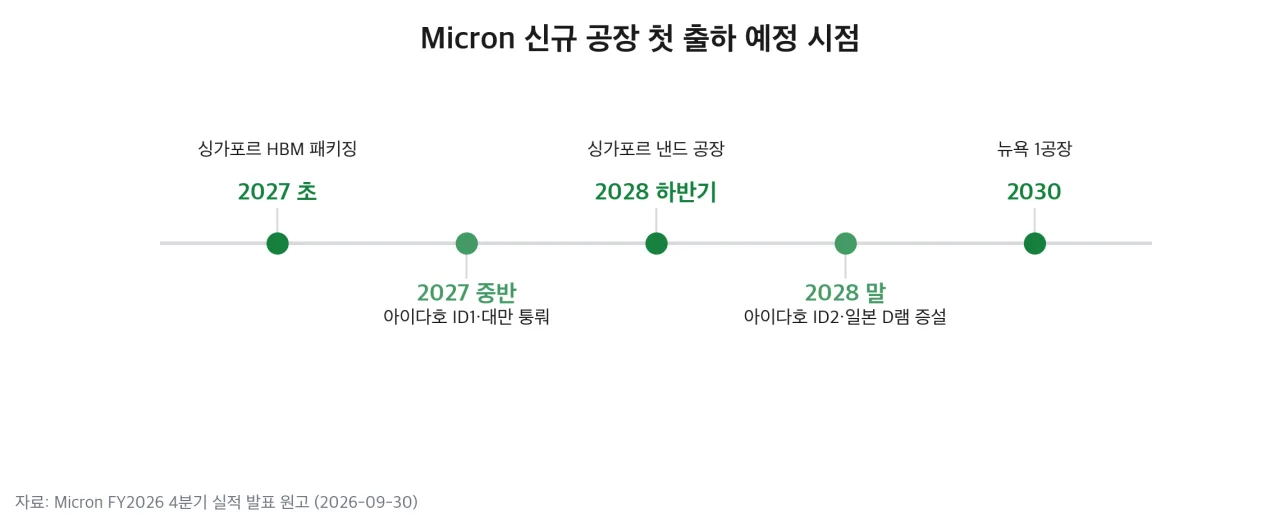 Timeline of first shipments from Micron’s new fabs — Source: self-rendered from Micron’s prepared remarks
Since the way to add supply is cleanrooms, fab completion dates ultimately set the supply picture. The ID1 fab in Idaho produces its first wafers in mid-2027 and ID2 in late 2028; New York fab 1 is targeted for 2030. The Japan DRAM expansion starts operating in late 2028, and the Singapore HBM packaging facility in early 2027.
Capital spending is going up too. Net capex was $27.37 billion (₩38.3 trillion) in fiscal 2026; for fiscal 2027 Micron plans to spend $25 billion (₩35 trillion) in the first half alone and more in the second half. Most of the increase is construction cost, used to pull forward cleanroom builds scheduled for late 2028 and beyond.
Because most new fabs make their first shipments between mid-2027 and late 2028, supply growth until then has to come from process conversions on existing lines.
What it means for consumer prices
 Concept image of rising PC and smartphone memory prices — Source: concept image · self-generated with agy
On September 30, 2026, market researcher TrendForce forecast Q4 contract prices rising 10–15% quarter-over-quarter for conventional DRAM and 15–20% for NAND. It expects PC DRAM to keep climbing as PC makers keep buying ahead of a projected 2027 shortage, and said higher component costs have started to show up in laptop inventory.
Micron itself forecast that PC and smartphone shipments could fall by double digits in 2026. It still expects market revenue to grow, led by high-end products — fewer units, but more memory cost per unit.
Retail prices in Korea are high too. On Danawa, the lowest price for Samsung DDR5-5600 32GB desktop memory was ₩790,960 on October 5, 2026. Global Economic reported that some high-end smartphones are cutting RAM from 16GB to 12GB, and mid-range models to 8GB.
If large customers lock up volume first through SCAs, the supply left for the DIY PC and retail markets may shrink accordingly.
Samsung Electronics and SK hynix in Q3
 Samsung Electronics logo — Source: Samsung
 SK hynix logo — Source: SK hynix
Right after Micron’s report, expectations for Q3 results at Korea’s two memory makers went up as well.
| Company | Period | Operating profit (₩ trillion) |
|---|---|---|
| Samsung Electronics | Jul–Sep 2026 consensus | 110.3 |
| SK hynix | Jul–Sep 2026 consensus | 78.1 |
| Micron | Jun–Aug 2026 actual | 61.3 |
FnGuide’s operating-profit consensus as of October 5, 2026 is 23% above the previous quarter for Samsung Electronics and 29% above for SK hynix. If Samsung meets it, it will top ₩100 trillion in quarterly operating profit for the first time.
Long-term contracts are growing at both Korean companies as well. According to The Korea Herald, Samsung Electronics has secured 60–70% of its volume under long-term contracts, and SK hynix has signed roughly five-year agreements with about 10 customers. Neither company discloses contract counts or amounts the way Micron does.
What to watch next
- Whether Samsung’s preliminary Q3 earnings (expected early to mid October) and SK hynix’s earnings call disclose their long-term contract share
- The pricing of Micron’s new SCAs, and how far above June’s cap it goes
- Whether the mid-2027 first shipments from Idaho ID1 and Tongluo, Taiwan stay on schedule
- PC DRAM price growth in TrendForce’s Q1 2027 contract price outlook
- Micron’s fiscal Q1 2027 (September–November 2026) results, and whether it hits the $61.5 billion (₩86.1 trillion) guidance
All About RAM (6) — HBF, a New Tier That Stacks NAND Next to HBM (in Korean)
Sources
- [Micron] FY2026 Q4 earnings press release (2026-09-30)
- [Micron] FY2026 Q4 prepared remarks (source of two images in this post)
- [Micron] FY2026 Q3 prepared remarks (June SCA figures)
- [Micron] FY2026 Q2 earnings press release (quarterly revenue trend)
- [StockAnalysis] FY2026 Q4 earnings call transcript (75% of 2027 volume under contract)
- [TrendForce] 4Q26 memory contract price outlook (2026-09-30)
- [Solution News] FnGuide Q3 operating profit consensus (2026-10-05)
- [The Korea Herald] Samsung Electronics and SK hynix long-term contracts
- [Global Economic] Smartphone memory capacity cuts (2026-10-01)
- [Danawa] Samsung DDR5-5600 32GB price (checked 2026-10-05)
- Exchange rate: converted at $1 ≈ ₩1,400