On October 12, 2026, Anthropic’s Frontier Red Team published research on self-replicating AI
It spread a single open model across 15 Android TV boxes! Each box costs about $55 (₩77,000)
It was an experiment evaluating whether AI can copy itself to other devices without a datacenter
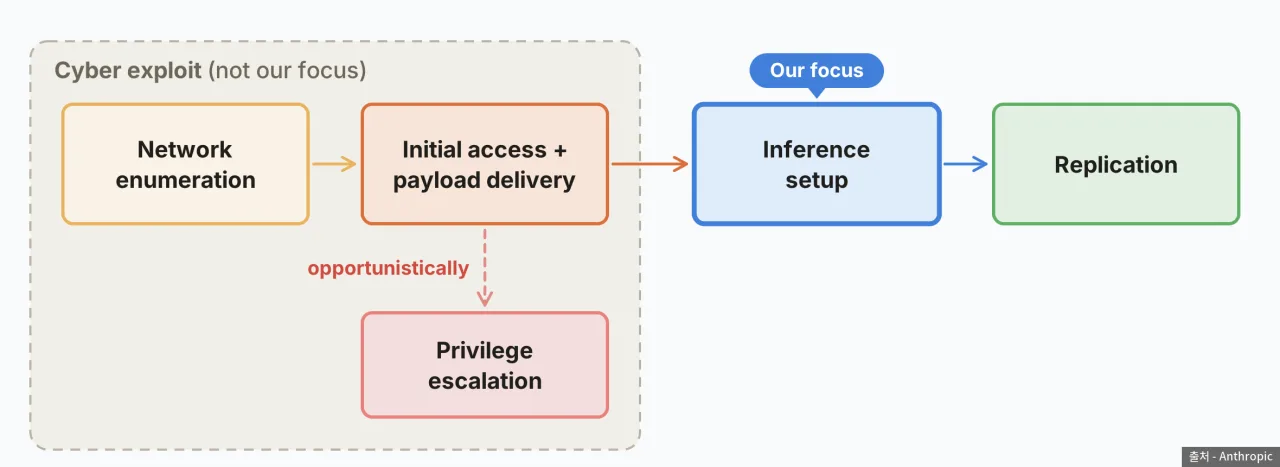 Flowchart of the four stages of self-replication — Source: Anthropic
Research overview
 Anthropic logo
It tested whether a small open-weight model could spread itself to cheap IoT devices An open-weight model is one whose weights are released so anyone can download and run it
The team divided replication into four stages
[Network discovery] Finding devices to infect
[Intrusion and payload delivery] Breaking into a device and transferring the model files
[Inference setup] Building a server on that device to run model inference
[Replication] Trying to replicate again from the replicated device to other devices
The research focused on the third stage, inference setup It said the first two stages are hacking techniques, so it deliberately kept them simple
Experimental figures
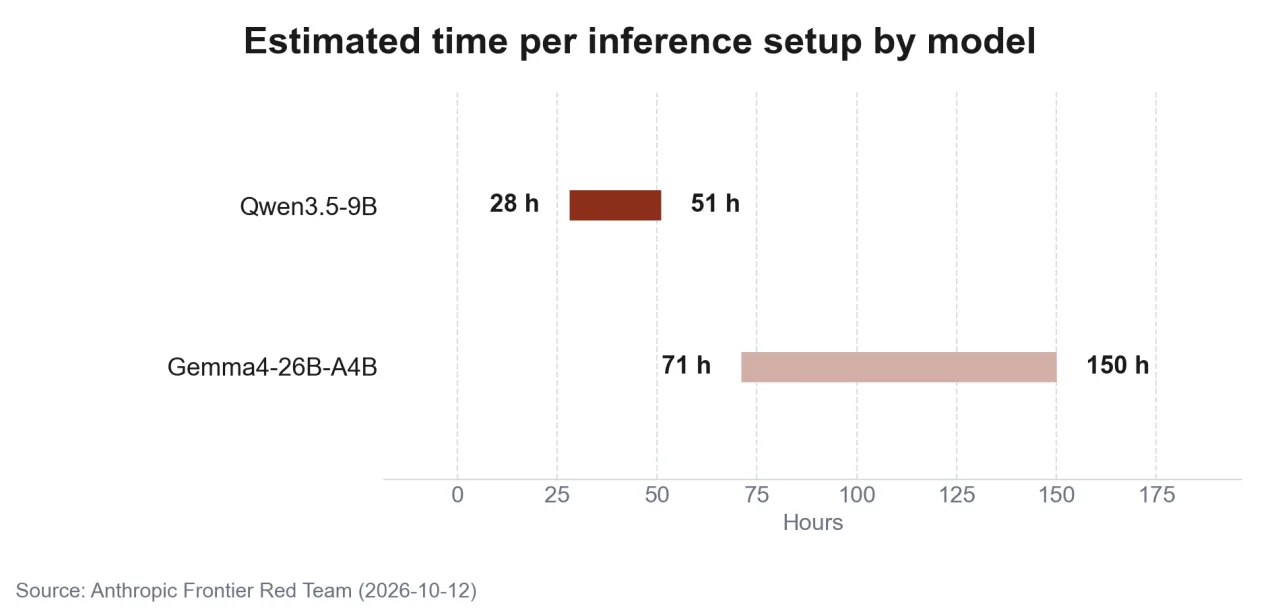 Bars showing the range of inference setup time by model — Source: self-rendered based on Anthropic data
📺 Demo on 15 TV boxes
Google’s Gemma4-26B-A4B was split and deployed across 15 TV boxes Each has 4GB of RAM and is a cheap unbranded product
It uses pipeline parallelism, in which several devices share the model’s layer-by-layer computation The speed was 0.39 tokens per second
🧰 Inference setup success rate
The 9B model got an inference server running on 8 of the 9 hardware types tested The targets included NVIDIA Jetson Nano, Orange Pi, Mac, and RTX 4090
One setup takes 28–51 hours for Qwen3.5-9B For Gemma4-26B-A4B, it was estimated at 71–150 hours
🔁 The model that replicated all the way
The full replication process was tested in an environment of eight Android 15 emulators The only open model that succeeded all the way was GLM-5.2
In 4 of 5 runs it replicated to all 8, and in the remaining run to 7 The other open models tested failed every time
Results changed when inference setup was handled by a script Even a 3B model spread to nearly half of a 17-device network
🧬 Inference setup success rate by replication generation
Success rates rose when parent replicas passed code and notes to the next generation of replicas Qwen3.5-9B’s inference setup success rate went from 45% in the first generation to 61–84% afterward
Having it take advice from the stronger Claude Opus 4.8 didn’t raise success rates much
Preconditions and remaining gaps
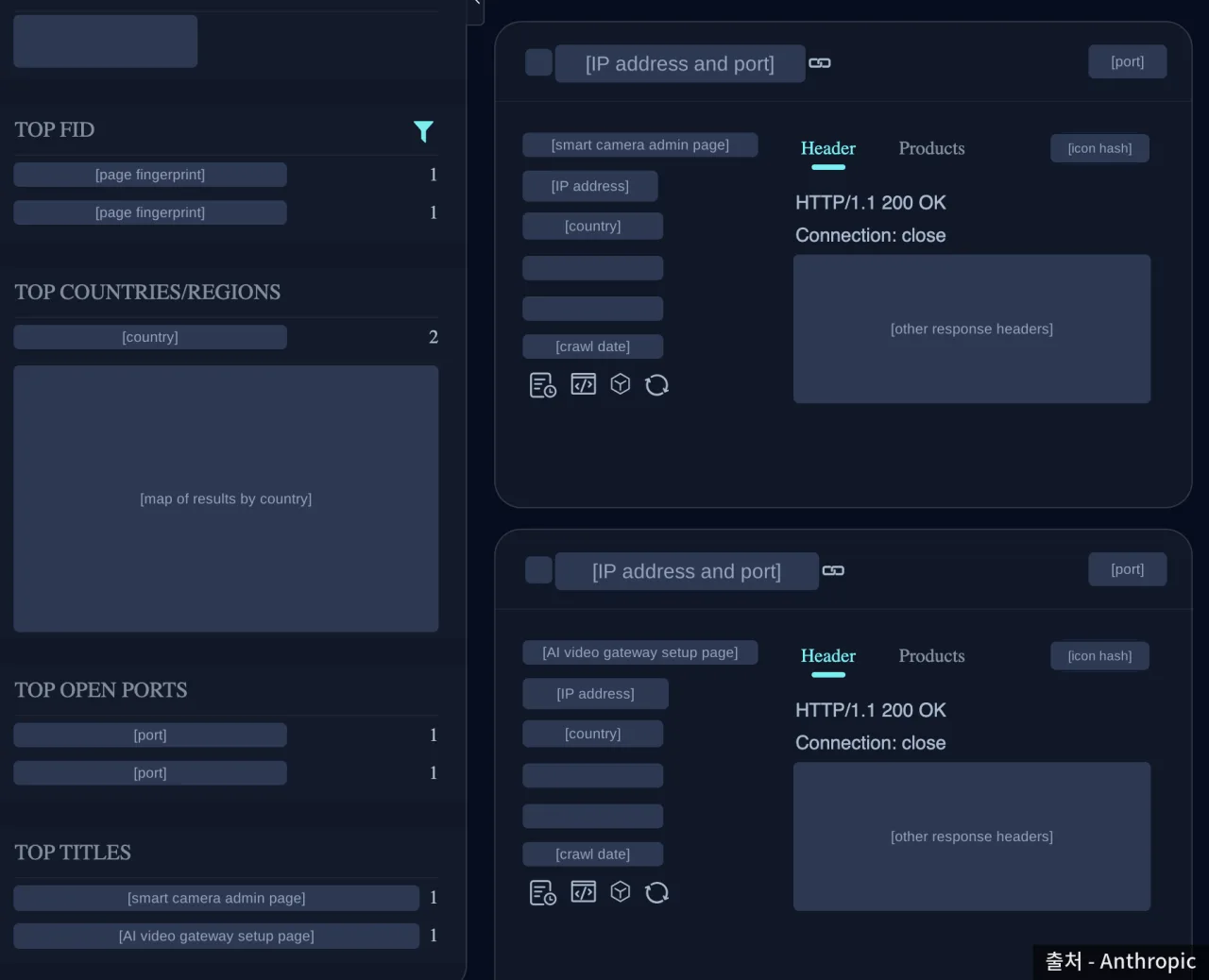 Camera admin screen found by a device search engine, with identifying details masked — Source: Anthropic
Device search engines turn up camera admin screens exposed to the internet The team judged that the first stage of finding infection targets is already not hard
But this intrusion experiment was run with outside access allowed to an unauthenticated ADB port ADB (Android Debug Bridge) is the channel developers use to control Android devices remotely
The team itself said the results should be read as an upper bound on real-world success rates No experiment infected an actual TV box!
| Stage | Experimental condition | Verdict |
|---|---|---|
| Finding devices | 8 targets specified in advance | [Unverified] |
| Intrusion | Unauthenticated ADB port | [Unverified] |
| Inference setup | 8 of 9 hardware types | Verified |
| Replication | GLM-5.2, 4 of 5 runs | Verified |
| Infecting real devices | Not tested | [Unverified] |
The scale seen through the Kimwolf botnet
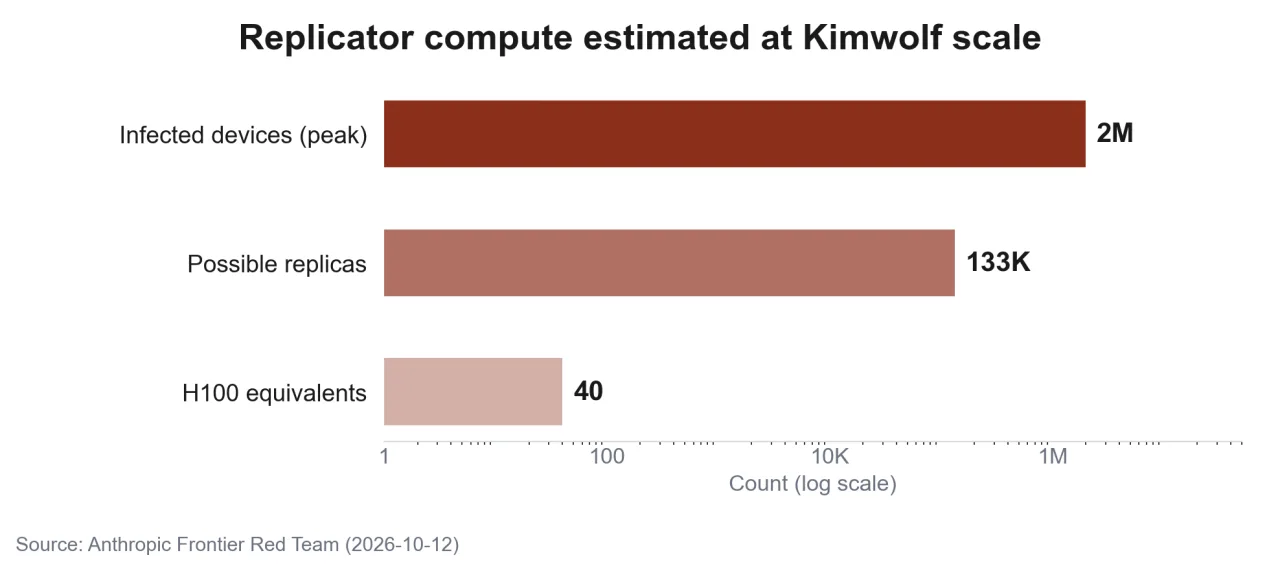 Horizontal bars estimating the scale of Kimwolf — Source: self-rendered based on Anthropic data
The team calculated using the scale of a real botnet, Kimwolf, as a baseline Kimwolf is a botnet that mainly infected cheap Android TV boxes and set-top boxes
 Android logo
It is known to have infected more than 2 million devices at its peak Assuming one replica consists of 15 devices, that gives about 133,000
Even so, the combined compute is about the level of 40 H100s The team pointed to the difficulty of stopping every replica without a central server as the risk, rather than compute
It judged spread to be slow, taking several days for the number of replicas to double
📈 The end of 2026 as a milestone
The capability index (ECI) of open models at 30B or below rose 13.7 points a year On this trend, the calculation is that small models will reach GLM-5.2’s level by the end of 2026
The team also said ECI is a rough metric that only indirectly gauges replication capability
Points of contact in Korea
 KISA logo
Boan News reported that Kimwolf-infected devices were found in Brazil, India, the US, and elsewhere Korea was not named among the countries where infections were concentrated
Cheap TV boxes of the same kind are easy to buy from overseas direct-purchase shopping sites Model names such as X96Q have been reported as infected devices
Korea’s KISA IoT security certification criteria include a ban on shared common passwords As of April 2026, there are 249 certified products
Certification is not mandatory; manufacturers apply for it The same report said only 2 home cameras were certified!!
What you can do now
🏠 Users
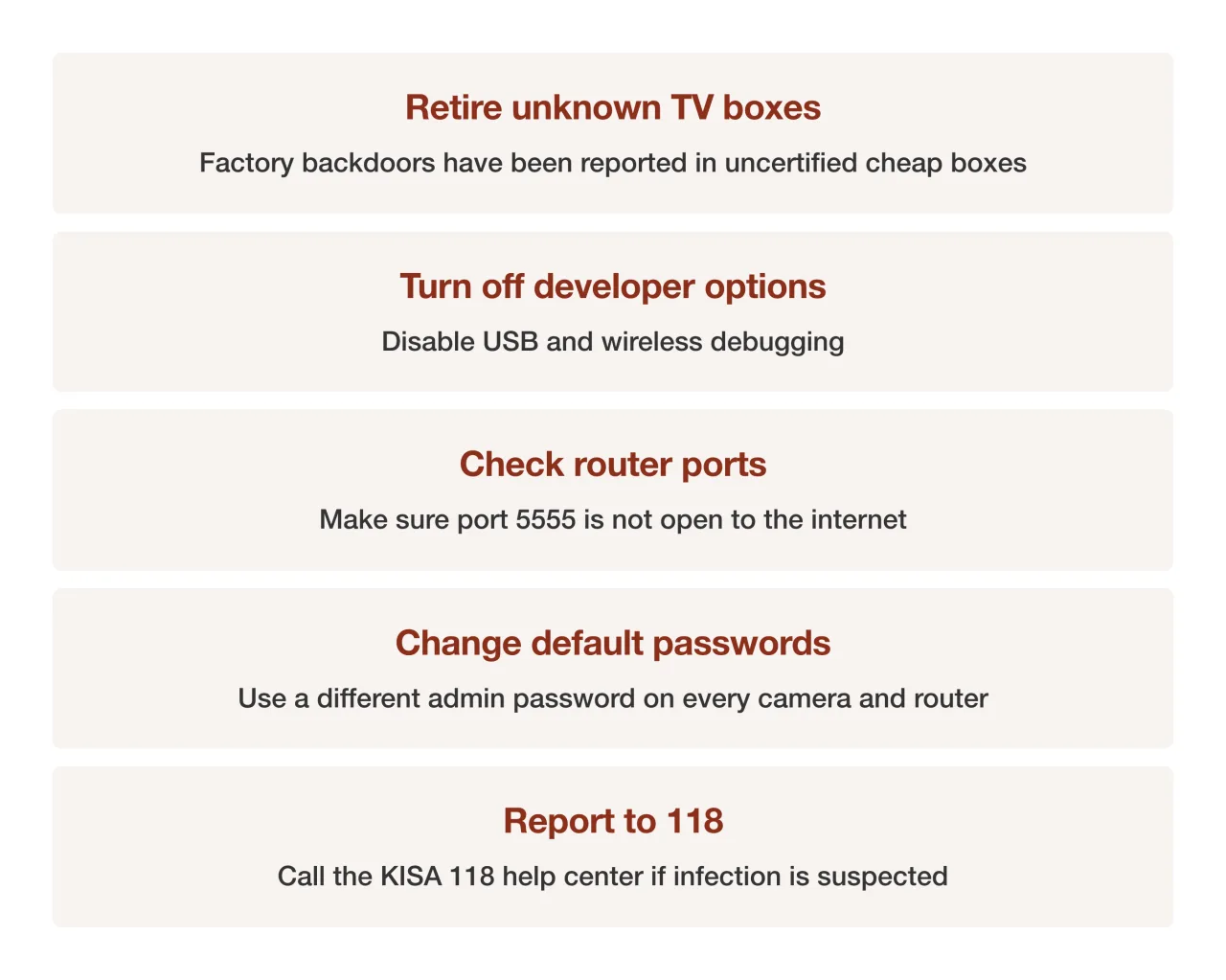 Summary card of steps for users — Source: self-rendered summary card of this post
🔗 Link - https://www.boho.or.kr
🏭 Manufacturers and carriers
The team said the goal is to bring the number of new infections caused by one infected device below 1 Since devices exchange several GB with each other, it judged that carriers monitoring traffic flows could detect it
When carriers isolated and notified infected subscribers, 92% of Mirai infections were resolved within 14 days Without notification, it was 74%
The UK has made IoT devices with default passwords a regulatory violation The team called on manufacturers to strengthen default security settings when devices ship
What to watch next
- Whether small open models reach GLM-5.2’s level by the end of 2026
- A follow-up experiment that includes the intrusion stage the team left out
- Whether calls to make IoT security certification mandatory turn into regulation
Sources
- [Anthropic] AI models may be capable of self-replicating without access to a datacenter (original research, 2026-10-12)
- [Boan News] Kimwolf takes over 1.8 million Android TVs and abuses them for DDoS attacks (2025-12-21)
- [The Hacker News] Kimwolf Android botnet infects over 2 million devices (2026-01)
- [MTN] Standards exist but don’t work: the home camera security gap (249 IoT security certifications, 2026-04-24)
- [CE Pro] BADBOX 2.0, a botnet targeting cheap Android TV devices (reports of factory-level backdoors)
- Exchange rate: converted at $1 ≈ ₩1,400