The fifth launch of the Nuri rocket took place at 12:25 p.m. on October 7 at the Naro Space Center in Goheung, South Jeolla Province, and the Korea AeroSpace Administration (KASA) announced the launch a success the same day. The primary payload of five NEONSAT microsatellites (Nos. 2–6) and nine CubeSats were placed into their target orbits.
It was the first time Nuri inserted several primary satellites into orbit in sequence on a single launch. The cumulative success rate is now 4 of 5 launches, or 80%, and KASA Administrator Oh Tae-seok said at a briefing that this was the first launch in Nuri’s history to lift off at the scheduled time.
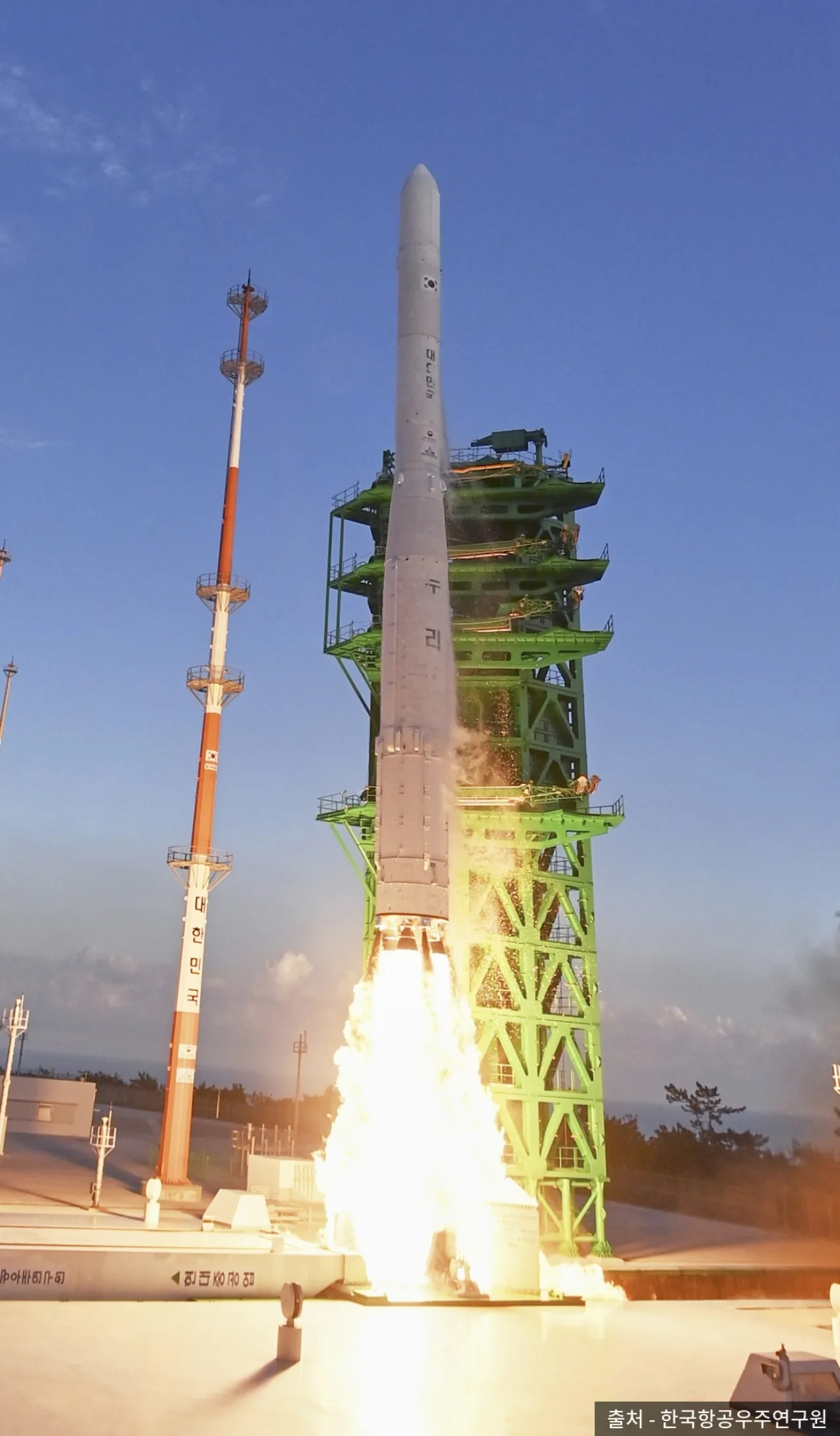 Nuri’s first launch (October 21, 2021) — Source: Korea Aerospace Research Institute
Launch timeline
 Korea AeroSpace Administration logo
According to the Korea Aerospace Research Institute’s (KARI) initial analysis of the telemetry sent by Nuri, the rocket reached its target altitude and separated all the satellites as planned. All three stages’ engines burned normally, and the fairing also separated as planned.
- 12:25: Nuri lifts off
- Around 13:08: No. 6 makes first contact with the ground station at King Sejong Station in Antarctica
- Around 14:42: No. 4, King Sejong Station ground station
- Around 15:27: No. 3, Svalbard ground station in Norway
- Around 16:18: No. 2, King Sejong Station ground station
- Around 17:52: No. 5, King Sejong Station ground station
At 18:45, KASA and KAIST announced that all five satellites had sent their unique identifiers and telemetry, responded normally to ground commands, and showed good solar panel deployment, power generation, temperature, and attitude. On that basis they judged the launch a success and began initial operations.
Flight sequence
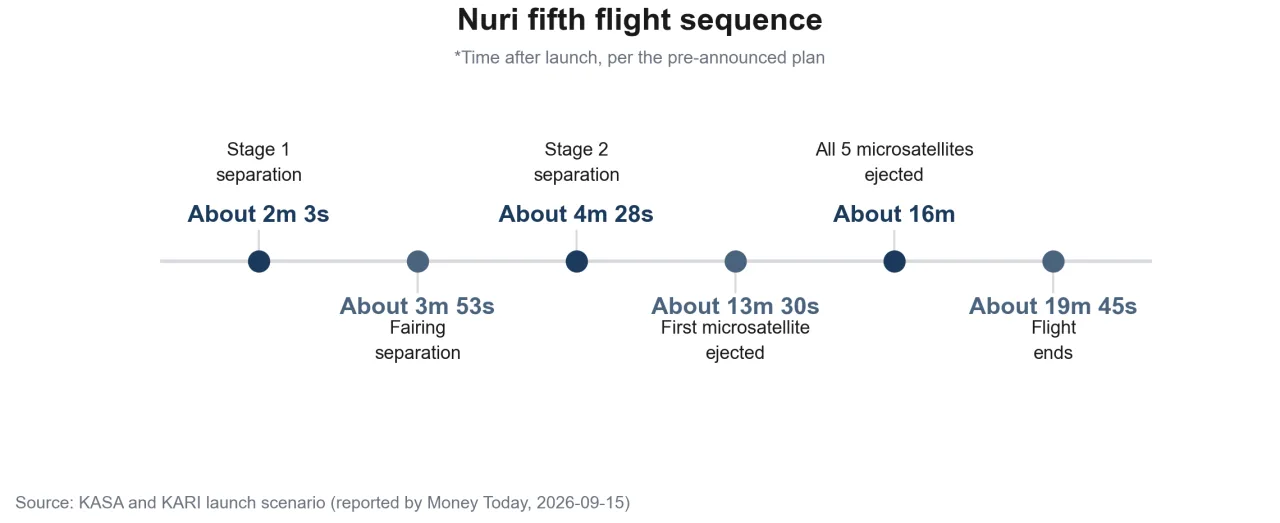 Nuri fifth flight sequence — Source: self-rendered from the KASA and KARI launch scenario
According to the scenario released in advance, the first stage separates about 2 minutes after launch and the second stage at 4 minutes 28 seconds, and the third stage carries the satellites up to an altitude of about 570km. From about 13 minutes 30 seconds after launch, the microsatellites separated one at a time at 35–40-second intervals, and the 10 CubeSats were then ejected two at a time at about 10-second intervals.
The microsatellites were separated one by one with time gaps so they wouldn’t collide with each other. KASA said this launch carried a newly installed low-shock separation device for the microsatellites and applied a separation procedure to prevent satellite collisions.
Satellites carried and results
| Item | Carried | Inserted into orbit |
|---|---|---|
| NEONSAT Nos. 2–6 | 5 | 5 |
| CubeSats | 10 | 9 |
| Total | 15 | 14 |
NEONSAT is an Earth observation satellite under 100kg built by KAIST’s Satellite Technology Research Center. It carries an optical camera with 1m black-and-white and 4m color resolution, used for disaster response and national security observation over the Korean Peninsula. No. 1 was put into orbit earlier, in April 2024, on a US Rocket Lab launcher, and this time Nos. 2–6 were added to orbit all at once.
The 10 CubeSats’ missions included testing semiconductors and space electronic parts, demonstrating optical communication, growing crystals of the dementia drug donepezil in microgravity, and observing marine debris and the atmosphere, and they included the first CubeSat made by a local government, the city of Daejeon. One of them, a CubeSat for marine debris observation, couldn’t separate because its ejector cover didn’t open. Since the primary satellites separated and the target altitude and speed were all achieved, KASA judged the launch a success.
Of the 9 CubeSats that separated normally, 8 had contacted ground stations by 18:00, and Daejeon’s DaejeonSat-1 is still attempting contact. KASA plans to announce the overall status of the secondary satellites separately on October 13.
Nuri’s launch history
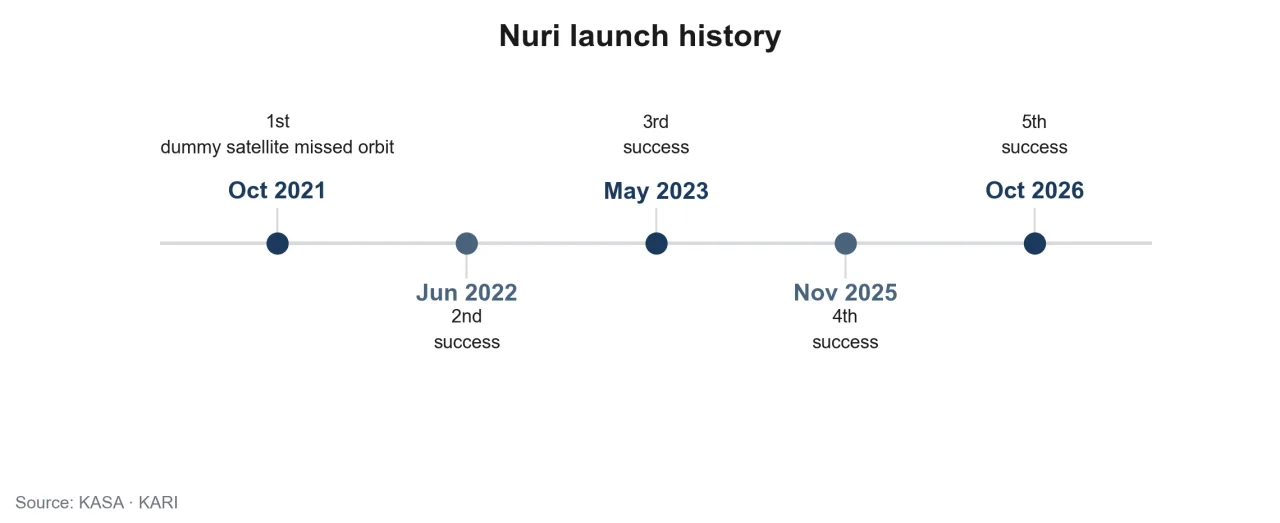 Nuri launch history — Source: self-rendered from KASA and KARI announcements
On its first launch in October 2021, Nuri’s third-stage engine shut down early and it failed to put a dummy satellite into orbit. It then succeeded four times in a row: the second launch in June 2022, the third in May 2023, the fourth in November 2025, and now the fifth.
| Launch | Main payload | Result |
|---|---|---|
| 1st (2021) | Dummy satellite | Did not reach orbit |
| 2nd (2022) | Performance verification satellite | Success |
| 3rd (2023) | Next-Generation Small Satellite 2 | Success |
| 4th (2025) | Compact Advanced Satellite 3 | Success |
| 5th (2026) | Five NEONSAT microsatellites | Success |
Expanding private-sector launch operations
 Hanwha Aerospace logo
Hanwha Aerospace, Nuri’s system integrator, expanded its role in launch operations compared with the fourth launch. KASA explained that letting the private sector gain launch operations experience strengthens the foundation for moving to private-led launch services.
Money Today reported that about 40 Hanwha Aerospace staff took part in this launch, 10 more than the fourth, and 18 of them directly operated launch control consoles.
What to watch next
- The sixth launch in the second half of 2027, planned to carry five more NEONSAT microsatellites
- At least one launch a year through 2032
- The schedule for moving to private-led commercial launch services after 2029
- The October 13 overall status announcement for secondary satellites and whether DaejeonSat-1 makes contact
- When NEONSAT Nos. 2–6 take test images and begin constellation Earth observation missions
Sources
- [Korea AeroSpace Administration] Nuri’s fifth launch carrying Korea’s first NEONSAT microsatellites Nos. 2–6 succeeds (2026-10-07, launch results, contact, upcoming schedule)
- [Korea AeroSpace Administration] All five production NEONSAT microsatellites make initial contact (2026-10-07 18:45, contact time per satellite, CubeSat contact status)
- [Korea AeroSpace Administration] Nuri fifth launch time confirmed (2026-10-07)
- [Money Today] Nuri fifth launch scenario revealed for the first time (2026-09-15, flight sequence, private-sector staff)
- [Financial News] KASA chief: launches every year through 2032, shift to private commercial launches (2026-10-07, one CubeSat failed to separate, sixth launch schedule)
- [Etoday] First step in mission-based space transport (2026-10-07, CubeSat missions)
- [MBC] First launch at the scheduled time succeeds, KASA chief briefing (2026-10-07)
- [Wikimedia Commons] KARI Nuri photo (KOGL Type 1; source of 1 image in the body)
