On October 6, 2026, Google made Nano Banana 2.1 (gemini-nano-banana-2.1), an image generation and editing model, generally available. It succeeds Nano Banana 2 (Gemini 3.1 Flash Image) and is built on Gemini 3.6 Flash.
The API price is $0.0336 (about ₩47) per 1K-resolution image, half of Nano Banana 2. In Google’s own evaluation, it scored higher than both Nano Banana 2 and the higher-end Nano Banana Pro on all 3 text-to-image items, including overall preference, and all 7 editing items.
 Google DeepMind Nano Banana 2.1 model card — Source: Google DeepMind
What changed
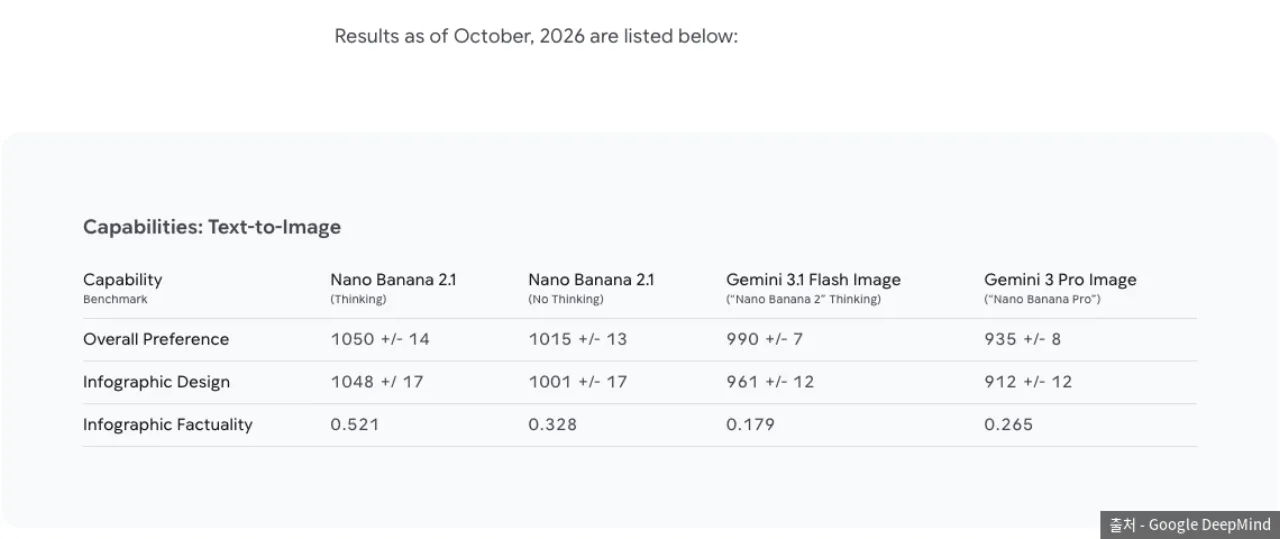 Text-to-image evaluation table from the Nano Banana 2.1 model card — Source: Google DeepMind
The Gemini API changelog lists five improvements.
- Visual quality and prompt adherence
- Character consistency across multiple turns
- Text rendering within images
- Added wide and panoramic aspect ratios of 1:4, 4:1, 1:8, and 8:1
- 1K, 2K, and 4K resolution output
The model card’s evaluations are Elo scores from people choosing between two images side by side. On overall preference, Nano Banana 2.1 (thinking mode) scored 1050, higher than Nano Banana 2’s 990 and Nano Banana Pro’s 935.
The infographic factuality item showed a large gap. Its automated evaluation score of 0.521 was about 3 times Nano Banana 2’s (0.179) and about 2 times Nano Banana Pro’s (0.265). With thinking mode off it fell to 0.328, so for information-dense images the score depends on whether thinking mode is used.
Editing and character consistency
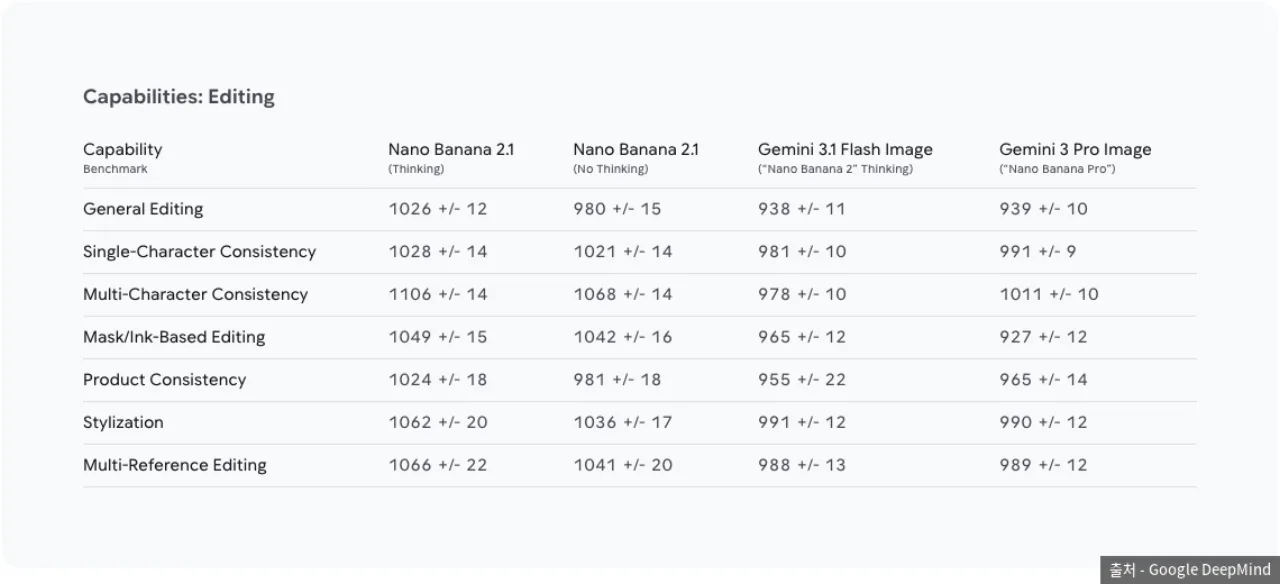 Editing evaluation table from the Nano Banana 2.1 model card — Source: Google DeepMind
Nano Banana 2.1 (thinking mode) also ranked first on all 7 editing items.
| Item | 2.1 (thinking) | Nano Banana 2 |
|---|---|---|
| Multi-character consistency | 1106 | 978 |
| Mask and pen editing | 1049 | 965 |
| Multi-reference image editing | 1066 | 988 |
| General editing | 1026 | 938 |
Multi-character consistency checks whether faces and clothes stay the same when several characters appear in one scene. Mask and pen editing is a feature that paints or scribbles over an area of the image to change only that part.
All figures are from evaluations Google ran itself, and as of October 14, 2026, no independent evaluations from outside organizations have come out.
Korean text rendering, as far as official material says
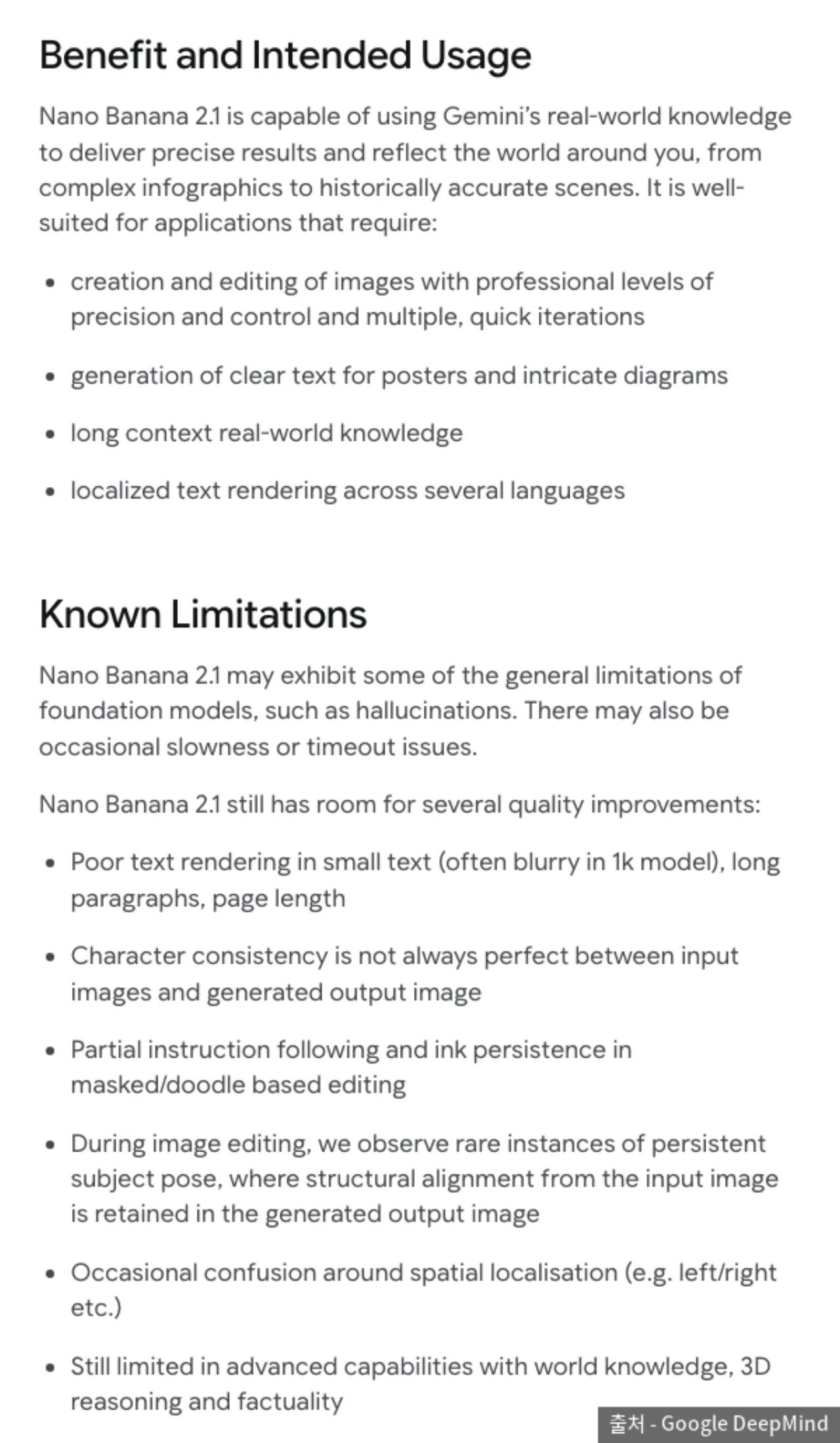 Intended uses and known limitations from the Nano Banana 2.1 model card — Source: Google DeepMind
The model card lists among suitable uses generating crisp text in posters and diagrams and rendering localized text in multiple languages. Multilingual (i18n) text rendering is also among the evaluation items.
However, it doesn’t publish results by language. There’s no list of supported languages, and the multilingual examples on the DeepMind model page are Hindi, German, and Spanish, so there’s no official basis for judging Korean quality.
[Small text] Small text often blurs at 1K resolution
[Long text] Rendering quality drops for long paragraphs or a page’s worth of text
[Position confusion] Sometimes confuses spatial arrangement such as left and right
For images where text matters, like signs and posters, making them at 2K or higher and cutting the amount of text is the usage that fits the model card’s limitations.
Pricing
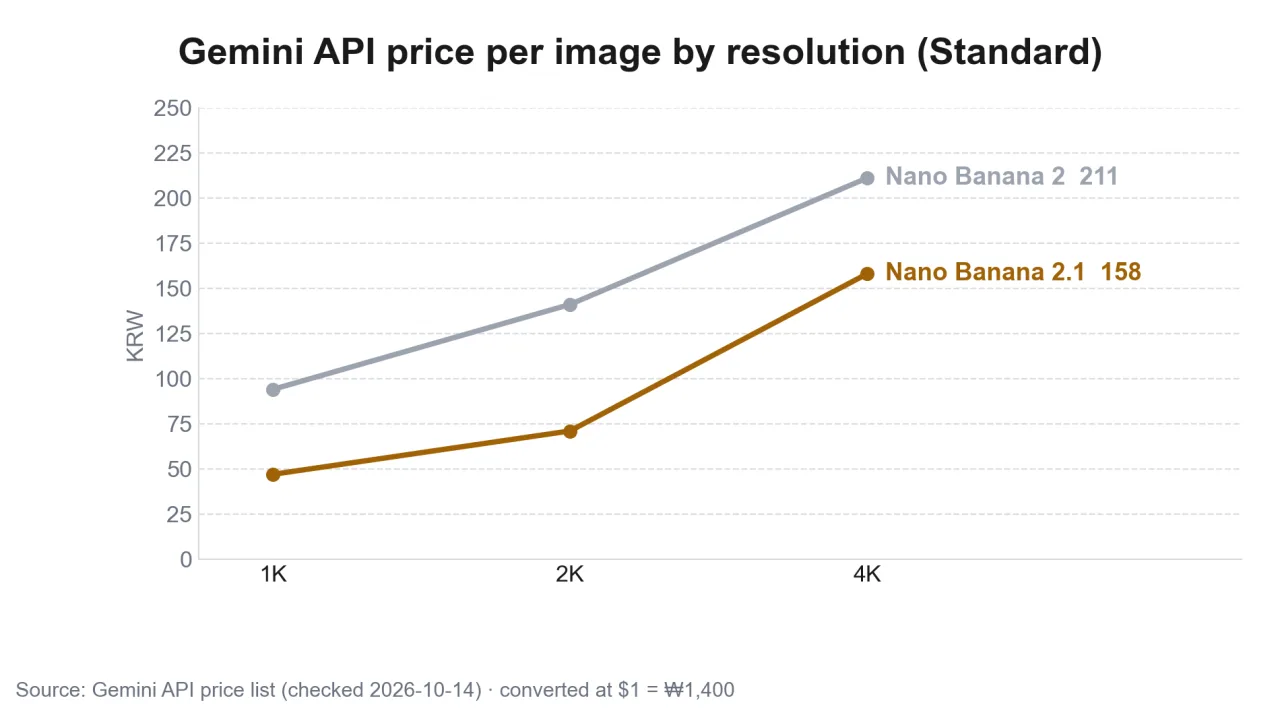 Chart comparing Gemini API price per image by resolution — Source: self-rendered from the Gemini API price list
The image output token price is $30 (₩42,000) per million tokens, half of Nano Banana 2’s $60 (₩84,000). But the same 4K image now takes 3,780 tokens instead of 2,520, so the price of one 4K image only falls 25%, from ₩211 to ₩158.
Some Korean posts reported the 4K price as about $0.0756 (₩106) per image, but the 2.1 price in Google’s price list is about $0.113 (₩158).
| Item | 2.1 price | Nano Banana 2 |
|---|---|---|
| Input (per 1M tokens) | $1.50 (₩2,100) | $0.50 (₩700) |
| Text output (per 1M tokens) | $7.50 (₩10,500) | $3.00 (₩4,200) |
| Image output (per 1M tokens) | $30 (₩42,000) | $60 (₩84,000) |
Input and text/thinking output prices are actually 3 times and 2.5 times those of Nano Banana 2. If you enter long instructions or several reference images and generate in thinking mode, the per-image savings shrink. Running in Batch halves every price, and neither model has an API free tier.
Where to use it, and use in Korea
The model card lists seven distribution channels: the Gemini app, Google AI Studio, the Gemini API, Google Search AI Mode, Google Ads, Google Flow, and Google Stitch. The existing Nano Banana 2 (gemini-3.1-flash-image) is slated for deprecation, with no end date announced.
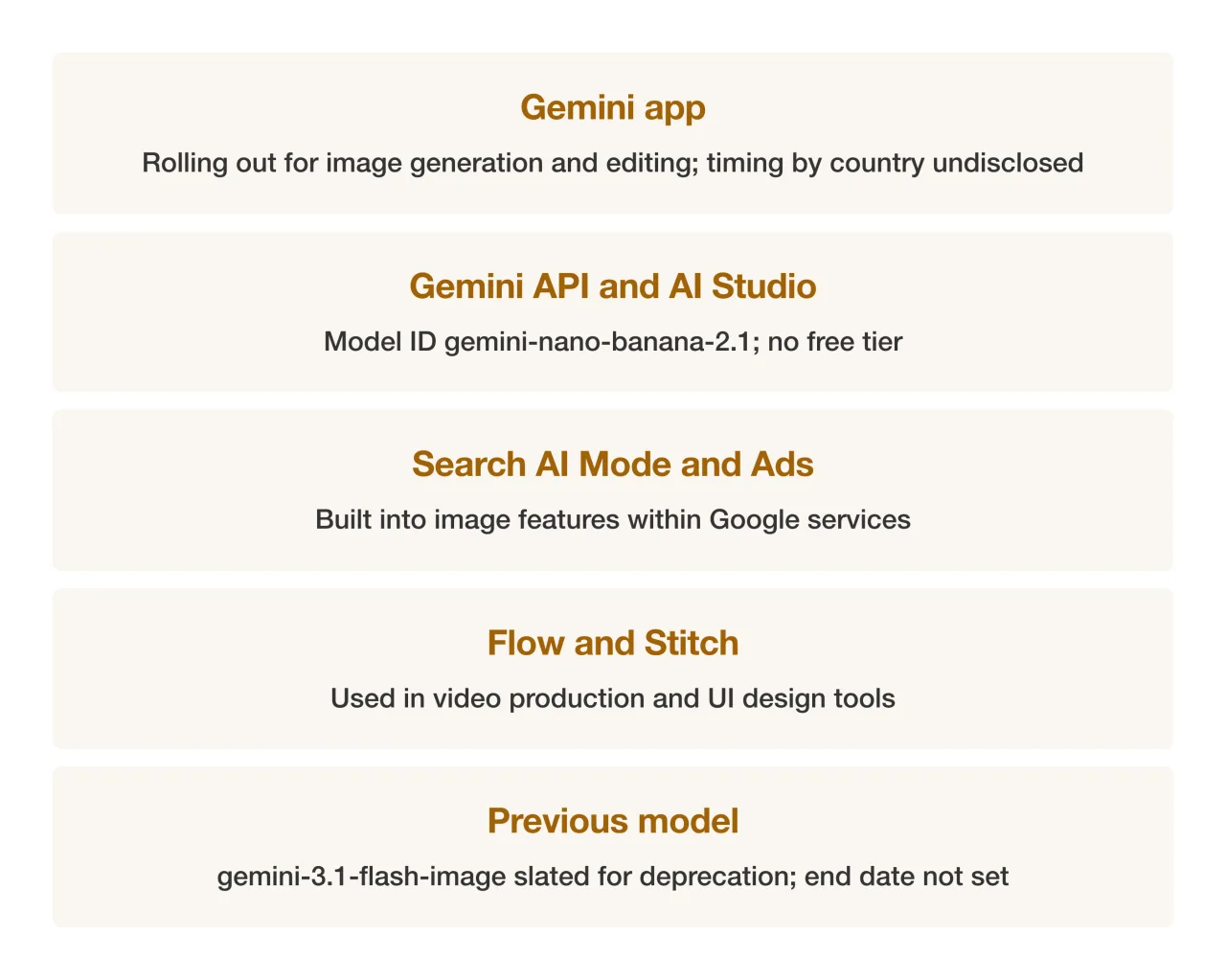 Summary card of five ways to use Nano Banana 2.1 — Source: self-rendered from the Google DeepMind model card and Gemini API documentation
Developers in Korea can use it right away through Google AI Studio and the paid Gemini API. For the Gemini app, it’s only known to be rolling out gradually, and as of October 14, 2026, there’s no official announcement confirming Nano Banana 2.1 in the Gemini app in Korea. The Gemini app release notes also have no 2.1 entry through October 13.
What to watch next
- Whether the Gemini app release notes announce 2.1 and its country coverage
- Whether independent evaluations by outside organizations reproduce Google’s own Elo results
- Whether text rendering evaluation results by language are published
- The end-of-support date for gemini-3.1-flash-image
Sources
- [Google DeepMind] Nano Banana 2.1 model card (2026-10-06; source of 4 images in the body)
- [Google AI for Developers] Gemini API changelog (2026-10-06)
- [Google AI for Developers] Gemini Developer API pricing
- [Google DeepMind] Gemini Image Flash model page (multilingual examples)
- [Google] Gemini app release notes
- Exchange rate: converted at $1 ≈ ₩1,400