On October 8, 2026, SpaceX agreed to acquire all of the nationwide 800MHz spectrum held by US investment firm Grain Management. The deal aims to grow Starlink Mobile, which connects ordinary phones directly via satellite, into a major US mobile carrier. Right after the announcement, AT&T, Verizon, and T-Mobile shares each fell about 7% in after-hours trading.
 SpaceX logo
Deal terms
SpaceX said it is acquiring 100% of Grain’s 800MHz holdings, which include up to 14MHz of paired spectrum (an uplink and downlink pair). The deal requires approval from the US Federal Communications Commission (FCC); the two companies didn’t disclose the price, but The Wall Street Journal valued it at about $8 billion (about ₩11.2 trillion).
| Item | Details |
|---|---|
| What | All of Grain’s nationwide 800MHz |
| Bandwidth | Up to 14MHz paired |
| Price | Undisclosed (WSJ about $8 billion) |
| Condition | FCC approval |
| Previous holder | T-Mobile → Grain (August 2026) |
When Grain received this spectrum from T-Mobile in August 2026, it handed over cash and its own 600MHz spectrum. Grain CEO David Grain said, Spectrum is a finite resource with an expanding role in the economy.
Why 800MHz is needed
 Concept image of low-band radio waves passing through buildings and forest to reach a phone — Source: concept image · self-generated with agy
In September 2025, SpaceX agreed to buy 2GHz-band (AWS-4 and H-block) spectrum from EchoStar for about $17 billion (about ₩23.8 trillion), and this 800MHz is a lower band than that. The lower the frequency, the farther radio waves travel and the better they get through walls and trees, so coverage can extend to places like indoors and forests.
SpaceX explained that this spectrum narrows part of the technical gap between Starlink Mobile and the major mobile carriers. It also stressed that most existing phones already support 800MHz, so users don’t need to buy new devices.
However, the IEEE ComSoc technology blog pointed out that good low-band propagation doesn’t guarantee indoor service. Actual indoor quality hasn’t been verified yet.
Where Starlink Mobile stands now
 Starlink logo
On October 7, the FCC approved SpaceX’s deployment of 15,000 second-generation direct-to-device (D2D) satellites for the 2GHz band. The 800MHz acquisition has to go through a separate regulatory process.
Elon Musk said on social media that, to those who know the spectrum race, the deal is an “earthquake,” and mentioned completing phone coverage across the entire US.
Why carriers reacted
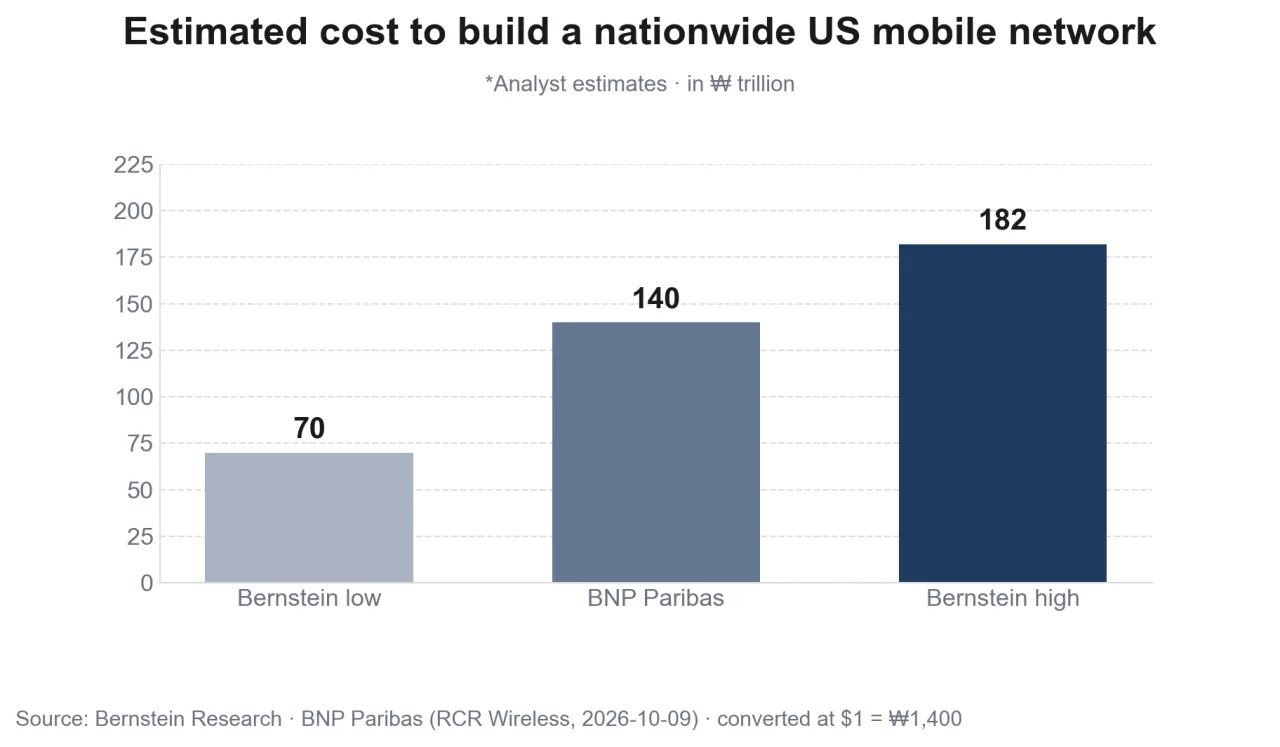 Chart of estimated costs to build a nationwide US mobile network — Source: self-rendered from Bernstein and BNP Paribas estimates
Stocks reacted strongly, but analyses were also published saying it’s hard to run a nationwide network on satellites alone. Analyst Vish Nandlall pointed out that this spectrum contributes more to expanding coverage than to capacity. In other words, traffic in places where users cluster, like city centers, needs a terrestrial network.
Bernstein Research estimated that building a competitive nationwide US mobile network would cost about $50–130 billion (₩70–182 trillion), and BNP Paribas estimated about $100 billion (₩140 trillion) based on 50,000–70,000 cell sites. Nandlall calculated that recovering $50 billion (₩70 trillion) over 10 years with 20 million subscribers would require about $21 (₩29,400) per subscriber per month.
RCR Wireless reported that shares of tower companies such as American Tower, Crown Castle, and SBA Communications moved in the opposite direction from the three carriers.
Status of direct-to-phone satellite service in Korea
In Korea, the Ministry of Science and ICT approved cross-border supply agreements for low-orbit satellite communications from Starlink Korea and others in May 2025, but direct-to-phone service hasn’t been commercialized yet. In Japan, NTT DOCOMO and SoftBank have launched Starlink direct-to-phone services, while Korean carriers see little demand given the country’s small land area and dense terrestrial network.
No concrete plan for allocating spectrum for direct-to-phone service in Korea has been announced either.
Sources
- [IEEE ComSoc Technology Blog] SpaceX 800MHz acquisition and FCC approval of second-generation satellites (2026-10-08)
- [Telecompetitor] 14MHz paired, support on existing phones (2026-10-08)
- [RCR Wireless] Stock reactions, build cost estimates, analyst analysis (2026-10-09)
- [EchoStar] Announcement of AWS-4 and H-block spectrum sale to SpaceX (2025-09-08)
- [Boan News] Ministry of Science and ICT approves Starlink cross-border supply agreement (2025-05)
- [ZDNet Korea] Starlink and the Korean telecom market (2026-08-18)
- Exchange rate: converted at $1 ≈ ₩1,400