The target date for the official release of PostgreSQL 19 has been set for November 19, 2026
8–10 major features were reverted during the beta! One core committer cited LLM-assisted code review as one of the reasons
 PostgreSQL logo
Timeline
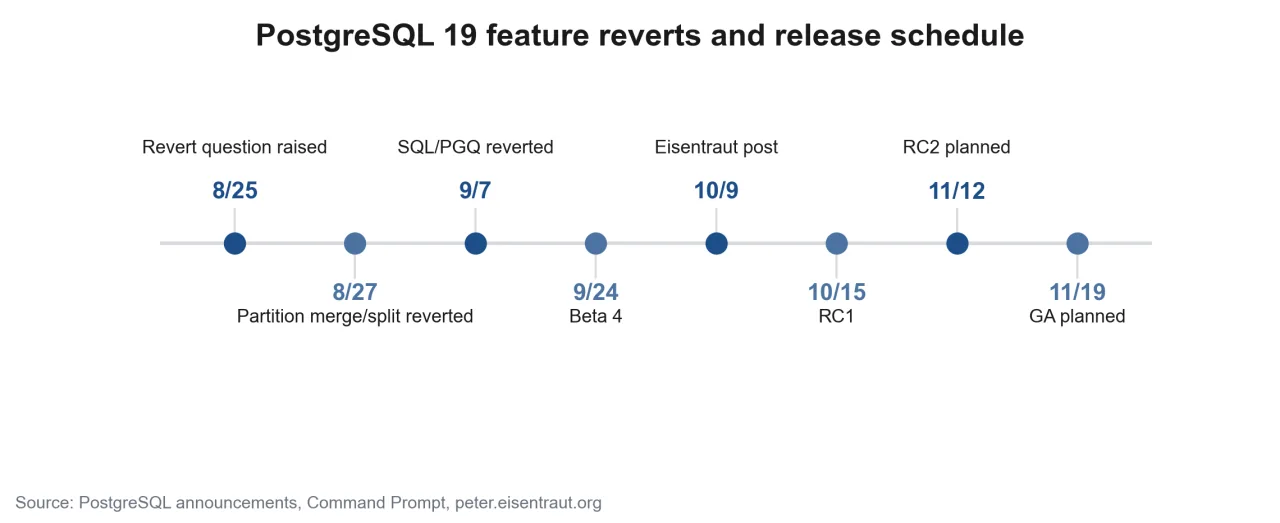 Timeline of PostgreSQL 19 feature reverts and release schedule — Source: self-rendered based on PostgreSQL announcements, Command Prompt, and peter.eisentraut.org
The September 24 Beta 4 announcement expected an RC in early October and the official release during October RC1 actually came out on October 15
The RC1 announcement said an additional RC2 would be released to include fixes from the November 12 regular update The official release target is November 19
The Register reported that the release was delayed after AI review found many defects
Reverted features
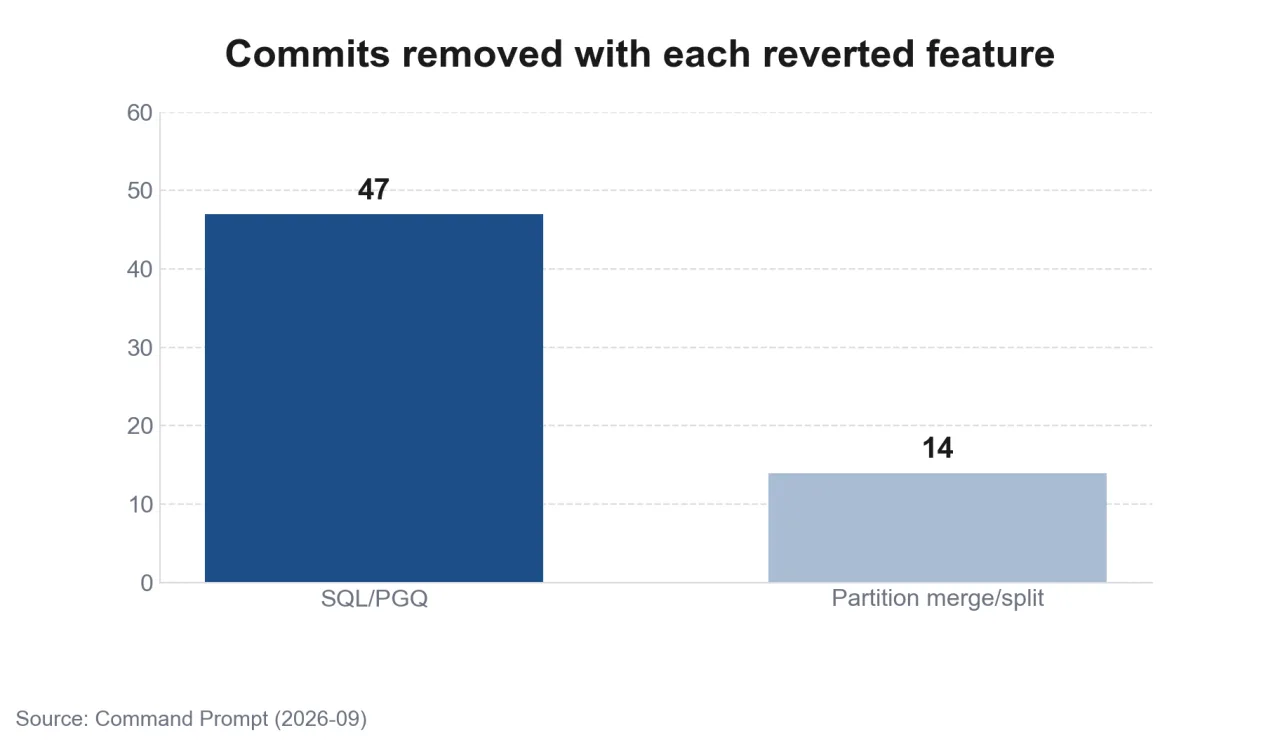 Bars showing the number of commits removed along with the reverted features — Source: self-rendered based on Command Prompt data
This is the revert list in the Beta 4 announcement
| Feature | Description | Outcome |
|---|---|---|
| SQL/PGQ | Property graph queries | Reverted |
| Online checksums | Turning checksums on and off while running | Reverted |
| FOR PORTION OF | Updates and deletes by time period | Reverted |
| Partition merge/split | MERGE, SPLIT PARTITIONS | Reverted |
| DDL output functions | Roles, tablespaces, databases | Removed |
The biggest feature is SQL/PGQ, the graph query syntax added to the SQL standard in 2023 When it was reverted on September 7, 47 related commits were reverted along with it
The reason stated in the commit message was several design problems hard to fix within the version 19 development period Tom Lane warned that including it in 19 would bring defects that would be hard to fix before 20 is released
The announcement explained that these features were left out of this version so they could be reintroduced in the next major version
What AI code review did
 Concept shot of LLM code review — Source: concept shot, self-generated with agy
Peter Eisentraut, a committer at EDB, wrote about the background on his blog on October 9 He said there is usually about one revert per cycle, but this time there were 8–10
He wrote that LLM-assisted code review finds such defects much faster When about 40 defects are reported against one feature, even small fixes take review time and the development period runs short
The code in question was written before such tools were used in practice His explanation is that the quality bar rose after the code was written
He drew a line, saying it was not the fault of vibe coding
He said LLM fuzzing also quickly finds bugs involving domains, composite types, partitions, views, and triggers So he proposed bringing fuzzing into the feature development process
Other causes
The causes Eisentraut gave are not just AI review
[Focus on security work] From April to August, senior developers concentrated on security fixes, cutting time for reviewing beta code
[Design defects] Some features had structural problems hard to fix during beta
[Range of feature combinations] Every feature has to be compatible with every other, so there are many combinations to test
He wrote that the community chose to keep the release schedule rather than delay it to fix more Opinions were also split in LWN reader comments over how much weight to give LLM review
Features left in 19 and upgrading
Eisentraut still saw 19 as a good release As evidence, he cited REPACK CONCURRENTLY, logical replication of sequences, and pg_plan_advice
RC1 included several fixes related to parallel autovacuum and REPACK COPY’s JSON output now uses the query’s column names and aliases as keys
Upgrading from 18 or earlier to 19 requires a major upgrade procedure You need to move the data with pg_upgrade, or pg_dump and pg_restore
As of October 20, I couldn’t find 19 support schedules for managed PostgreSQL on Korean clouds For production databases, it’s safer to consider upgrading after the official release and the first update release are out
What to watch next
- The update release coming with RC2 on November 12
- Whether the official release on November 19 comes out on schedule
- The reverted features’ return in PostgreSQL 20 and discussion of introducing an experimental feature status
Sources
- [PostgreSQL] PostgreSQL 19 RC 1 Released (RC2, official release schedule, 2026-10-15)
- [PostgreSQL] PostgreSQL 19 Beta 4 Released (revert list, 2026-09-24)
- [peter.eisentraut.org] The reverts will continue until morale improves (2026-10-09)
- [Command Prompt] Two features just left PostgreSQL 19 (commit counts, 2026-09)
- [The Register] Postgres 19 delayed after AI reviewers find more bugs than humans can fix (2026-10-16)
- [LWN.net] Eisentraut: The reverts will continue until morale improves (comment debate)