The 2026 Nobel Prize in Physics went to Francis Halzen, a professor at the University of Wisconsin–Madison who led IceCube, the neutrino observatory buried in Antarctic ice. The Royal Swedish Academy of Sciences named him sole laureate on October 6.
The prize was awarded for decisive contributions to the IceCube Neutrino Observatory and the discovery of high-energy neutrinos of astrophysical origin. Korean media reported it as the first solo physics prize in 34 years, since 1992.
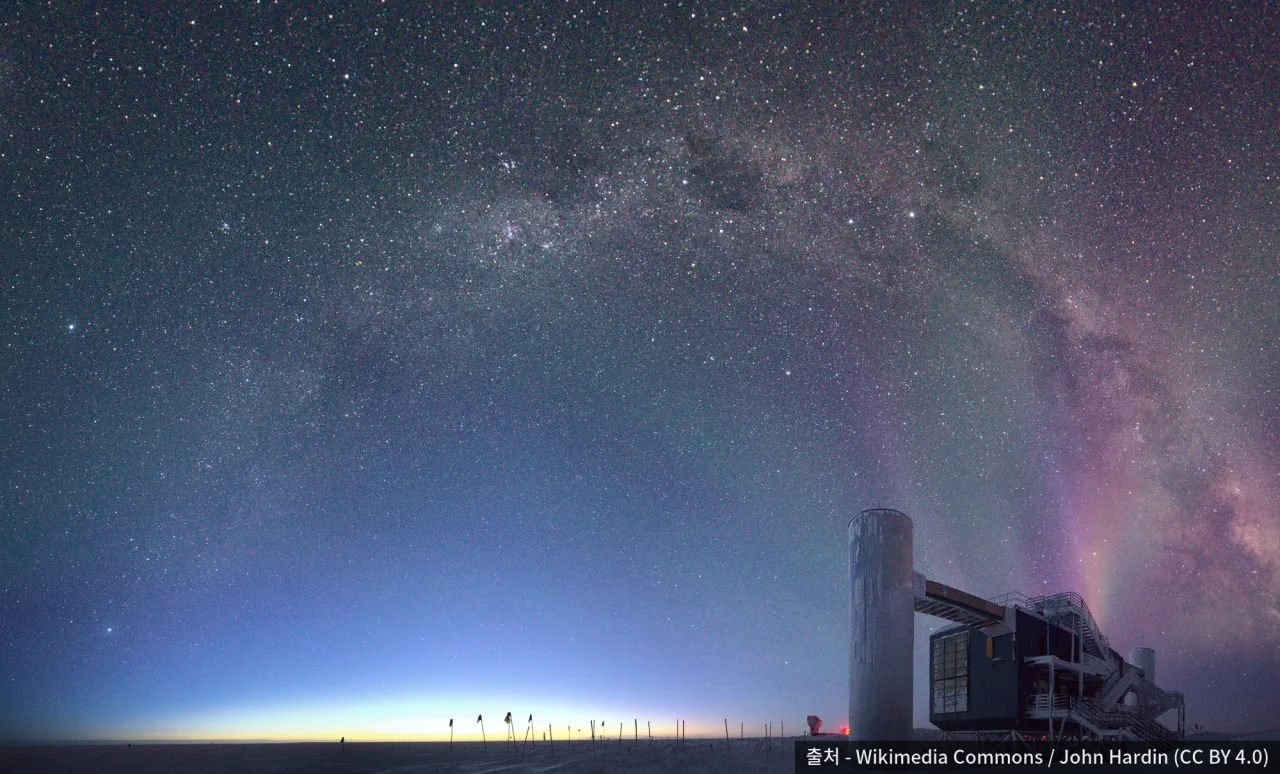 The IceCube Lab at the South Pole and the Milky Way — Source: Wikimedia Commons / John Hardin (CC BY 4.0)
The laureate and the prize
Halzen was born in 1944 in Tienen, Belgium, received his PhD from KU Leuven in Belgium in 1969, and is a professor at the University of Wisconsin–Madison. He receives the prize money of about ₩1.7 billion (12 million Swedish kronor, about $1.2 million) alone.
Mark Pearce, chair of the Nobel Committee for Physics, said Halzen led an international team of researchers and engineers to build an observatory that made a new kind of astronomy possible. IceCube is run by an international collaboration, not by Halzen personally, and the Nobel Committee also explained that Halzen’s vision and scientific leadership were the foundation of the observatory.
Why observe neutrinos
 Concept image of a neutrino from space leaving light on a sensor in Antarctic ice — Source: concept image · self-generated with agy
Neutrinos are everywhere in the universe, but they barely interact with other matter and pass straight through the Earth and our bodies. Only on the very rare occasions when one strikes an atomic nucleus can instruments detect a trace.
The universe is known to have natural particle accelerators that emit particles at up to a million times the energy of laboratories on Earth, but what they are and where they are hasn’t been fully revealed. Other charged particles are bent by magnetic fields on the way, so their starting direction is lost, but neutrinos arrive without changing direction or losing energy. The Nobel Committee explained that neutrinos provide information that can’t be obtained any other way.
Detector design
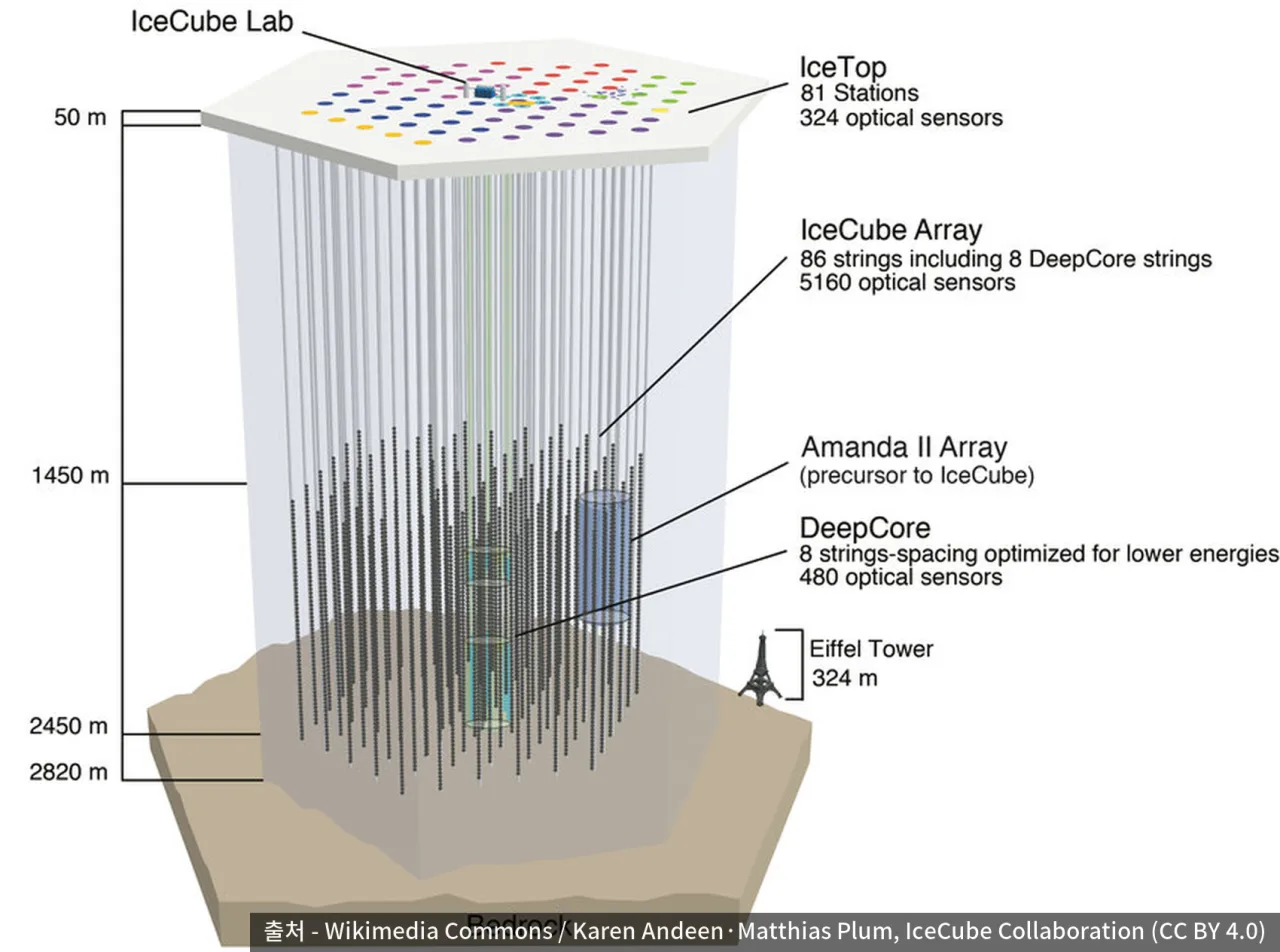 IceCube detector design, with cables and light sensors in the ice — Source: Wikimedia Commons / Karen Andeen, Matthias Plum, IceCube Collaboration (CC BY 4.0)
When a neutrino strikes a nucleus in the ice, there’s a flash of light, and light sensors buried in the transparent glacial ice record it. High-energy neutrinos from space are extremely rare, so observing enough collisions required an enormous volume. The ice at the South Pole also has low noise and geology stable enough to have no earthquakes.
| Item | Value |
|---|---|
| Volume | 1㎦ of ice |
| Light sensors (DOMs) | 86 cables × 60 = 5,160 |
| Installation depth | 1,450–2,450m |
| Construction period | 2004–2010 |
| Atmospheric neutrinos detected | About 275 per day |
| Collaboration | About 450 people at 58 institutions in 14 countries |
Halzen first presented the idea of using Antarctic ice in 1988, and tests of sensors in the ice followed a few years later. IceCube says drilling each hole took 48 hours on average.
The road to discovery
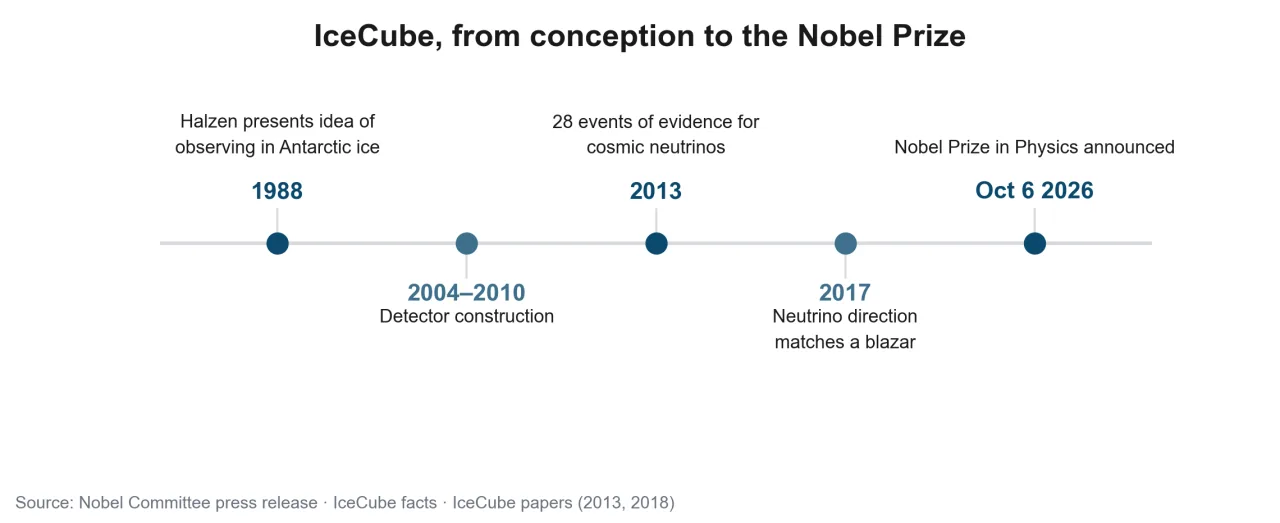 Key years from IceCube’s conception to the Nobel Prize — Source: self-rendered from the Nobel Committee press release and IceCube papers
Once the detector was complete, the researchers soon detected the first high-energy neutrinos, and a few years later published observations of neutrinos from outside the solar system. The Nobel Committee explained that this discovery began in earnest the research into identifying the sources of neutrinos in the universe.
2013: evidence for cosmic neutrinos
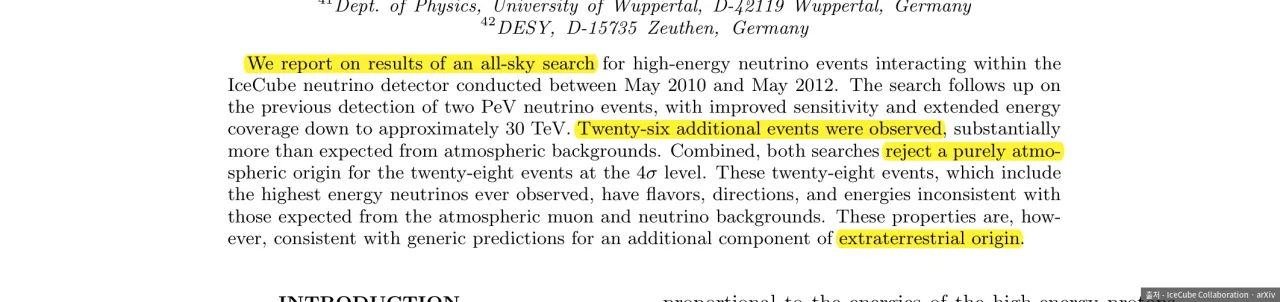 Abstract of the 2013 IceCube paper, 28 high-energy neutrinos — Source: IceCube Collaboration · arXiv
In 2013 the IceCube Collaboration published Evidence for High-Energy Extraterrestrial Neutrinos at the IceCube Detector. Searching the whole sky from May 2010 to May 2012, they observed 26 more events in addition to 2 previously detected PeV-scale (1,000 trillion electron volt) events.
The 28 events combined rejected, at the 4σ level, the possibility that they could be explained by atmospheric background alone, and their direction, flavor, and energy didn’t match the Earth’s atmospheric background. The authors wrote that these features are consistent with predictions that include a component of cosmic origin. Published in Science the same year, this result is the discovery of neutrinos from outside the solar system that the Nobel Committee referred to.
2017: a match with a blazar
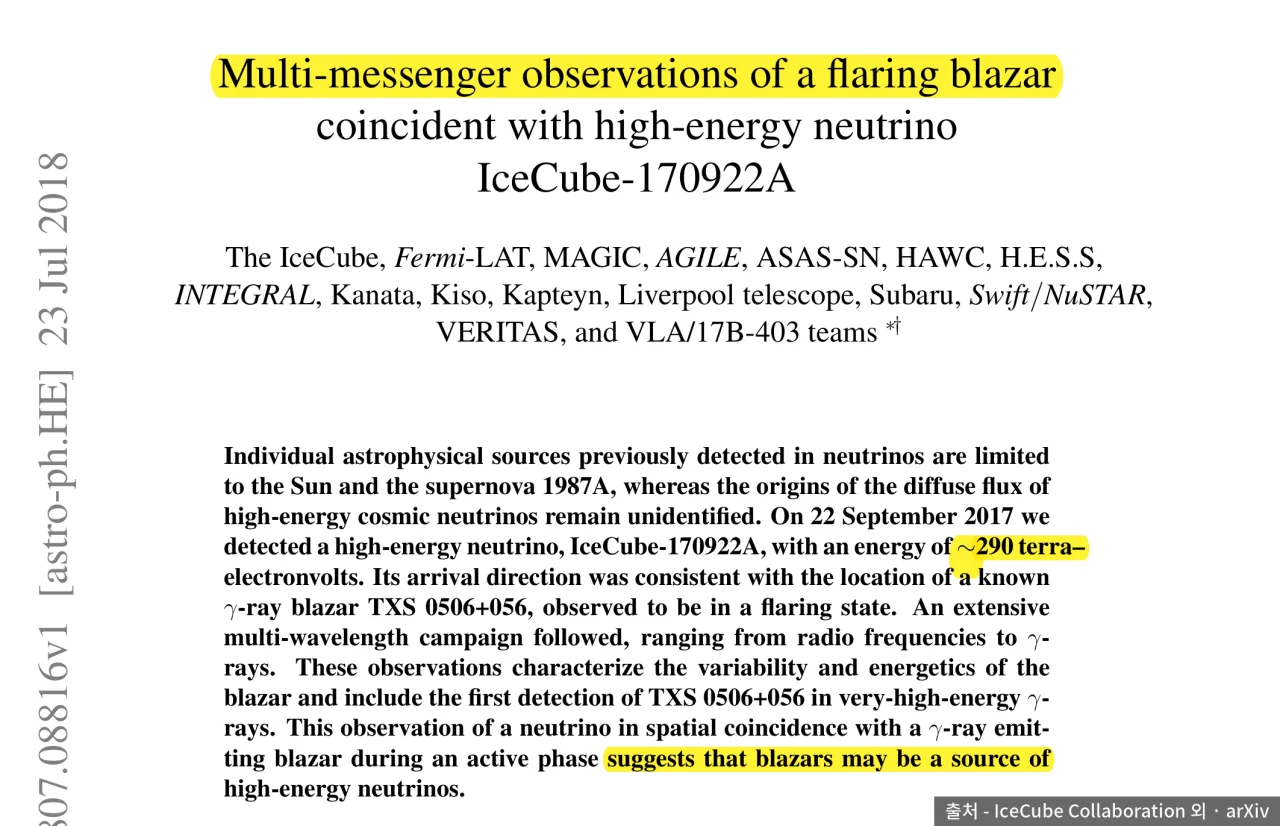 Title and abstract of the 2018 multi-messenger observation paper — Source: IceCube Collaboration et al. · arXiv
On September 22, 2017, IceCube detected IceCube-170922A, a neutrino with about 290 TeV (tera-electron volts) of energy. Its arrival direction matched the position of TXS 0506+056, a gamma-ray-emitting blazar (a galaxy whose giant black hole fires a jet toward Earth), and the blazar was in a flaring state at the time.
Radio, optical, and gamma-ray telescopes around the world followed up, and the results were published in 2018 in a joint paper by IceCube, Fermi-LAT, MAGIC, and other teams. Until then, the only individual objects confirmed through neutrinos were the Sun and the 1987 supernova.
What we still don’t know
Coverage of the prize often says it revealed the origins of the universe, but the scope the papers themselves claim is narrower.
| Phrasing | Scope the original says |
|---|---|
| Cosmic neutrinos discovered | 2013, 4σ, consistent with a cosmic component |
| Source identified | 2017 blazar may be a source |
| Overall origin | Sources of most high-energy neutrinos unconfirmed |
The 2018 paper also notes that, as of that time, the sources of most high-energy cosmic neutrinos had not been identified. The Nobel Committee likewise explained that the data IceCube continues to collect will provide knowledge about the environments where high-energy neutrinos arise.
Korean participating institutions
The IceCube Collaboration’s list of institutions (58 institutions in 14 countries as of April 2025) includes Chung-Ang University and Sungkyunkwan University from Korea. IceCube’s institution records say Sungkyunkwan University researchers have worked on dark matter searches, ice property calibration, detector monitoring, and online data filter development.
Sources
- [The Nobel Prize] Press release: The Nobel Prize in Physics 2026 (2026-10-06, laureate, achievement, 1988 proposal, prize money)
- [IceCube] Facts (number of cables and sensors, depth, construction period, detection count, collaboration size)
- [IceCube] Collaboration institutions (list as of April 2025, Chung-Ang University and Sungkyunkwan University)
- [arXiv] IceCube Collaboration, Evidence for High-Energy Extraterrestrial Neutrinos at the IceCube Detector (2013, Science 342; source of 1 image in the body)
- [arXiv] IceCube, Fermi-LAT, MAGIC et al., Multi-messenger observations of a flaring blazar coincident with high-energy neutrino IceCube-170922A (2018, Science 361; source of 1 image in the body)
- [Seoul Shinmun] First solo prize in 34 years (2026-10-06)
- [Scientific American] 2026 Nobel Prize in Physics awarded to Francis Halzen (prize money in dollars)
- Exchange rate: converted at $1 ≈ ₩1,400