On October 16, 2026, Anthropic released a report analyzing employment changes at its own company
The share of new grads among new technical hires fell from 27% to 9%!
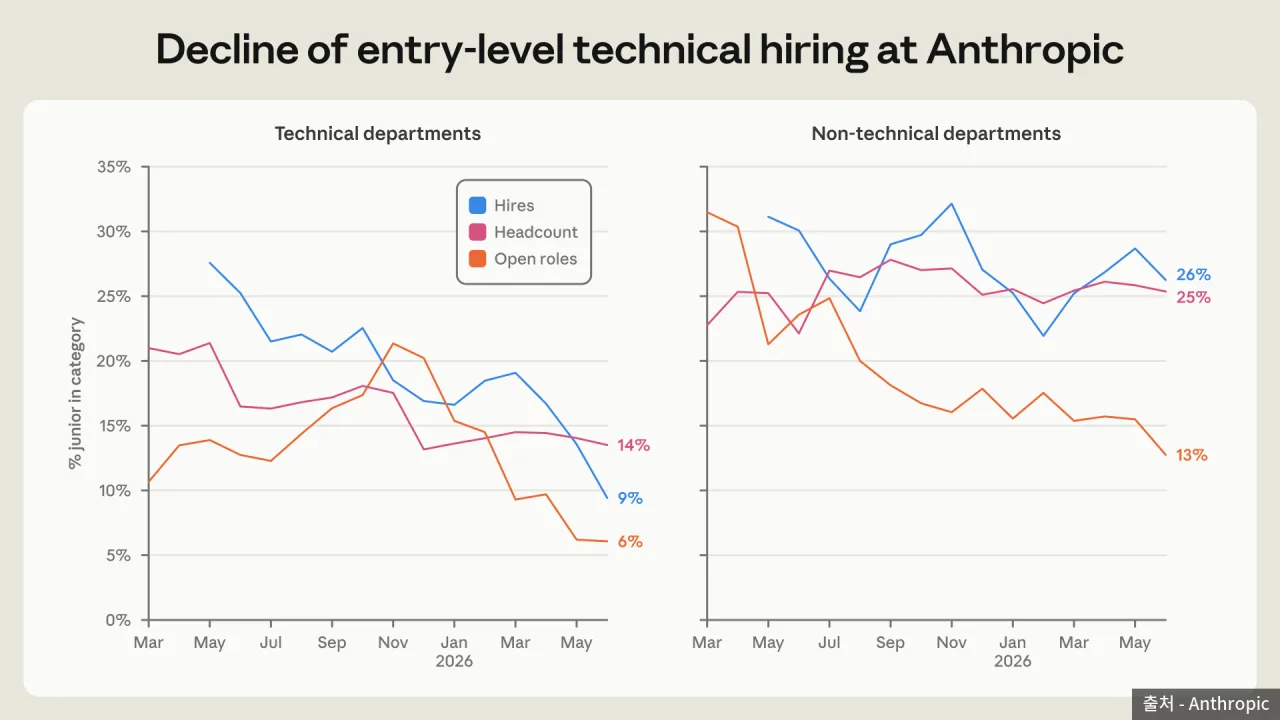 Graph of the falling share of new-grad technical hires at Anthropic — Source: Anthropic
Report overview
 Anthropic logo
The title is How employment is changing at Anthropic It is a technical report written by four economists at the Anthropic Institute
It draws on internal employment, AI usage, output, surveys, Slack, calendars, and hiring records On top of that, it adds interviews with 17 employees
[Fewer new-grad hires] The share of new grads among new technical hires fell while agent working time grew rapidly
[Higher output per person] Engineers’ code writing, sales deals, and legal contract handling all increased
[Human attention as the bottleneck] Work reviewing and managing AI-generated output was added
[Changing hiring criteria] Hiring came to value autonomy and judgment more than specialized knowledge
Change in the new-grad share
Among staff in technical departments, the new-grad share fell from 21% in early 2025 to 14% Over the same period, the new-grad share of new technical hires fell from 27% to 9%
Job postings aimed at new grads dropped sharply from December 2025 In April 2026, engineering and research organizations lowered the share of junior-level hires
| Metric | Before | After |
|---|---|---|
| New grads among technical hires | 27% | 9% |
| New grads on staff in technical departments | 21% | 14% |
| Technical departments’ share of employment | 61% | 56% |
In an April 2026 manager survey, a majority said they had changed the skills they assess in hiring because of AI About a third of ML managers and about a fifth of SWE managers said they are hiring fewer people because of AI
The company’s total headcount tripled in a year Technical headcount grew too, but sales, finance, and recruiting headcount grew faster
Agent working time
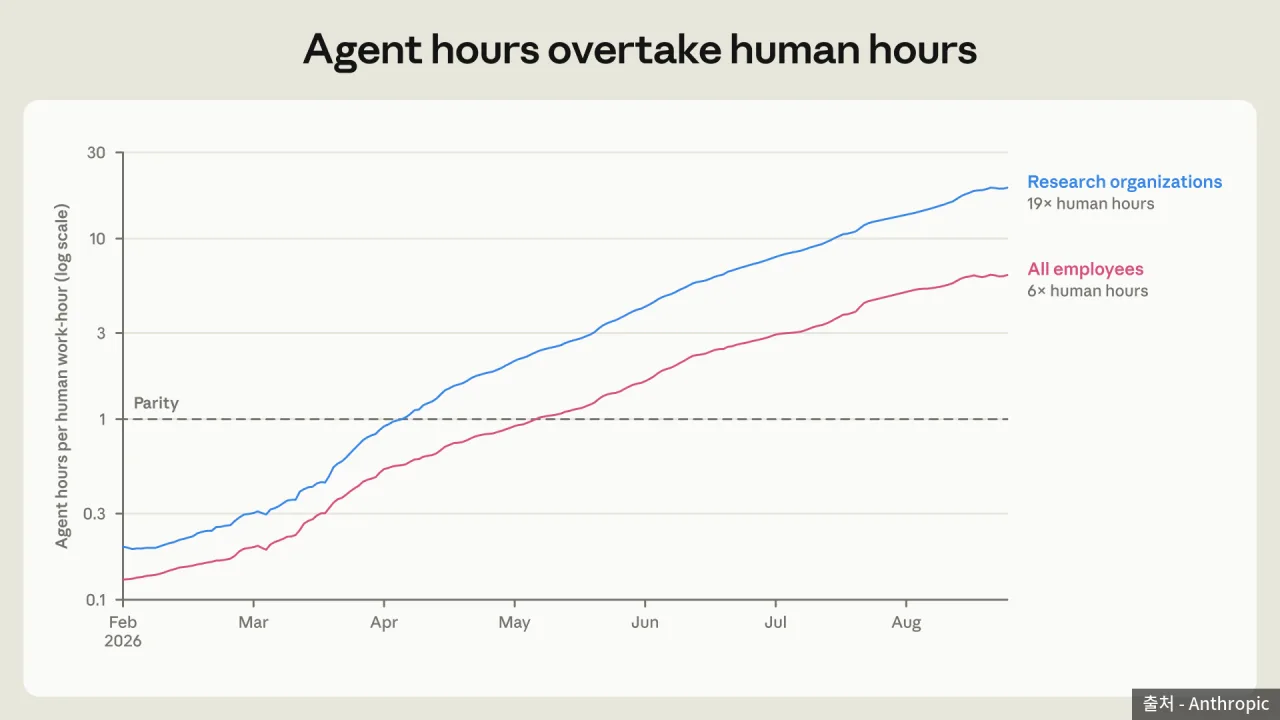 Graph of the ratio of agent working time to human working time — Source: Anthropic
In March 2026, the working time of agents run by employees exceeded total human working hours for the first time In August, agent working time per employee was 6 times human working hours
For the research organization alone, it was 19 times! Agent time is reasoning and tool-use time, and time spent waiting more than 30 minutes was excluded from the calculation
Human time was calculated as headcount times 40 hours a week About 80% of interactive session time was agents waiting for human input
Output per person
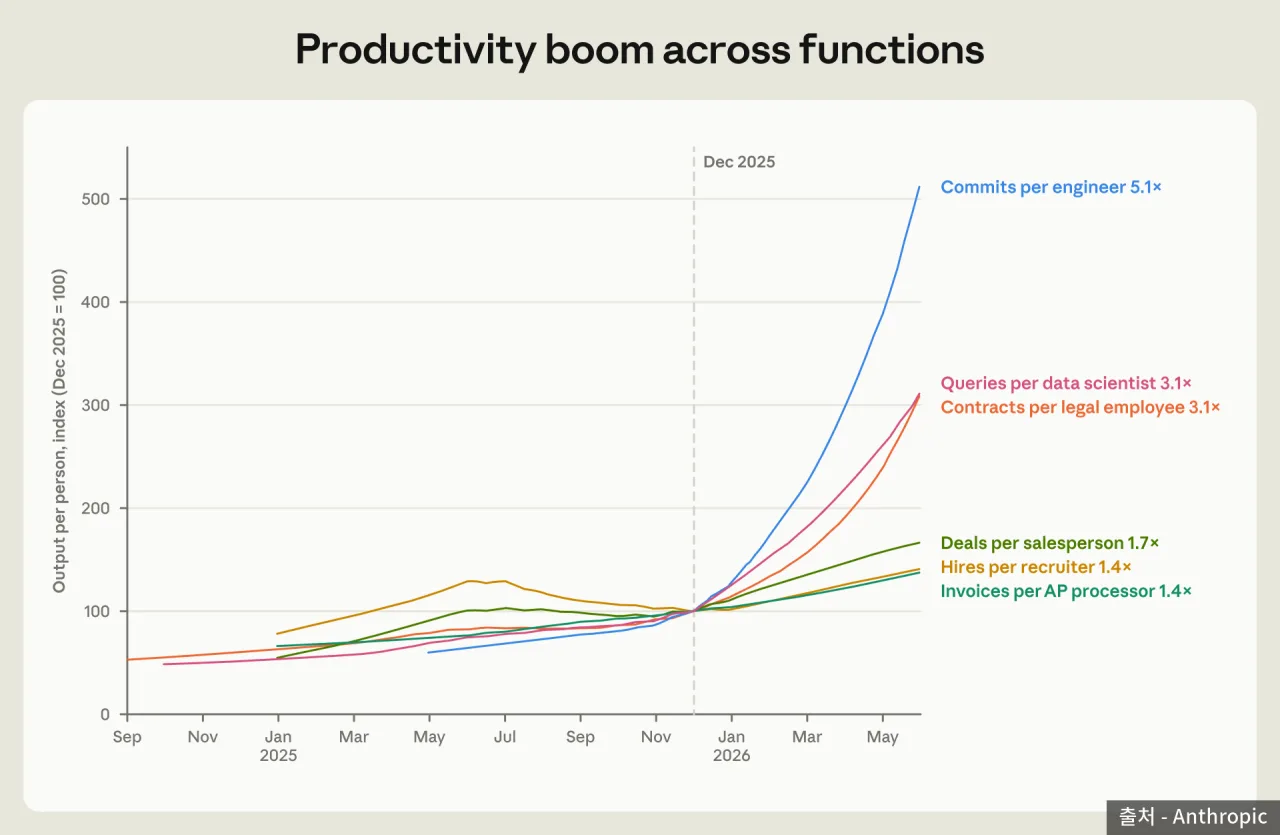 Graph of the per-person output index by job family — Source: Anthropic
Commits per engineer reached 5.1 times the December 2025 level Data scientist queries and legal contract handling were 3.1 times, and sales deals 1.7 times
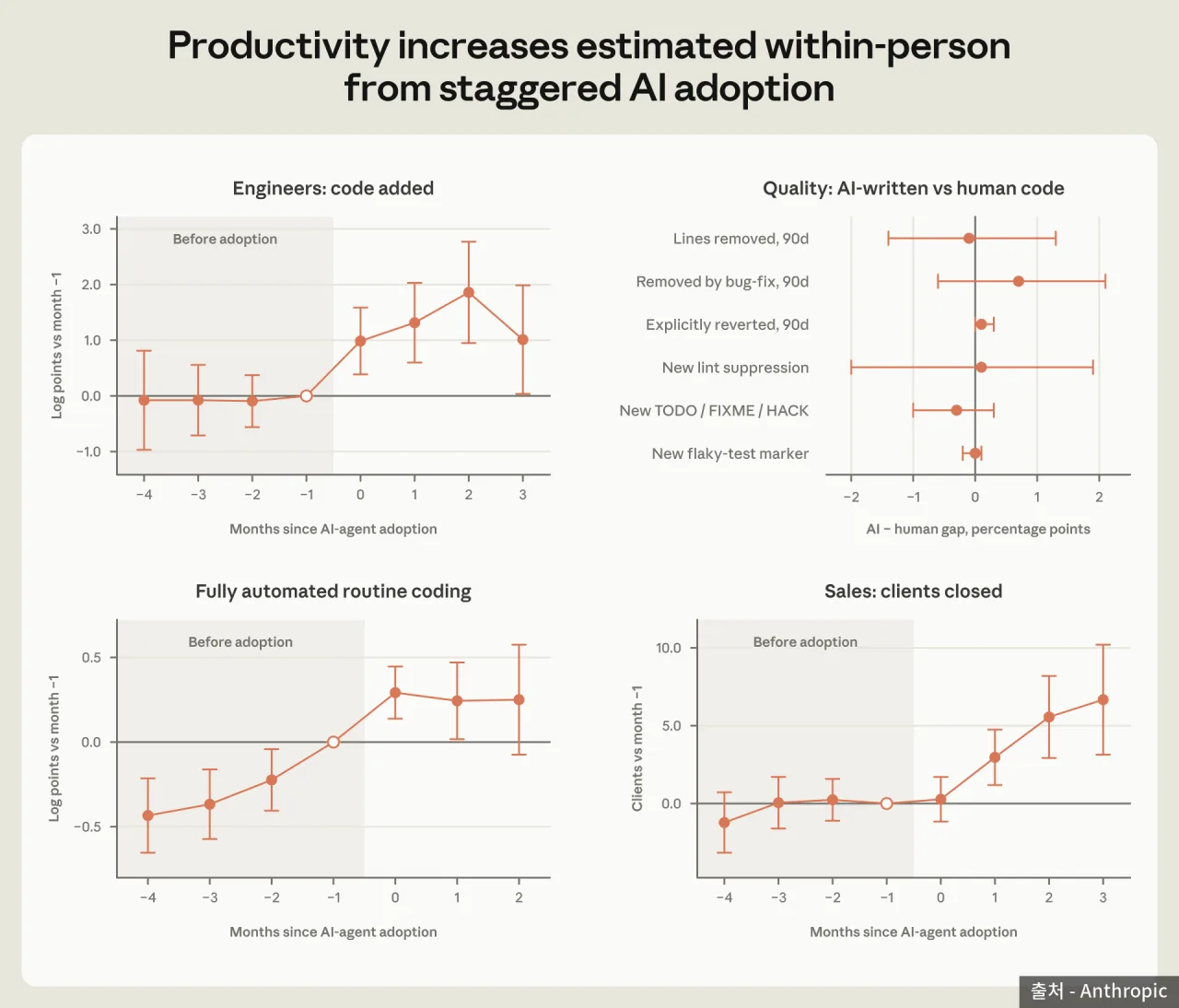 Within-person productivity comparison before and after adopting coding agents — Source: Anthropic
It compared 192 engineers who used coding agents with 74 who did not Lines of code added rose sharply after the month of adoption
It compared code written by the same person in the same month in the same folder There was no difference in deletion or revert rates between code written by AI and code written by people
📝 The shape of work
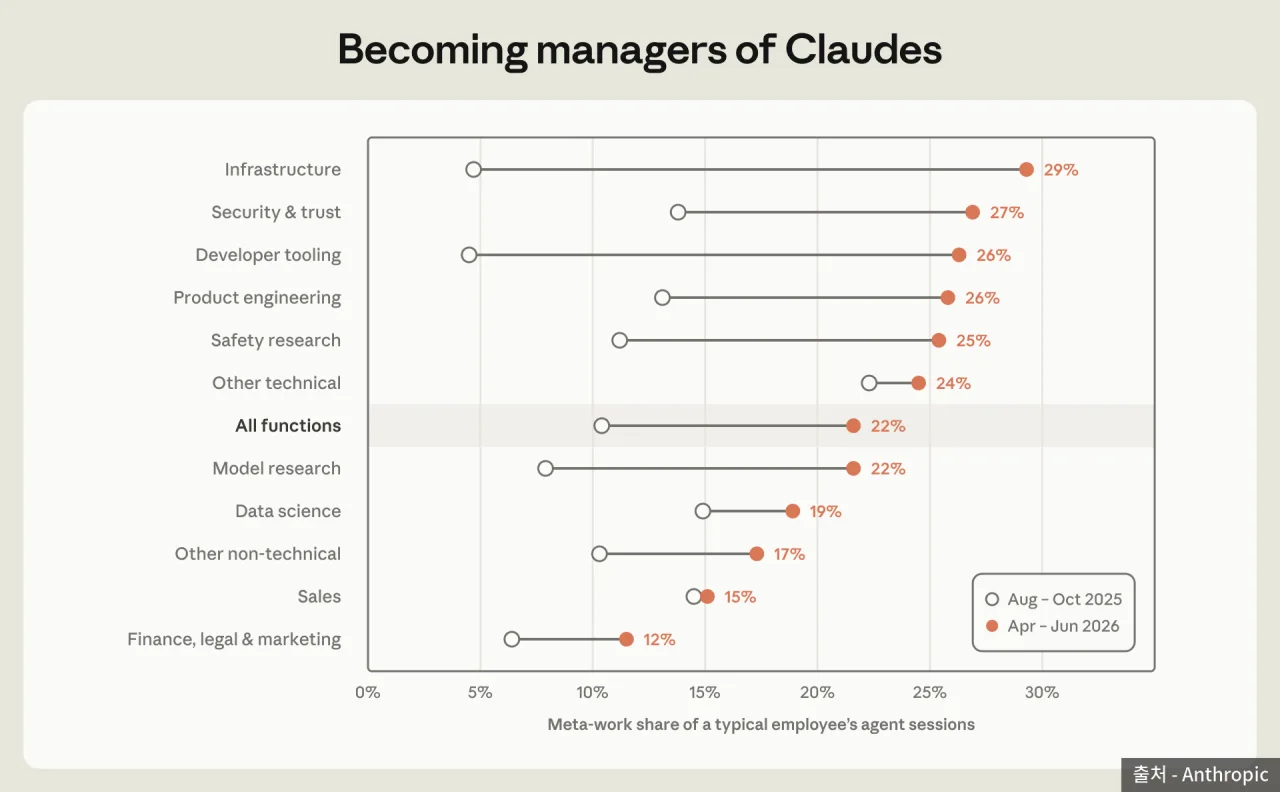 Change in the share of metawork by organization — Source: Anthropic
Metawork, managing agent runs and reviewing results, increased Its share of interactive sessions went from 10% in fall 2025 to 22% in spring 2026
It calculated that reading all of Claude’s output would take half of a non-technical employee’s working hours The median meeting time per employee rose 20% from a year earlier
The share of interview evaluations mentioning a history of using AI tools also rose From 5% for technical and 7% for non-technical roles in 2024, they grew 3 times and 4 times respectively
Points of contact in Korea
In Korea too, entry-level hiring opportunities in development roles are shrinking
By the Korea Labor Institute’s count, the new-grad share of SW development job postings was 53.5% in 2022 In 2024 it fell to 37.4%
| Metric | Before | After |
|---|---|---|
| New grads among Anthropic technical hires | 27% | 9% |
| New-grad share of Korean SW job postings | 53.5% | 37.4% |
In a Bank of Korea analysis, young people in employment declined from June 2022 to June 2026
Computer programming and system integration fell 16.6% Publishing, which includes the game software industry, fell 27.4%
The two metrics measure different things, so they can’t be compared directly It is right to read only that they point in the same direction
Caveats when reading it
These are results from a company that sells agents measuring itself The report itself says Anthropic’s employment patterns can’t be generalized to the whole economy
The limitations the authors state themselves are these
- Tool adoption was not random; employees facing big work may have used them first
- More code does not mean better code or business results
- Adopters’ output was already on a rising trend before adoption
- Survey questions changed in April 2026, making direct comparison with earlier results difficult
As things the company should do, it proposed employee equity ownership and internal redeployment of affected employees Still, it admitted there is no way to directly stop the decline in new-grad hiring
What to watch next
- Whether other AI companies disclose internal employment data
- The size of second-half new-grad recruiting at Korean IT companies
- Policy discussion of the retraining and income support the report calls for