On October 7, the Royal Swedish Academy of Sciences announced that the 2026 Nobel Prize in Chemistry goes to Henri B. Kagan of France and Kenso Soai of Japan. The prize was awarded for the discovery of non-linear effects and autocatalysis in asymmetric organic synthesis.
The amino acids and sugars of living things use only one of two mirror-image forms, but in the lab both mirror images of a chiral molecule were often produced together. The two discovered principles by which one mirror image is produced predominantly in a reaction, and these principles are now used in drug synthesis.
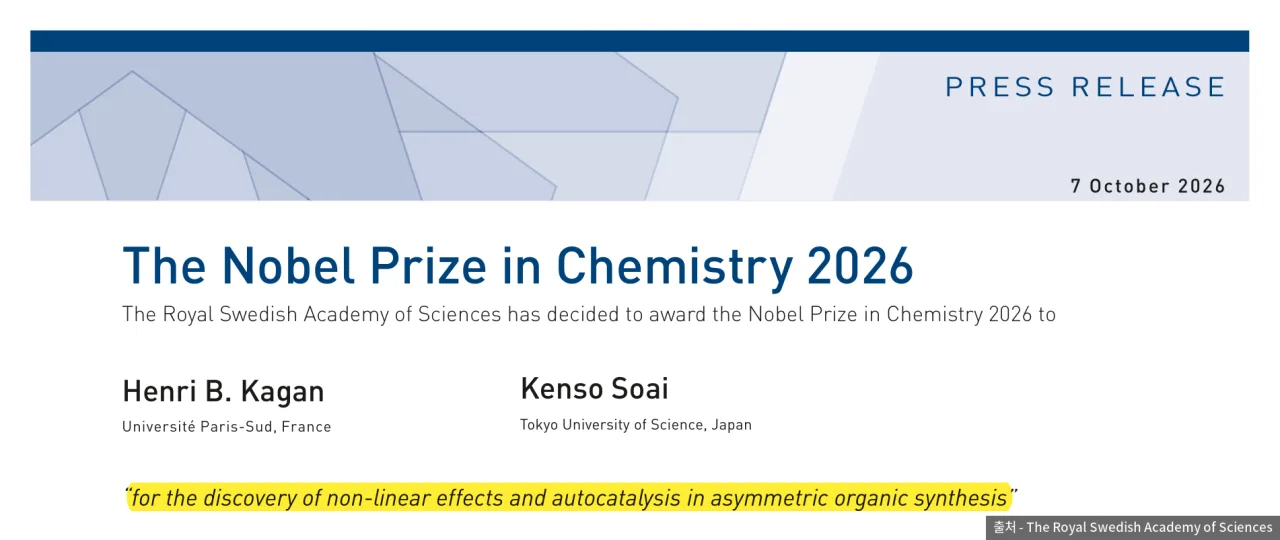 2026 Nobel Prize in Chemistry press release, with the prize motivation highlighted — Source: The Royal Swedish Academy of Sciences
The laureates and the prize
| Laureate | Born | Affiliation |
|---|---|---|
| Henri Kagan | 1930, France | Professor emeritus, former Université Paris-Sud |
| Kenso Soai | 1950, Hiroshima, Japan | Professor emeritus, Tokyo University of Science |
Kagan received his PhD from the Collège de France in 1960, and Soai from the University of Tokyo in 1979. The prize money of about ₩1.7 billion (12 million Swedish kronor, about $1.2 million) is split equally between the two.
Heiner Linke, chair of the Nobel Committee for Chemistry, said the two provided an answer to a chemistry problem more than 100 years old: whether homochirality can form on its own.
Mirror-image molecules and homochirality
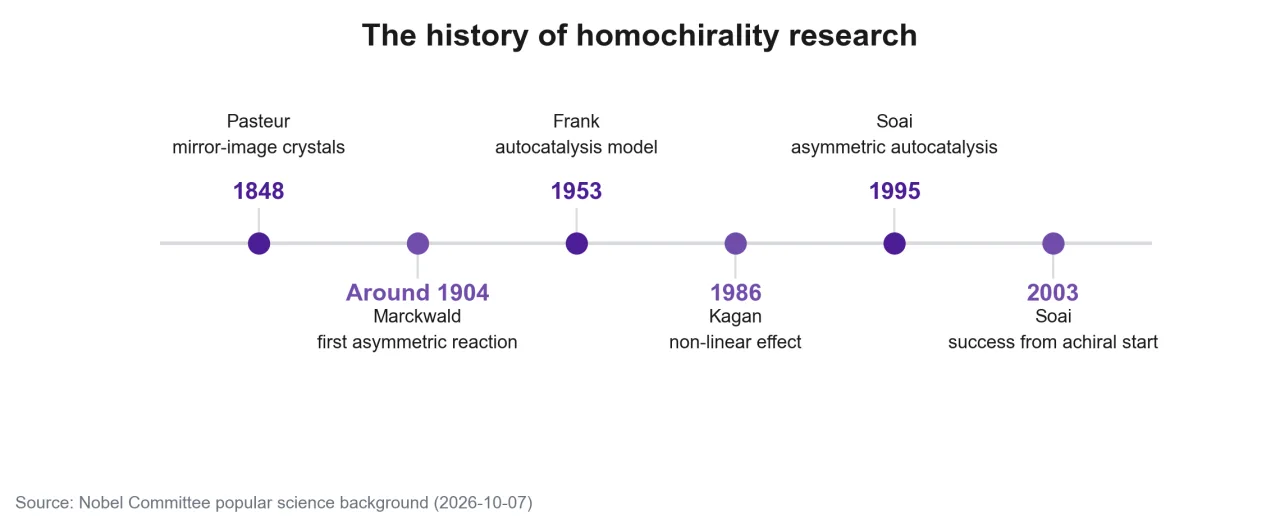 The history of homochirality research — Source: self-rendered from Nobel Committee background material
Some molecules exist in two forms that are mirror images of each other but can’t be superimposed, like right and left hands. This property is called chirality, and the two forms are called enantiomers.
Living things use only one mirror image. The amino acids that make up proteins are only left-handed and the sugars in DNA only right-handed, and this state in which only one mirror image predominates is called homochirality. By contrast, making chiral molecules in the lab always yields a half-and-half mix of the two forms, so how one mirror image came to dominate in living things was a long-standing question.
In medicines, this difference can determine efficacy and side effects. Even for the same molecule, only one mirror image may have the desired effect while the other is useless or harmful. The Nobel Committee cited the thalidomide disaster of the 1960s as an example.
In 1953, British physicist Charles Frank proposed a mathematical model saying three conditions are needed for one mirror image to become dominant on its own.
[Condition 1] A chiral catalyst drives an asymmetric reaction
[Condition 2] One mirror image increases while the other is suppressed
[Condition 3] The reaction’s product is itself the catalyst of that reaction (autocatalysis)
The first condition was met in the early 20th century, and this prize recognizes proving the remaining two conditions with actual reactions.
Kagan’s non-linear effect
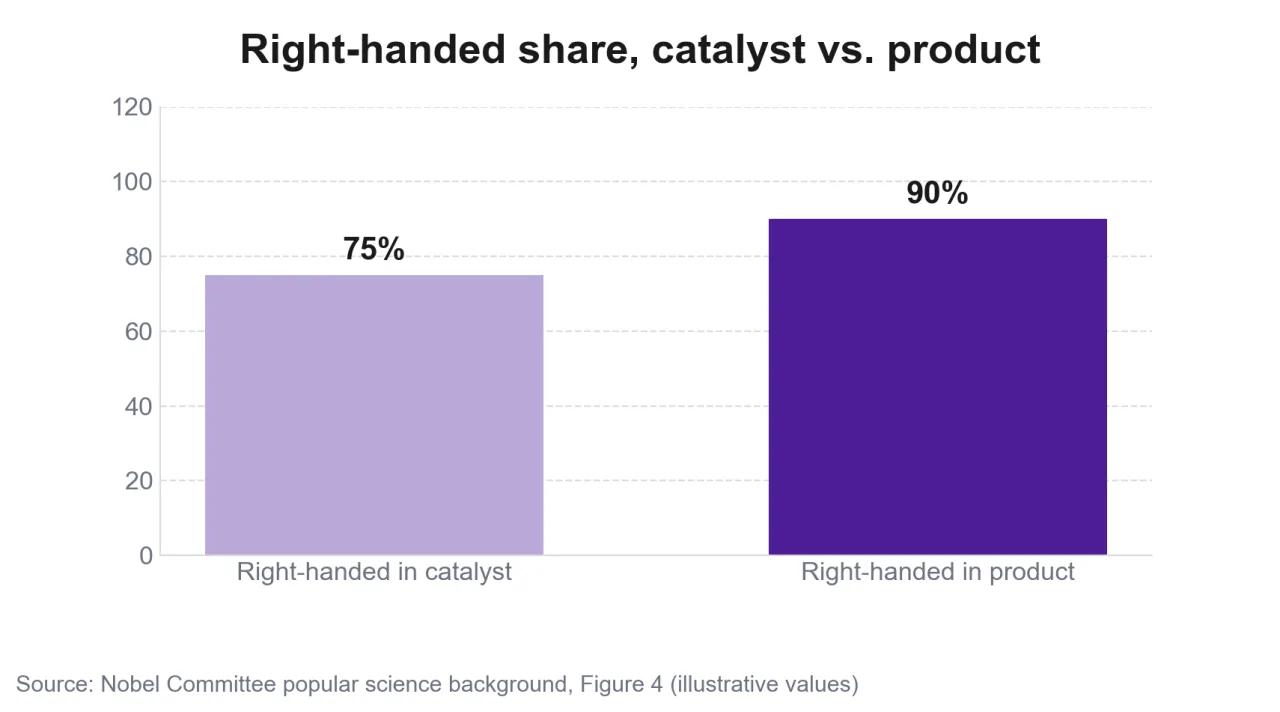 Right-handed share in catalyst and product, Nobel Committee example — Source: self-rendered from Nobel Committee background material
Asymmetric reactions use catalysts that bind a metal atom to chiral molecules. Chemists assumed the mirror-image ratio of the catalyst would be reflected directly in the ratio of the product — that is, that the two had a linear relationship.
Kagan reasoned that a metal atom binds two or more chiral molecules, so mixing right- and left-handed forms would produce three kinds of catalyst: right+right, left+left, and left+right. Experiments showed that the mixed left+right catalyst barely drove the reaction, so the catalyst of the more abundant form dominated the reaction accordingly.
In the Nobel Committee’s example, mixing a catalyst of 75% right-handed and 25% left-handed makes the actual reaction proceed at 90% right-handed and 10% left-handed. In 1986 Kagan published three asymmetric reactions showing this non-linear effect in the Journal of the American Chemical Society (JACS), and Frank’s second condition was met this way.
Soai’s asymmetric autocatalysis
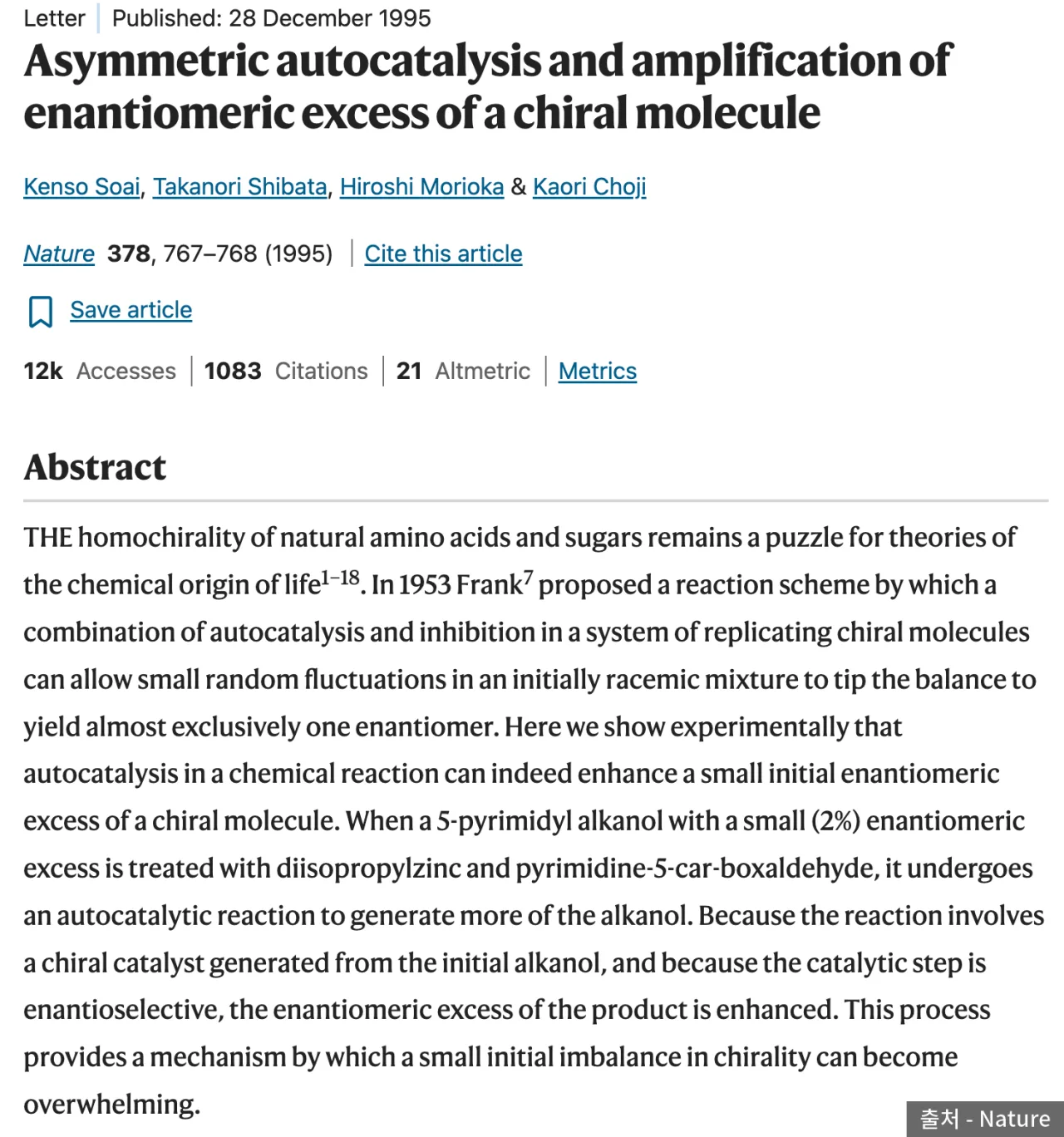 Title and abstract of Soai’s 1995 Nature paper — Source: Nature
While studying reactions with large non-linear effects, Soai noticed that the catalyst and product had similar structures and discovered a reaction in which the product becomes its own catalyst. In a paper published in Nature in 1995 (Soai, Shibata, Morioka, Choji), he started with a 5-pyrimidyl alkanol with a 2% excess of one mirror image and amplified that enantiomeric excess to 87%. This paper is paywalled, so I summarized it from the abstract and Nobel Committee material.
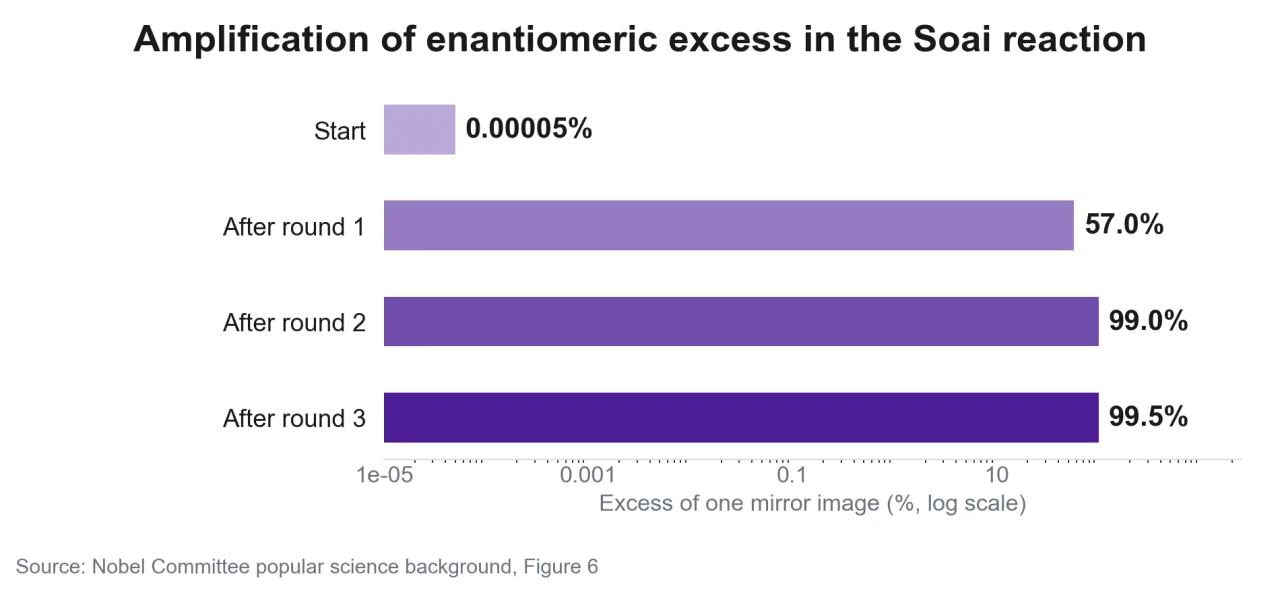 Amplification of enantiomeric excess in the Soai reaction — Source: self-rendered from Nobel Committee background material
In 2003 he demonstrated a reaction starting from material with no enantiomeric excess. At first, by chance, slightly more of one mirror image forms, and that mirror image becomes dominant by repeatedly catalyzing the production of the same mirror image. In the example in the Nobel Committee material, an enantiomeric excess of 0.00005% was amplified to more than 99.5% over three rounds of replenishing the starting material.
If you run the same experiment again, the opposite mirror image might dominate this time. That means which side dominates is decided by chance at the starting moment, and it is regarded as the first actual reaction to meet all three of Frank’s conditions.
What this discovery doesn’t yet answer
[Not the origin of life] The Soai reaction is an artificial reaction, and the Nobel Committee also notes it differs from the chemistry of life
[Reproducing amino acids and sugars is ongoing] Research to synthesize homochiral amino acids and sugars the same way is underway around the world
[The limits of thalidomide] Thalidomide’s two mirror images interconvert in the body, so purifying and administering only one doesn’t remove the danger
[The non-linear effect is a tool] It’s an analytical tool for understanding reaction mechanisms and raising purity, not itself a process for synthesizing drugs
The explanation that the harmful form in the thalidomide disaster was one mirror image is correct, but because the mirror images flip inside the body, many studies conclude that making only the pure single form would not have prevented the disaster.
Connection to Korea
Nobel Committee material and published reports show no joint research between the two laureates and Korean researchers. The connection is on the application side. Korean pharmaceutical companies have also developed improved drugs that separate only the effective mirror image from existing drugs that mix both, and making such drugs uses asymmetric catalytic reactions and enantiomeric purity analysis.
What to watch next
- The December 10 award ceremony in Stockholm and the laureates’ lectures
- Progress in research making homochiral amino acids and sugars by the Soai reaction approach
- The literature, peace, and economics prizes announced from October 8
Sources
- [The Royal Swedish Academy of Sciences] Press release: The Nobel Prize in Chemistry 2026 (2026-10-07, laureates, motivation, prize money; source of 1 image in the body)
- [The Royal Swedish Academy of Sciences] Popular science background: They solved chemistry’s asymmetric mystery (history, Kagan example, Soai reaction figures)
- [The Royal Swedish Academy of Sciences] Scientific background to the Nobel Prize in Chemistry 2026 (references)
- [Nature] Soai, Shibata, Morioka, Choji, Asymmetric autocatalysis and amplification of enantiomeric excess of a chiral molecule, 378, 767–768 (1995; source of 1 image in the body)
- [Journal of the American Chemical Society] Puchot, Samuel, Duñach, Zhao, Agami, Kagan, Nonlinear effects in asymmetric synthesis, 108, 2353–2357 (1986)
- [Angewandte Chemie] Sato, Urabe, Ishiguro, Shibata, Soai, Amplification of Chirality from Extremely Low to Greater than 99.5% ee by Asymmetric Autocatalysis, 42, 315–317 (2003)
- Exchange rate: converted at 1 SEK ≈ ₩140