Six of every ten things Korea exported in August were ICT products. It’s the first time this has happened on a monthly basis.
According to the August information and communications technology (ICT) import and export trends released by the Ministry of Trade and Industry on September 14, ICT exports were $59.98 billion (₩83.97 trillion), up 162.6% from a year earlier. Their share of total exports was 61.0%, topping 60% for the first time.
It was a month where several records overlapped, but looking at the detailed figures, what went up was effectively one item.
 An export structure concentrated in one item — Source: concept image · self-generated with agy
Key figures
- ICT exports $59.98 billion (₩83.97 trillion) · +162.6% year over year
- ICT imports $18.61 billion (₩26 trillion) · +48.8%
- Trade surplus of $41.37 billion (₩57.92 trillion) · above $40 billion for the first time
- ICT share 61.0% of total exports of $98.25 billion (₩137.55 trillion)
ICT’s share topping 60% also means Korea’s export performance depends that much more on conditions in this one sector.
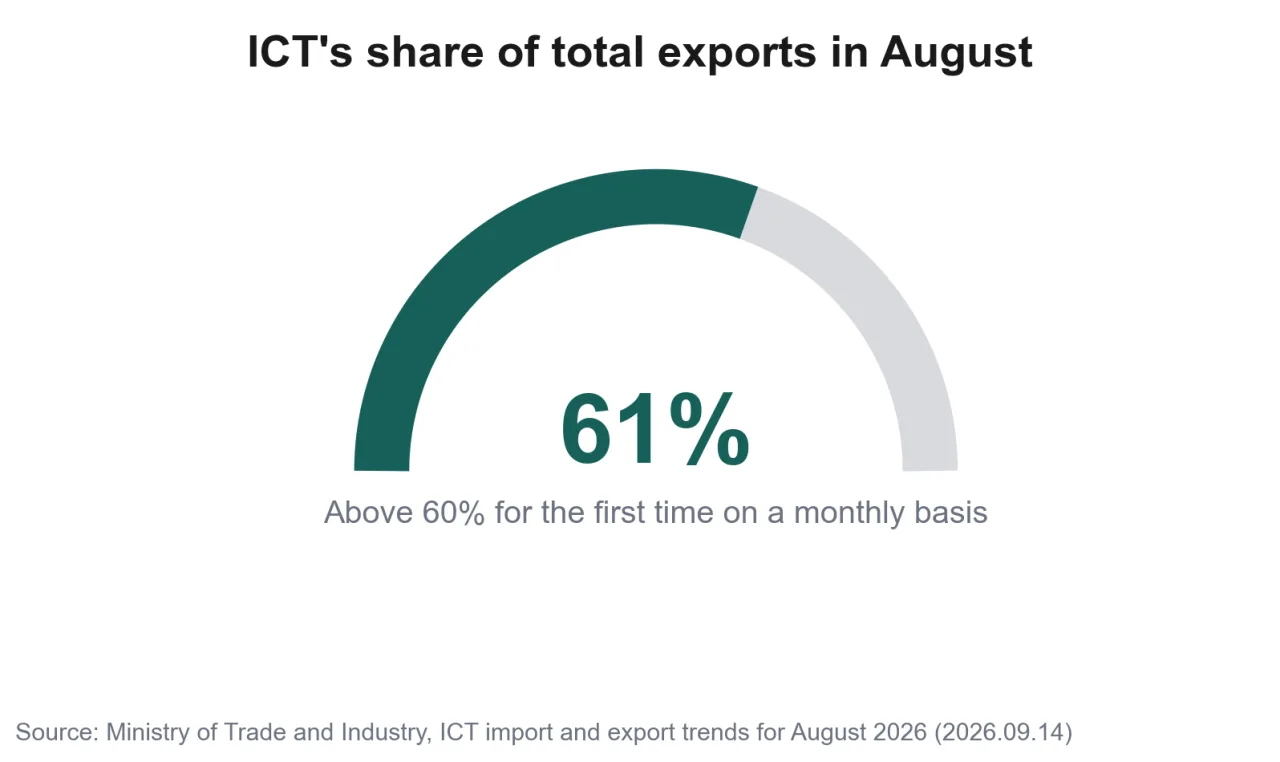 ICT’s share of total exports in August — Source: self-rendered based on figures released by the Ministry of Trade and Industry
Semiconductors alone at 78%
Breaking it down by item makes the concentration clear.
Semiconductor exports were $46.67 billion (₩65.34 trillion), a monthly record. Semiconductors alone account for 77.8% of all ICT exports.
The second-largest, computers and peripherals, came to $6.4 billion (₩8.96 trillion), about a seventh of semiconductors. The remaining items each fall short of ₩3 trillion.
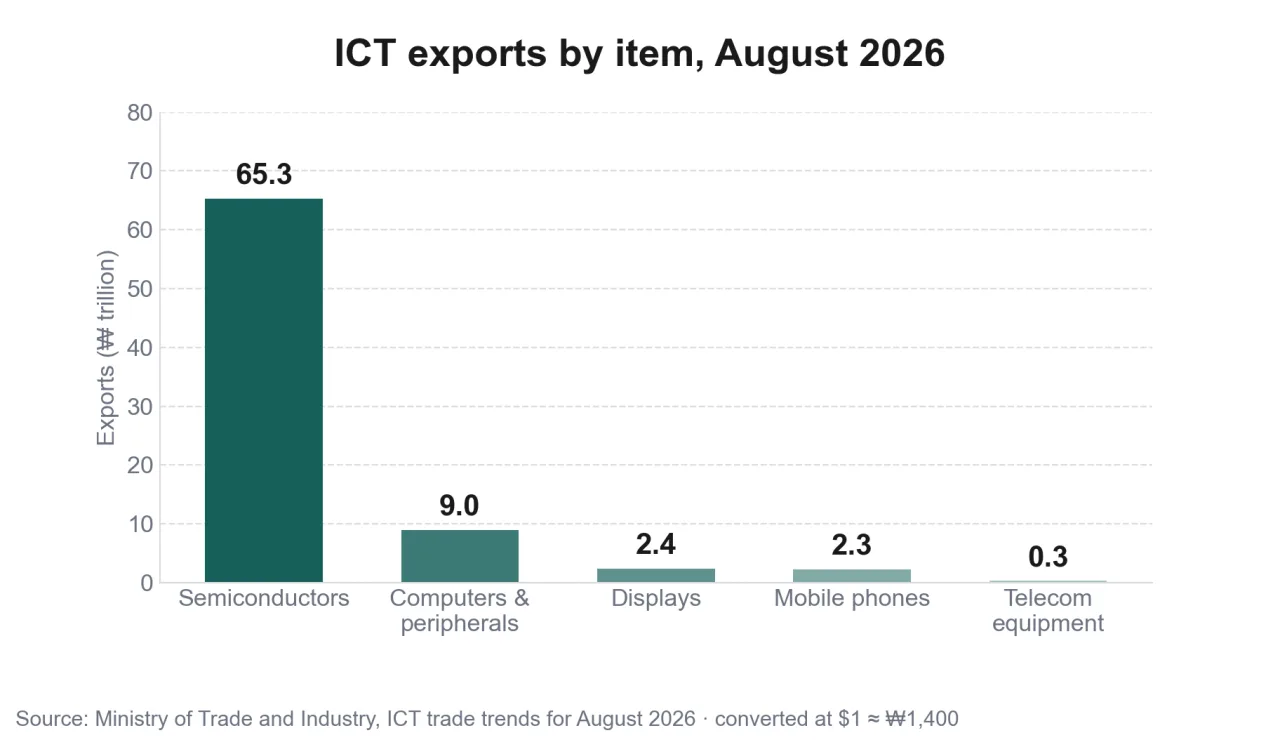 ICT exports by item, August 2026 — Source: self-rendered based on figures released by the Ministry of Trade and Industry
Two drivers of the increase
A 162.6% increase means exports grew 2.6 times in one year.
The first is memory prices. As AI data center investment continued, memory demand outstripped supply and fixed contract prices rose. By Counterpoint Research’s count, quarterly contract prices for commodity DRAM rose by up to 95%, a different magnitude from the past peak of 35%.
Looking at the price of a single 64GB RDIMM that goes into servers makes the movement clear. It rose from $255 (₩357,000) in Q3 2025 to $450 (₩630,000) in Q4, and was forecast to reach $700 (₩980,000) in March 2026.
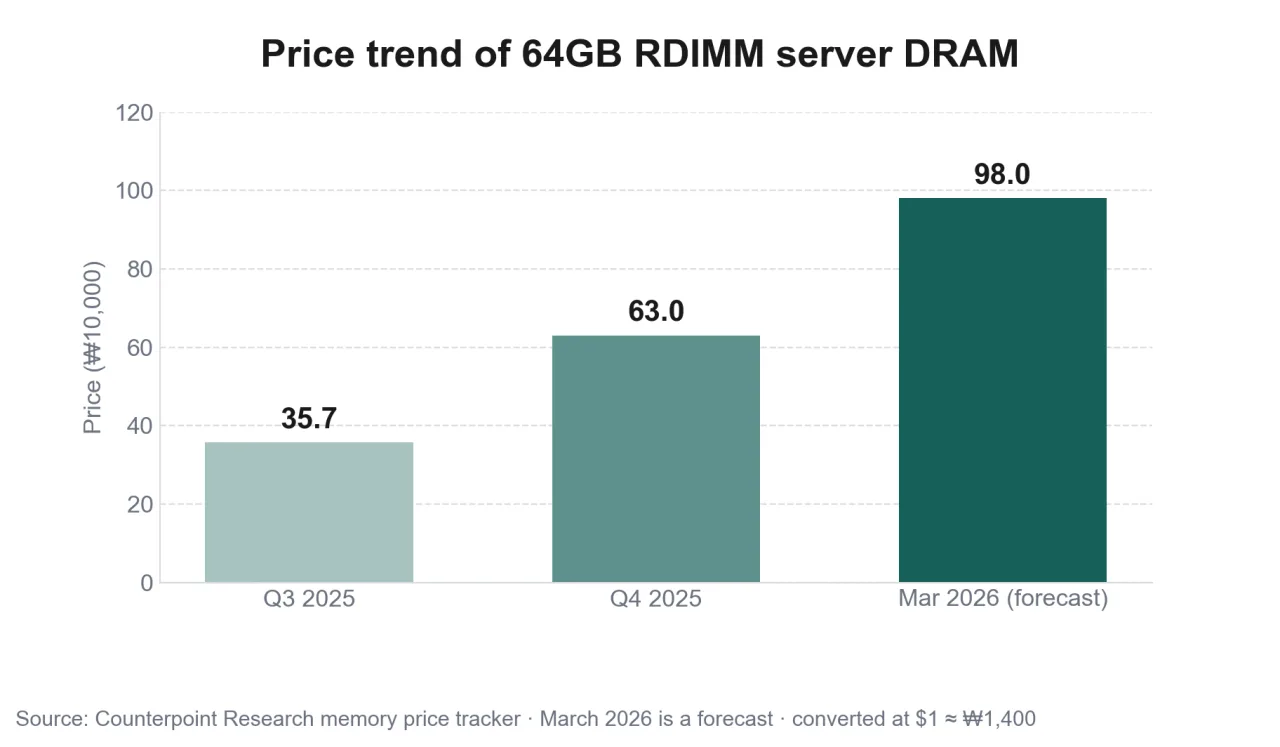 Price trend of 64GB RDIMM server DRAM — Source: self-rendered based on Counterpoint Research figures
The second is the prior-year base. ICT exports in August 2025 were only $22.84 billion (₩31.98 trillion), so the growth rate came out large.
Computers and peripherals growing the most, at 383.1%, fits the same pattern. Demand rose as storage devices including SSDs went into AI servers, and higher memory prices were reflected here too.
Only displays fell, by 7.0%
Not every item rose. Displays came to $1.69 billion (₩2.37 trillion), down 7.0%. It’s the only item that shrank in these statistics.
Putting the growth rates side by side reveals the gaps between items.
| Item | Change |
|---|---|
| Computers and peripherals | +383.1% |
| Semiconductors | +209.0% |
| Mobile phones | +23.2% |
| Telecom equipment | +11.5% |
| Displays | -7.0% |
Mobile phones and telecom equipment also grew, but only by double digits. That’s a different kind of trend from semiconductors and computers, which grew by triple digits. Within the same statistics, items directly tied to AI server demand split from those that aren’t.
Exports by region
By region, the increases for Greater China and the US stand out.
| Region | Exports (₩ trillion) | Change |
|---|---|---|
| China (incl. Hong Kong) | 38.2 | +227.9% |
| United States | 13.2 | +306.5% |
| Vietnam | 9.8 | +81.4% |
| Taiwan | 7.8 | +54.3% |
| European Union | 2.7 | +49.1% |
| India | 1.5 | +126.7% |
| Japan | 0.8 | +72.4% |
By value, China is largest, and by growth rate, the US is largest. The US’s 306.5% can be seen as the result of local data center investment translating into memory demand.
Much of the volume going to China, Taiwan, and Vietnam is intermediate goods assembled locally into servers and finished products. Where final demand lies is hard to judge from the destination alone.
Why it matters
Overlaying the 61% share with the 78% concentration, the math says nearly half of Korea’s total exports depend on the price of a single item: memory semiconductors.
Right now, prices are rising, so it’s working in a good direction. The problem is that the same structure also moves the other way. The low figure for August 2025 is the evidence.
Memory prices fall when supply catches up with demand. DRAM output in 2026 is forecast to grow 24% from the previous year, and when added capacity actually comes online will determine the next phase.
What constrains how fast supply grows is HBM. As manufacturers allocate production to more profitable HBM first, capacity left for regular DDR5 and NAND flash has shrunk. HBM’s share of total DRAM wafer input is around 20% now and is expected to grow further. It’s a structure where even with expansion, commodity memory supply doesn’t loosen right away.
As the decline in displays shows, even within ICT, the gap between items directly tied to AI demand and those that aren’t is becoming clear.
What to watch next
- How the growth rate adjusts in the September ICT trade trends, and when the base effect fades
- How many quarters the rise in memory fixed contract prices continues
- When prices are expected to turn as added capacity comes online
- Whether ICT’s share stays in the 60% range or stops at August
- Whether the decline in displays continues and whether Korean companies’ product mix changes
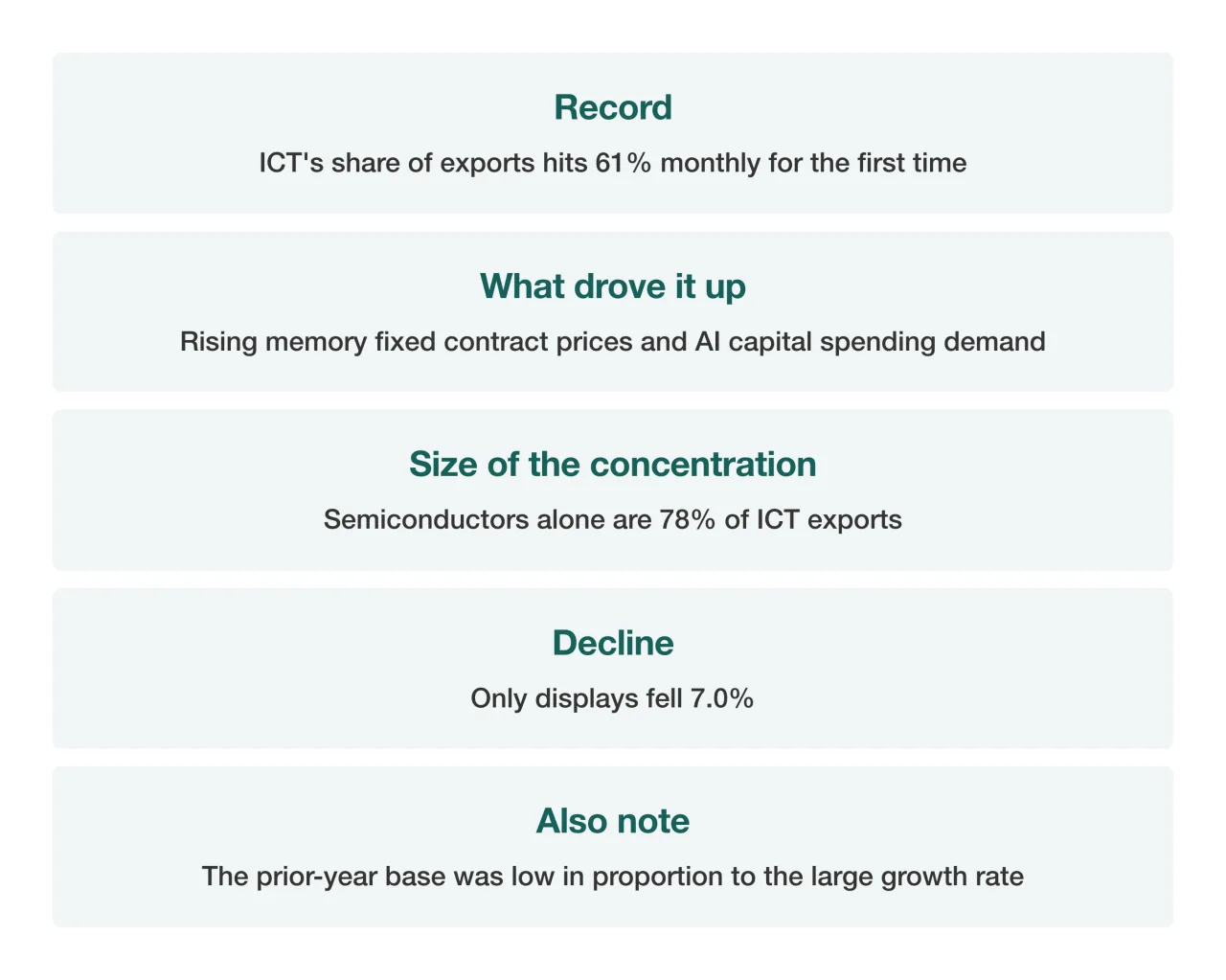 Summary of what to note in these statistics — Source: summary card of the article · self-rendered
Sources
- [Ministry of Trade and Industry] Information and Communications Technology (ICT) import and export trends, August 2026 (09.14, original figures by item and region)
- [Asia Economy] August ICT exports hit a new record of $60 billion… surging on AI demand (09.14, year-earlier figures)
- [Hankook Ilbo] August ICT exports $60 billion… export share tops 60% for the first time as AI investment expands (09.14)
- [Counterpoint Research] Memory price tracker (DRAM contract prices, RDIMM price trend)
- Exchange rate: converted at $1 ≈ ₩1,400