A large cohort study linking the preservatives commonly listed on ham, drinks, and bread to high blood pressure appeared in the European Heart Journal on May 20. Following 112,395 French adults for nearly eight years on average, it found more cases of high blood pressure among people who consumed more preservatives.
The eight additives with a confirmed association include familiar preservatives such as potassium sorbate and sodium nitrite, alongside L-ascorbic acid — known as vitamin C — and citric acid.
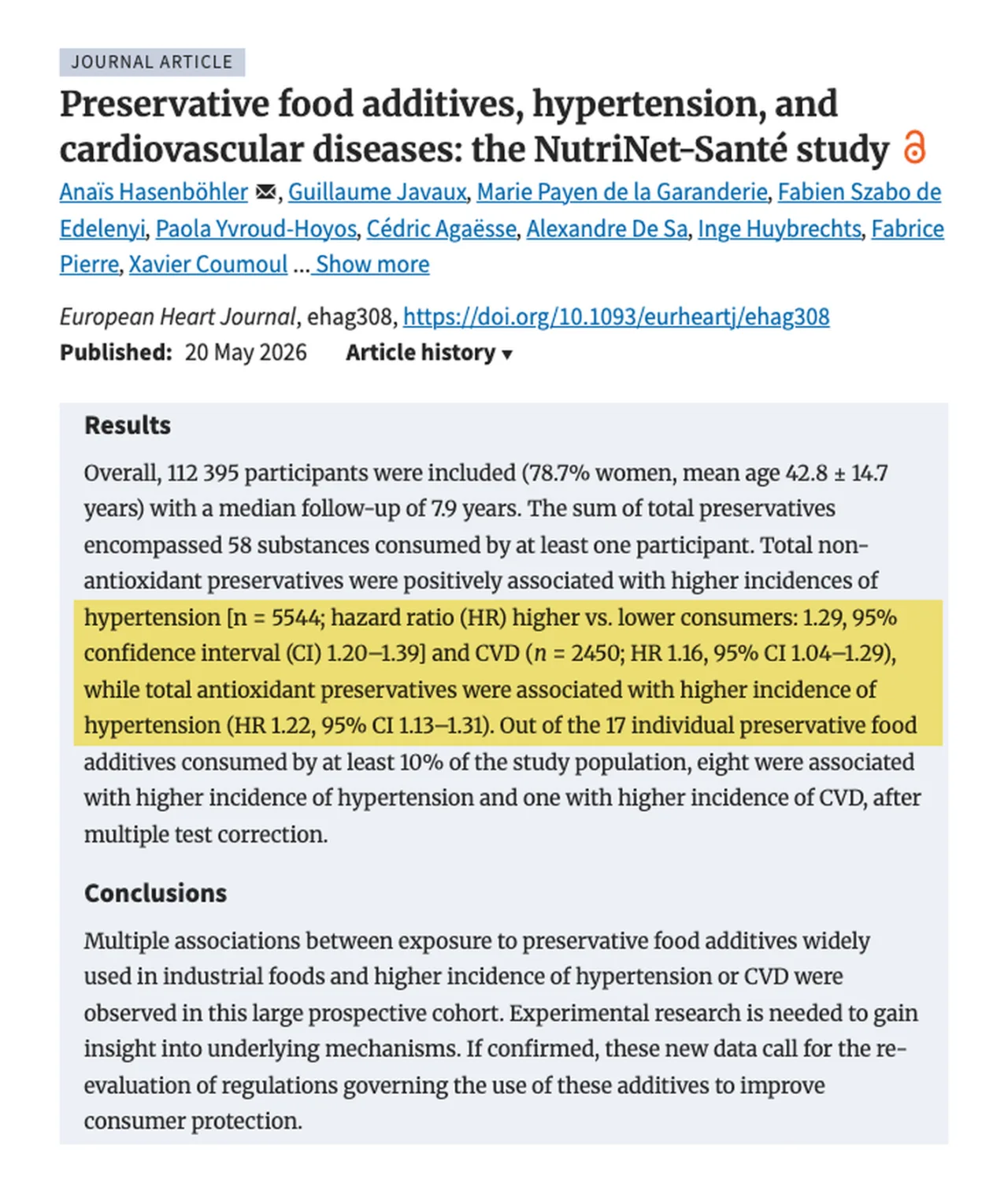 The European Heart Journal paper’s title and the results paragraph of its abstract, with the hazard ratios highlighted — Source: Hasenböhler et al., European Heart Journal (2026) (CC BY-NC 4.0, highlighting added)
About the study
The analysis was done by a nutritional epidemiology team at France’s National Institute of Health and Medical Research (INSERM) and Sorbonne Paris Nord University (first author Anaïs Hasenböhler, senior author Mathilde Touvier) using data from the NutriNet-Santé cohort. NutriNet-Santé is a large French nutrition cohort that has collected dietary records online since 2009.
What sets this study apart from earlier ones is how it measured intake. Participants left three 24-hour dietary records every six months, up to 96 in all, writing down the brand names of products, and the team calculated the amount of additives in those products using a brand-level ingredient database and laboratory analysis. Even for the same ham, additives differ by brand, and earlier cohort studies could not measure at this level.
| Item | Value |
|---|---|
| Participants | 112,395 |
| Share of women | 78.7% |
| Median follow-up | 7.9 years |
| Cases of high blood pressure | 5,544 |
| Cases of cardiovascular disease | 2,450 |
| Preservatives analyzed | 58 |
The results are reported as hazard ratios (HR) comparing the top third of intake with the bottom third. A hazard ratio of 1.29 means the risk of developing high blood pressure over the same period was 29% higher.
[Non-antioxidant preservatives × high blood pressure] Hazard ratio 1.29 (95% confidence interval 1.20–1.39)
[Non-antioxidant preservatives × cardiovascular disease] Hazard ratio 1.16 (95% confidence interval 1.04–1.29)
[Antioxidant preservatives × high blood pressure] Hazard ratio 1.22 (95% confidence interval 1.13–1.31)
Non-antioxidant preservatives are additives such as sorbates, sulfites, and nitrites that stop microbial growth; antioxidant preservatives are additives such as ascorbic acid, erythorbates, and citric acid that slow discoloration and rancidity by preventing oxidation. The team analyzed both kinds together as additives used for preservation.
The eight with a remaining link to high blood pressure
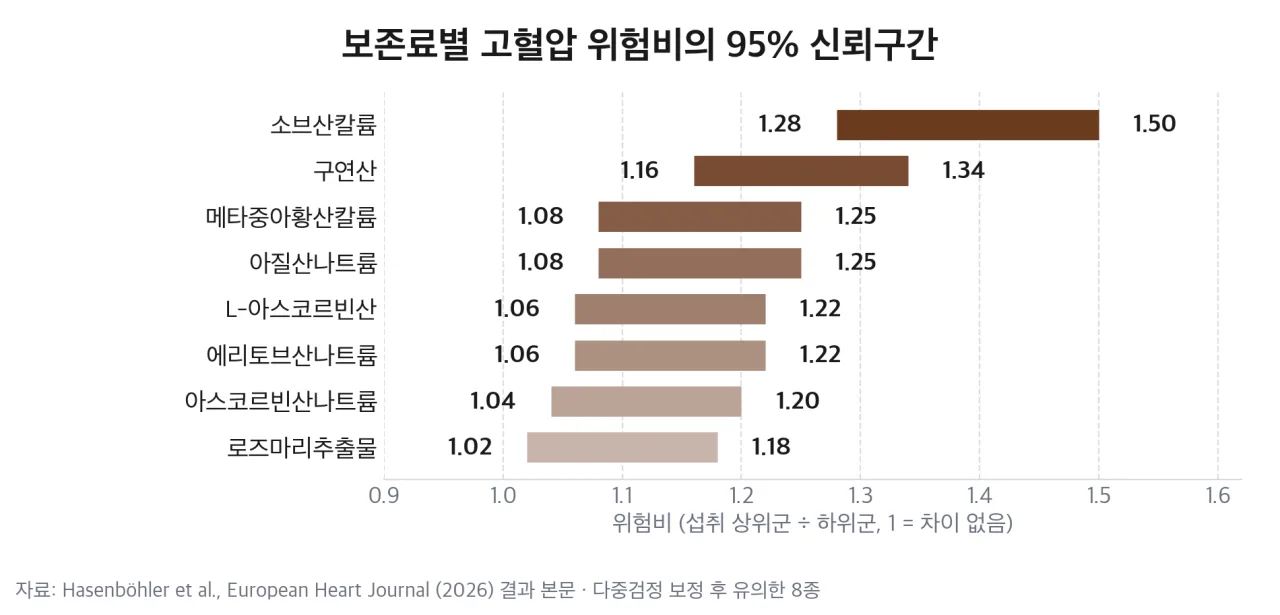 95% confidence intervals of the hazard ratio for high blood pressure by preservative — Source: self-rendered from the results section of Hasenböhler et al. (2026)
Analyzing one by one the 17 preservatives consumed by more than 10% of participants, eight still showed an association with high blood pressure and one with cardiovascular disease after correcting for the chance of error from multiple testing. A 95% confidence interval that does not include 1 means the association is statistically present.
| Additive (European number) | Main use in Korea | Main dietary source in the study |
|---|---|---|
| Potassium sorbate (E202) | Preservative | Processed foods generally |
| Potassium metabisulfite (E224) | Preservative | Alcoholic drinks (83.7% of sulfites) |
| Sodium nitrite (E250) | Color fixative and preservative | Processed meat (54.0%) |
| Sodium erythorbate (E316) | Antioxidant | Processed meat (42.1%) |
| L-ascorbic acid (E300) | Antioxidant and others | Processed fruit and vegetables (51.0%) |
Sodium ascorbate (E301), citric acid (E330), and rosemary extract (E392) also showed an association with high blood pressure. The largest hazard ratio was potassium sorbate’s 1.39, and the one additive still associated with cardiovascular disease was L-ascorbic acid (hazard ratio 1.15, 95% confidence interval 1.04–1.28).
The vitamin C additive’s association
L-ascorbic acid has the same molecular structure as the vitamin C in fruit. Yet vitamin C eaten in fruit and vegetables has been associated with lower cardiovascular risk in several studies, and this study analyzed only the amount consumed as an additive.
The team explained that the same compound can act differently depending on the other components of the food, the dose, and how it is absorbed, and their model adjusted separately for vitamin C eaten in natural foods. On average, 29% of the ascorbic acid participants consumed came from additives.
Limits on reading the hazard ratios
This is an observational study. It shows an association — more high blood pressure in the group that consumed more preservatives — and does not prove causation, that preservatives cause high blood pressure. The authors themselves qualified their conclusion, saying experimental studies are needed to establish a mechanism and that regulation should be reassessed if the findings are confirmed.
| Limit | Details |
|---|---|
| Study design | Observational, causation unproven |
| Participant makeup | 78.7% women, French online volunteers |
| Traits of the high-intake group | Younger, eating more ultra-processed food |
| Acceptable daily intake | No one exceeded it for sorbates or erythorbates |
The high-intake group was younger but got 21.4% of its diet from ultra-processed food against the low-intake group’s 14.3%. The team adjusted for sodium, sugar, saturated fat, processed meat, and fruit and vegetable intake as well as smoking, exercise, and family history, but the possibility remains that unmeasured factors affected the result.
The E-values the team calculated — the strength of association an unmeasured confounder would need to explain the observed association — were mostly above 1.5, and running the same analysis on hip fracture, where there is no reason for an association, produced none.
The amounts people consumed were also mostly within the limits. Nobody exceeded the European Food Safety Authority (EFSA) acceptable daily intake for sorbates, erythorbates, or nitrates, and only 96 people did for sulfites and 54 for nitrites. That an association appeared at intakes within the limits is the study’s basis for calling for a regulatory review — but it is equally not a basis for one person to cut a particular additive out of their diet.
Korean limits and how to read an ingredient list
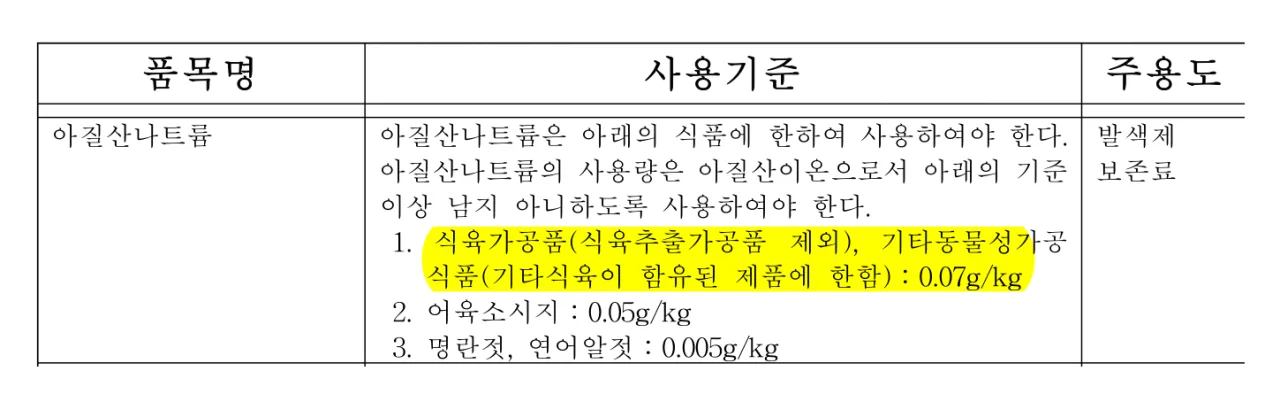 Korean Food Additives Code usage limit for sodium nitrite, with 0.07 g/kg for processed meat highlighted — Source: Ministry of Food and Drug Safety, Food Additives Code (highlighting added)
All eight are permitted additives in Korea too, and the Ministry of Food and Drug Safety’s Food Additives Code sets usage limits by food. Sodium nitrite is classified in Korea as a color fixative and a preservative, and in processed meat products such as ham and sausage it must be used so that no more than 0.07 g/kg (70 mg per kilogram) remains as nitrite ion. Sorbic acid and potassium sorbate are limited to 2.0 g/kg as sorbic acid in processed meat and fish products, and 1.0 g/kg in jangs, sauces, and pickled foods.
| Additive | Korean usage limit (Food Additives Code) |
|---|---|
| Sodium nitrite | Processed meat 0.07 g/kg |
| Sorbic acid and potassium sorbate | Processed meat 2.0 g/kg |
| Sorbic acid and potassium sorbate | Jangs and sauces 1.0 g/kg |
| Sodium erythorbate | Limited to antioxidant use |
The labeling standard for foods requires additives such as preservatives, antioxidants, and color fixatives to be listed with both the name and the purpose. So on an ingredient list you can find them by the purpose in parentheses — potassium sorbate (preservative), sodium nitrite (color fixative), sodium erythorbate (antioxidant). Additives used for several purposes, such as citric acid, have to be found by name.
In the study the main dietary sources of preservatives were processed meat, alcoholic drinks, and processed fruit and vegetable products. The authors recommended eating less processed foods; nothing in the study supports recommending particular preservative-free products or health supplements.
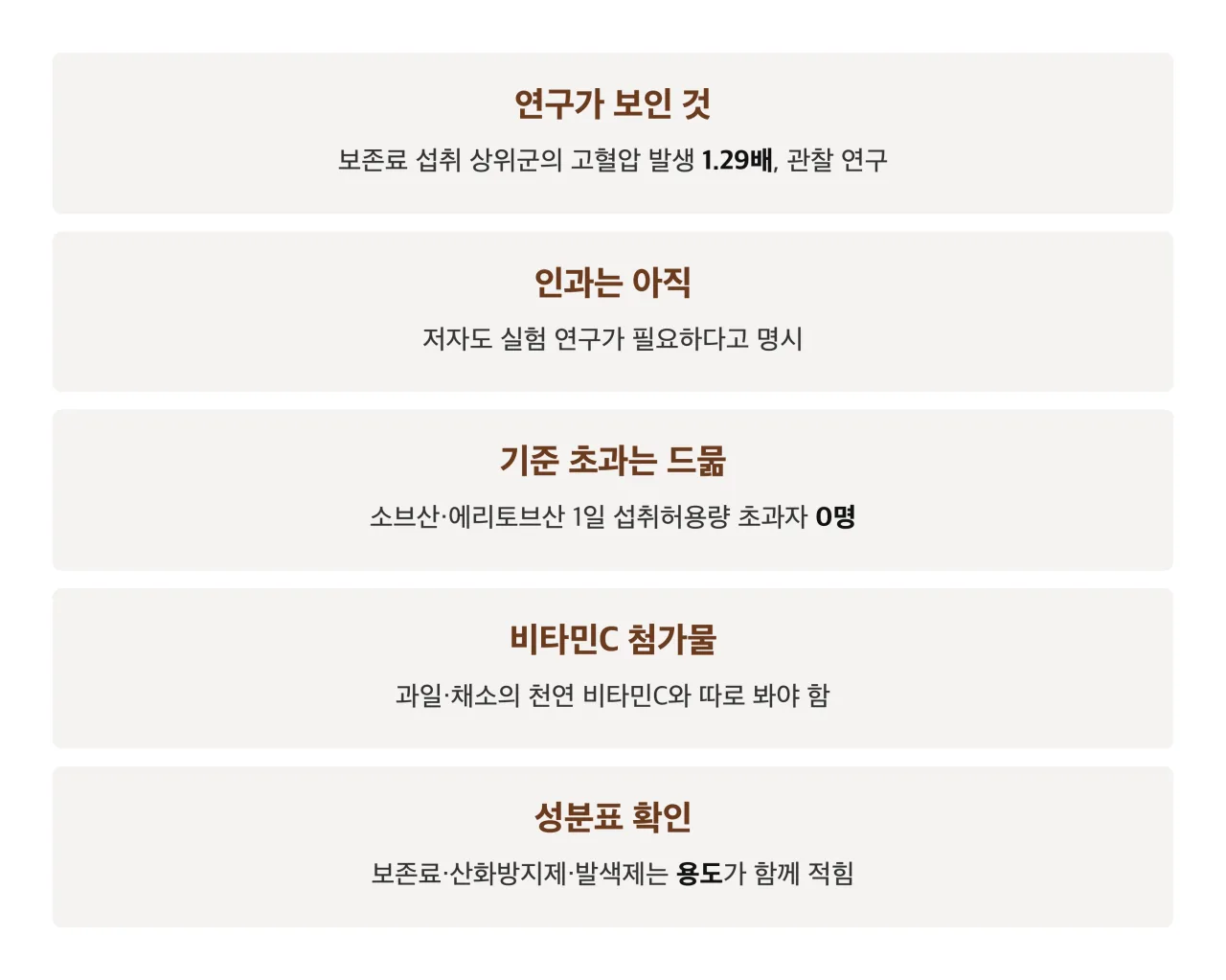 Summary card for the food preservatives study — Source: self-rendered from Hasenböhler et al. (2026) and the Food Additives Code
Sources
- [European Heart Journal] Hasenböhler A. et al., Preservative food additives, hypertension, and cardiovascular diseases: the NutriNet-Santé study (2026-05-20, source of one image in this post)
- [European Society of Cardiology] Common food preservatives linked to high blood pressure and heart disease (2026-05-21, press release)
- [Ministry of Food and Drug Safety] Food Additives Code, usage limits by item (sorbic acid, sodium nitrite, sodium erythorbate; source of one image in this post)
- [Korea Law Information Center] Labeling Standards for Foods (names and purposes of food additives)