On October 6, Boston Dynamics named Rohit Prasad its new chief executive officer (CEO), effective October 7. He led Alexa and the artificial general intelligence (AGI) organization at Amazon over 12 years.
Executing the Atlas mass-production schedule covered in Part 3 is now his responsibility. Hyundai Motor Group’s target is 30,000 units a year in 2028, but as of a May report, the production rate was four units a month.
Atlas (3) — Mass Production Begins and the Parts Supply Chain Becomes the Battleground (in Korean)
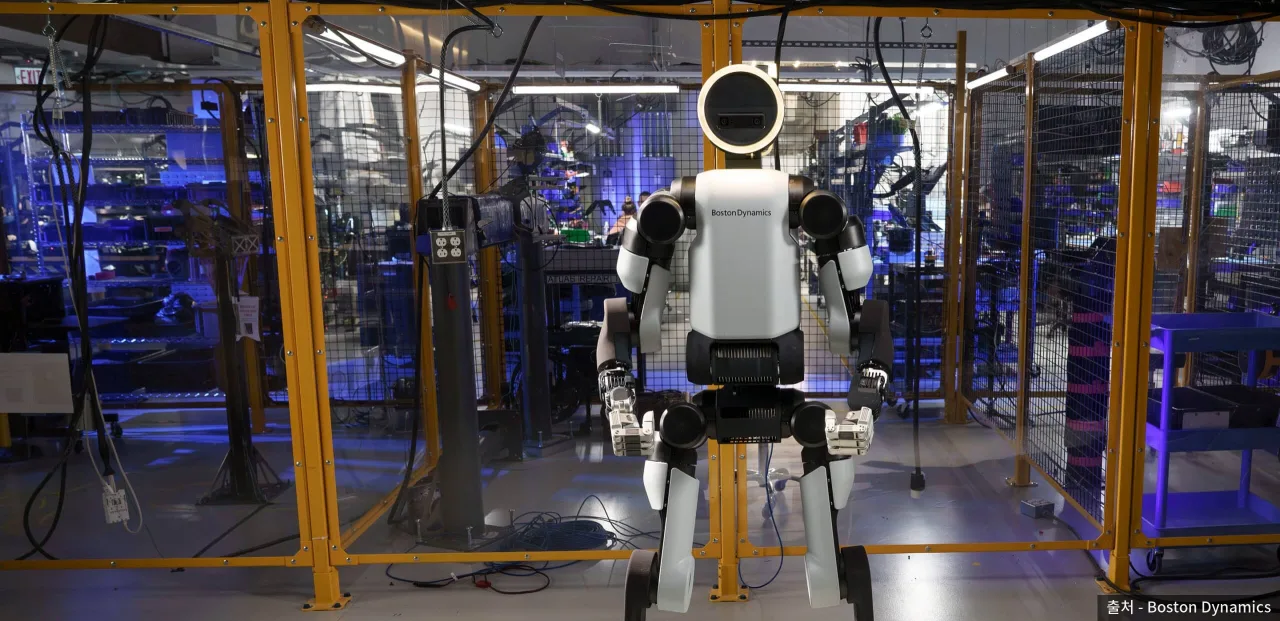 The 2026 electric Atlas — Source: Boston Dynamics
Timeline
 Boston Dynamics logo
Boston Dynamics announced Prasad’s appointment in a press release, introducing him as the right person to advance Physical AI. Physical AI refers to AI that moves in real space, like robots, rather than giving answers on a screen.
The CEO seat had been vacant for eight months. Robert Playter, who had led the company since 2020, stepped down in February, and Amanda McMaster served as interim CEO after that. Semafor reported that after Playter’s departure, the chief operating officer (COO) and chief strategy officer (CSO) also left the company.
- February: CEO Robert Playter steps down, Amanda McMaster becomes interim CEO
- May: Semafor reports a string of executive departures and production of four units a month
- July 13–15: Hyundai Motor union partial strike, demanding labor-management agreement on robot adoption
- October 6: Rohit Prasad’s appointment as CEO announced
- October 7: Prasad takes office
The new CEO’s background
Prasad is an executive who came up as a machine learning researcher and has worked in the Boston area for more than 25 years. Half his career was in research labs and half in consumer products.
| Period | Organization | Role |
|---|---|---|
| About 14 years | Raytheon BBN | Speech recognition and machine learning research |
| 12 years | Amazon | Launching and scaling Alexa |
| Most recently | Amazon | AGI organization, Nova models |
Alexa is a voice assistant used in hundreds of millions of homes, and Amazon Nova is Amazon’s own family of foundation models. His experience commercializing research into mass-market products was cited as the reason for the appointment.
Hyundai Motor Group Vice Chairman Chang Jae-hoon (chairman of the Boston Dynamics board) said in the press release that the group will grow Physical AI by combining Prasad’s ability to turn AI into products at global scale with Hyundai Motor Group’s manufacturing and logistics capabilities. Prasad said he is honored to join at a pivotal moment for the industry.
Mass-production target and current output
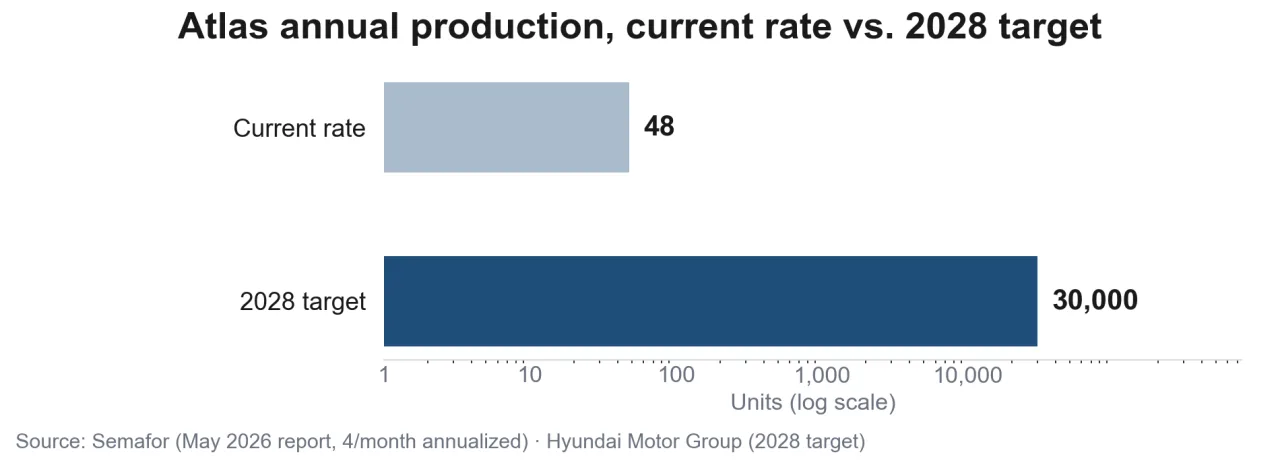 Atlas annual production, current rate versus the 2028 target — Source: self-rendered from Semafor and Hyundai Motor Group announcements
Hyundai Motor Group said at CES in January that it would build robot production capacity of 30,000 units a year in the US by 2028. In May it specified that more than 25,000 of those would be deployed in Hyundai and Kia plants. The remaining 5,000 or so are for external sales.
Semafor reported in May that Boston Dynamics makes four Atlas units a month. Annualized, that’s 48 units, so reaching 30,000 requires an increase of about 625 times. This figure wasn’t officially announced by the company, and the production rate since then hasn’t been disclosed.
Unit cost
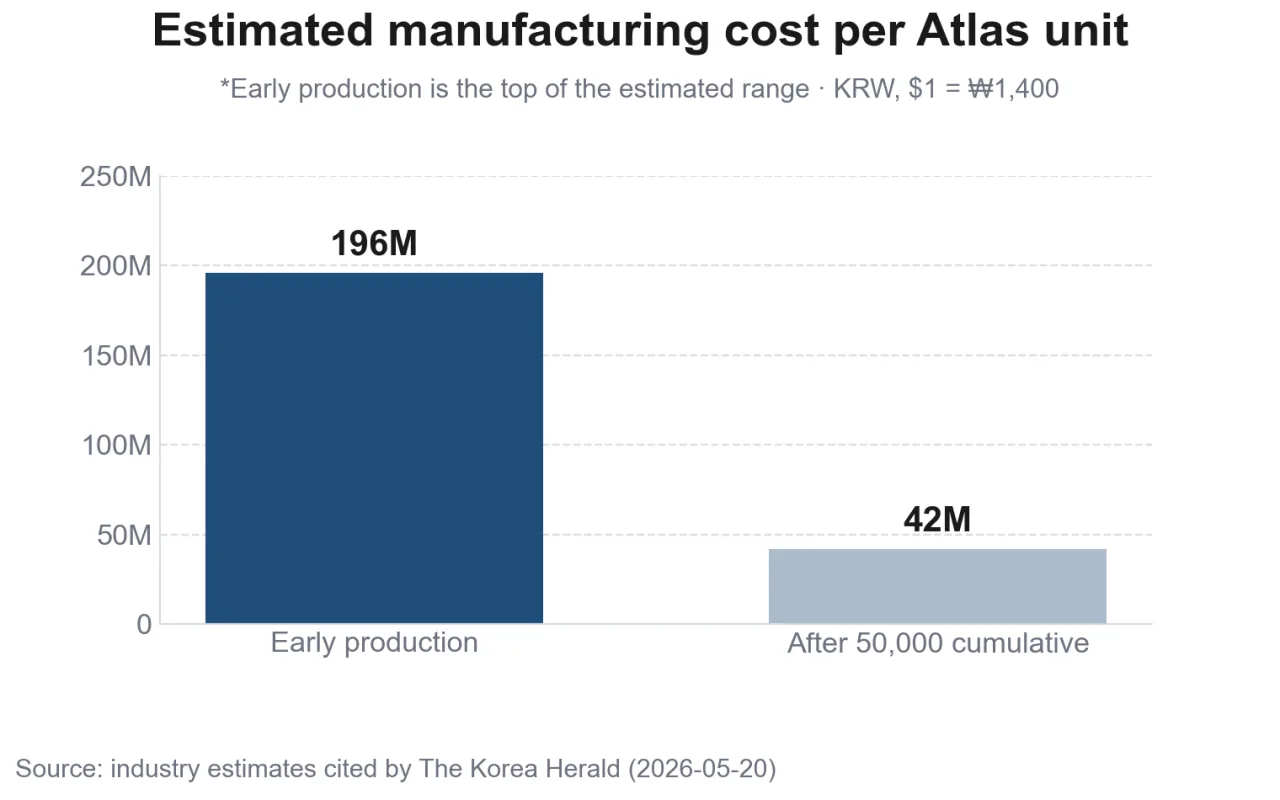 Estimated manufacturing cost per Atlas unit — Source: self-rendered from industry estimates cited by The Korea Herald
According to industry estimates cited by The Korea Herald in May, the manufacturing cost of one Atlas in early mass production is $130,000–140,000 (₩182–196 million). Once cumulative production passes 50,000 units, it is expected to fall to around $30,000 (₩42 million). These are estimates, not costs disclosed by the company.
The part that takes a large share of the cost is the actuator that moves the joints. The same report said actuators account for about 60% of the bill of materials, and Hyundai Motor Group plans to run a facility making more than 350,000 actuators a year from 2028. A single robot uses more than 10 actuators.
Schedule for deployment in Hyundai plants
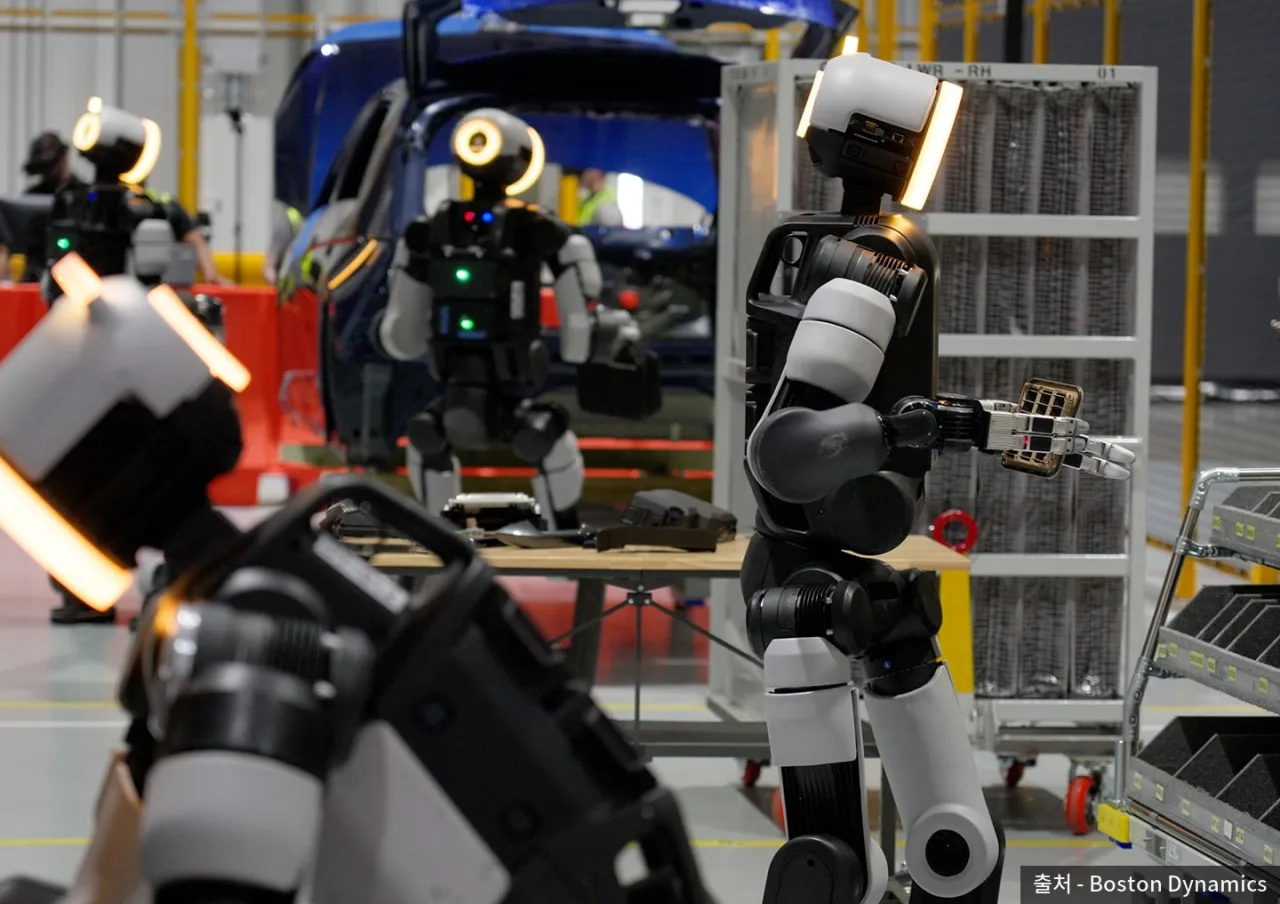 Atlas working at the Georgia RMAC — Source: Boston Dynamics
This summer Hyundai Motor Group opened the Robotics Metaplant Application Center (RMAC) in Georgia and began training Atlas to adapt to factory processes. It’s the center previewed in Parts 2 and 3.
| When | Where | Atlas’s job |
|---|---|---|
| Summer 2026 | Georgia RMAC | Process adaptation training |
| 2028 | HMGMA | Parts sorting |
| 2029 | Kia Georgia plant | Expanded deployment |
| 2030 onward | Hyundai and Kia plants | Assembly processes |
HMGMA is Hyundai Motor Group Metaplant America in Georgia. Atlas’s first job will be picking parts in sequence and feeding them to the line, and deployment in assembly processes is scheduled for 2030 or later.
Connection to Korea
 Hyundai Motor Group logo
During a partial strike on July 13–15, the Hyundai Motor union demanded a clause that humanoid robots can’t be introduced into plants without a labor-management agreement. The Wall Street Journal reported it as the first case of a car plant halting operations over humanoid robots.
No schedule for deployment in Korea has been announced. All announced deployment plans are for plants in Georgia in the US, and when Atlas will be introduced at domestic plants such as Ulsan remains a matter for labor-management negotiation. Korean parts makers producing actuators and reducers are the supply-chain connection covered in Part 3.
What to watch next
- Whether the first production rate under Prasad is disclosed
- Whether the 2028 HMGMA deployment schedule holds
- Groundbreaking and operating schedule of Hyundai Motor Group’s actuator plant
- The outcome of labor-management negotiations over robot adoption at domestic plants
- Announcement of the first customer for the 5,000 units for external sale
Sources
- [Boston Dynamics] Boston Dynamics Appoints Rohit Prasad as Chief Executive Officer (2026-10-06, appointment, background, quotes)
- [The Robot Report] Boston Dynamics appoints former Amazon exec Rohit Prasad as new CEO (Playter’s departure, interim CEO)
- [The Boston Globe] Boston Dynamics taps Rohit Prasad as CEO (2026-10-06)
- [Gizmodo] Summary of the new CEO, Atlas mass-production target, and four units a month
- [The Korea Herald] Atlas deployment plan, cost estimates, actuator share (2026-05-20)
- [Herald Economy] 25,000 robots in Hyundai plants, 30,000 units a year (2026-05-18)
- [Dailian] Hyundai union strike seen abroad as the first labor clash of the humanoid era
- Exchange rate: converted at $1 ≈ ₩1,400