If you run a business account on Instagram or Facebook, the terms change on October 30, 2026
Meta added a clause to its Commercial Terms saying it will collect linked websites with automated software
It states that the collected content can be used to develop, research, and train Meta products
If you don’t agree, the only option is to stop using it for business purposes!!
 Meta wordmark
What changes in the terms
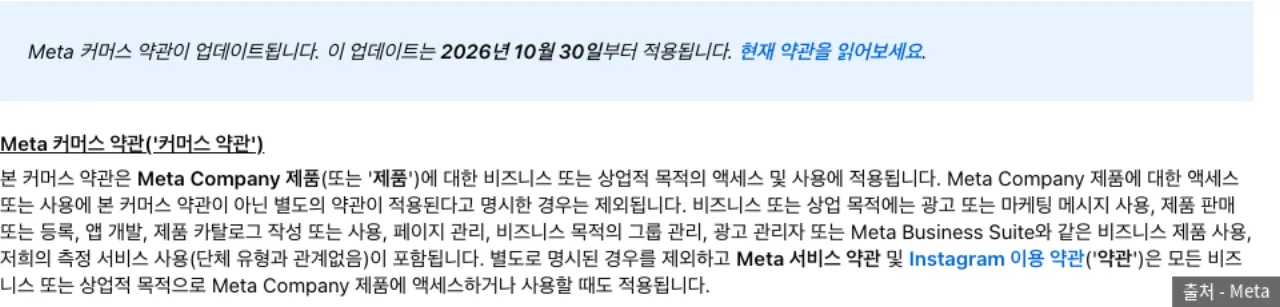 Notice at the top of the Korean version of Meta’s Commercial Terms saying they apply from October 30, 2026 — Source: Meta
The document being changed is the Meta Commercial Terms
These are the terms that apply to commercial activity such as running ads, managing Pages, and using Meta Business Suite
The revised version applies from October 30, 2026
Meta announced the revision in early October through its blog and Business Suite notifications
The Korean version of the terms carries the same date and the same clause
The revised terms only say that if you don't agree, you stop using them for commercial purposes
There is no separate setting to opt out
The new clause, explained
 Clause on automated software and test credentials in the Commercial Terms (highlighted) — Source: Meta
The new paragraph went into the second paragraph of the section “License and rights you give to Meta”
| Clause element | Wording in the terms |
|---|---|
| Collection tools | Web scrapers, bots, spiders, crawlers |
| Collection target | Domains and URLs associated with products and services |
| Collection actions | Indexing, caching, analyzing, collecting, crawling |
| Additional right | Creating test credentials |
| Purpose | Providing, developing, improving, researching, training |
It leaves room to be read as applying not only to landing pages used in ads but to every domain linked to the account
The word train in the English version was rendered as education (교육) in the Korean version
Read in English, it is the word for training AI models
Test credentials are read as meaning Meta can create test accounts on a site to access it
Lawyers’ readings and Meta’s rebuttal
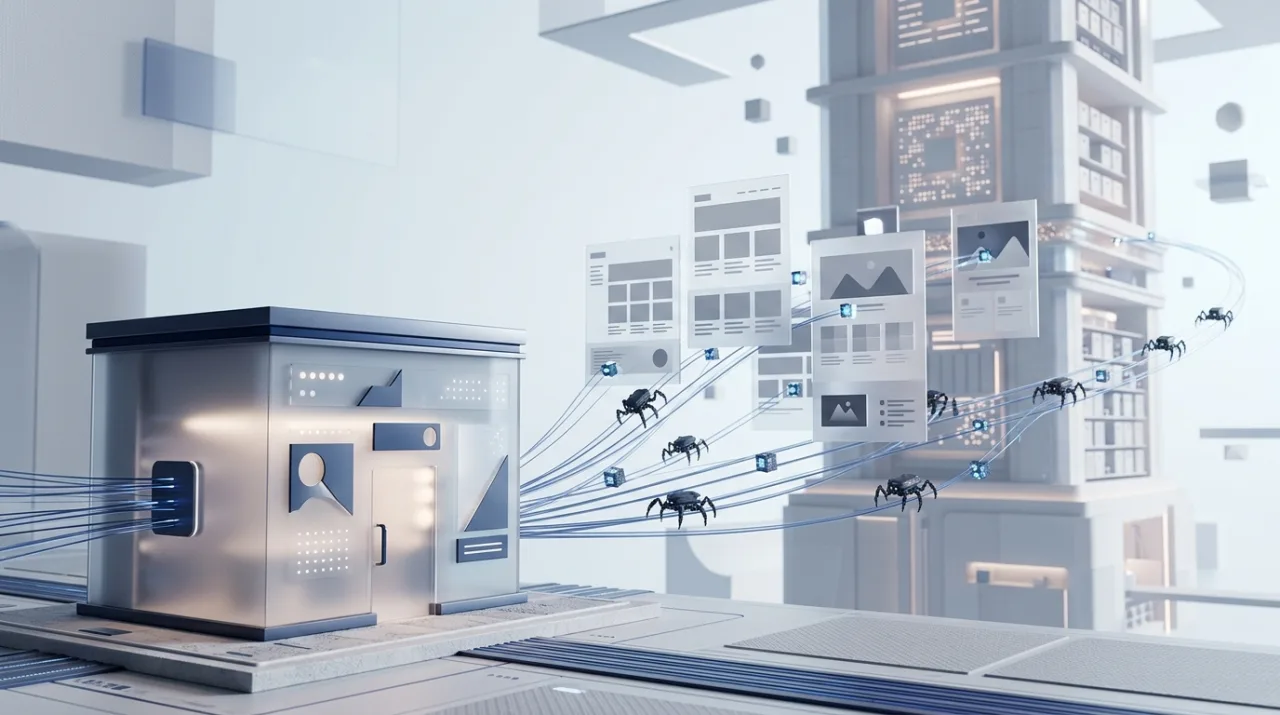 Concept shot of crawlers reaching out from a business account to linked websites — Source: concept shot · self-generated with agy
On October 15, the US journalism research outlet Nieman Lab had three lawyers review the clause
[James Grimmelmann] Cornell Law School professor; sees test credentials as giving access even to content that opens only after signing up
[Matt Topic] Attorney at Loevy & Loevy; sees millions of dollars (billions of won) worth of content at stake
[Benjamin Sobel] University of Wisconsin Law School professor; compares it to tying under antitrust law, which binds other conditions to using a product
All three said it is uncertain whether courts would uphold the clause
Still, Topic advised that news organizations should assume it will be enforced and prepare
Almost every news organization has at least one Meta business account, so it is hard to fall outside its scope!
A Meta spokesperson explained that it had merely consolidated crawling language that was in several terms
It said the way it crawls publishers does not change
Meta communications lead Andy Stone also posted on X on October 16 that it is not true
The explanation is that the revision is meant to accurately collect product information from external sites
Meta did not answer whether test credentials could be used to access content only paying subscribers can see
What robots.txt can block
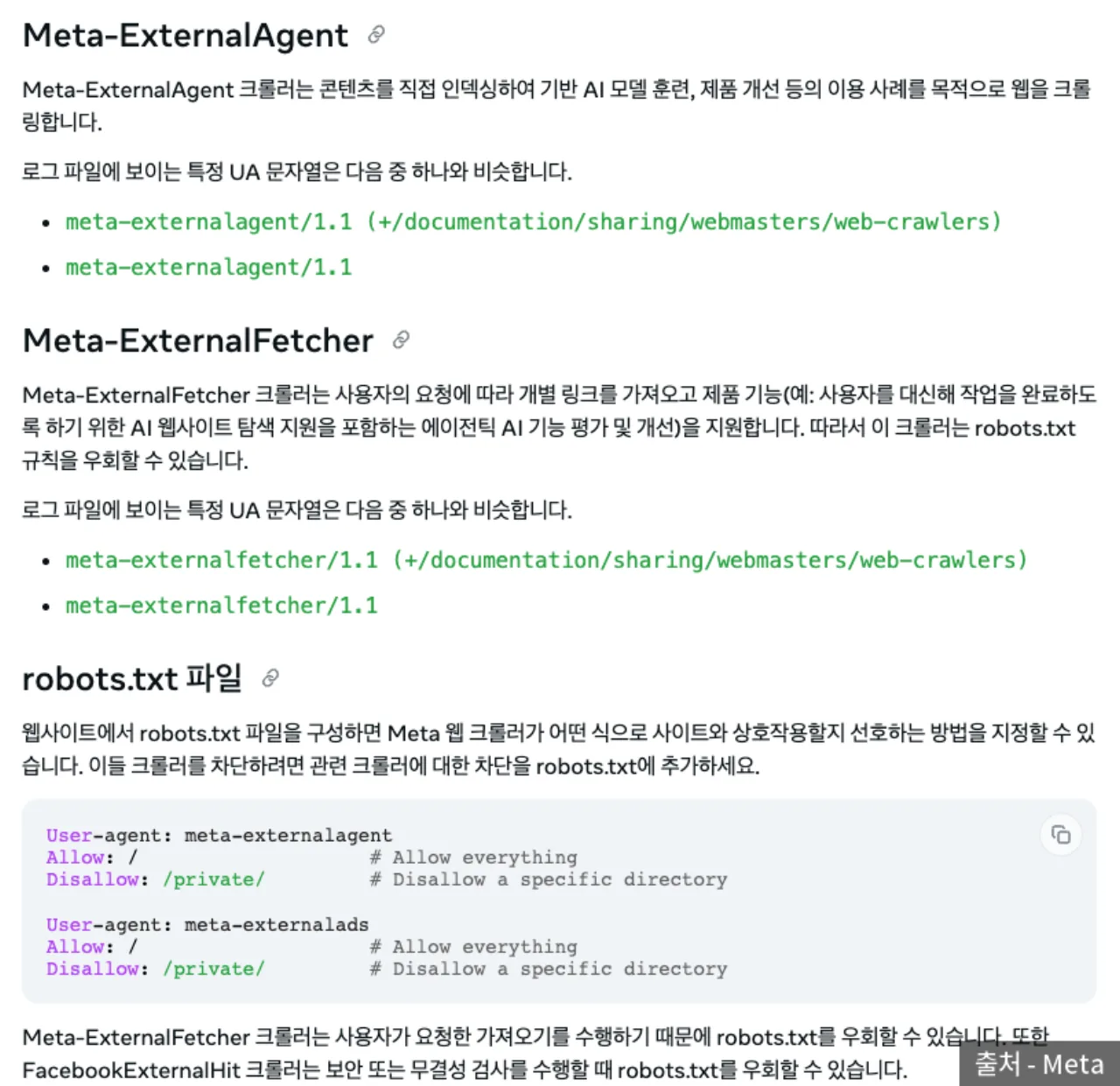 Meta developer documentation describing Meta-ExternalAgent and Meta-ExternalFetcher, with a robots.txt example — Source: Meta
The alternative Meta points to is robots.txt
It is a file placed at the top-level path of a site, and it can allow or block access per crawler
Meta’s developer documentation lists five crawlers
| Crawler | Purpose |
|---|---|
| Meta-ExternalAgent | Training foundation AI models, indexing |
| Meta-WebIndexer | Citations in Meta AI search |
| Meta-ExternalAds | Ads and business products |
| Meta-ExternalFetcher | Fetching links users request |
| FacebookExternalHit | Link previews |
To block AI training, you name and block Meta-ExternalAgent
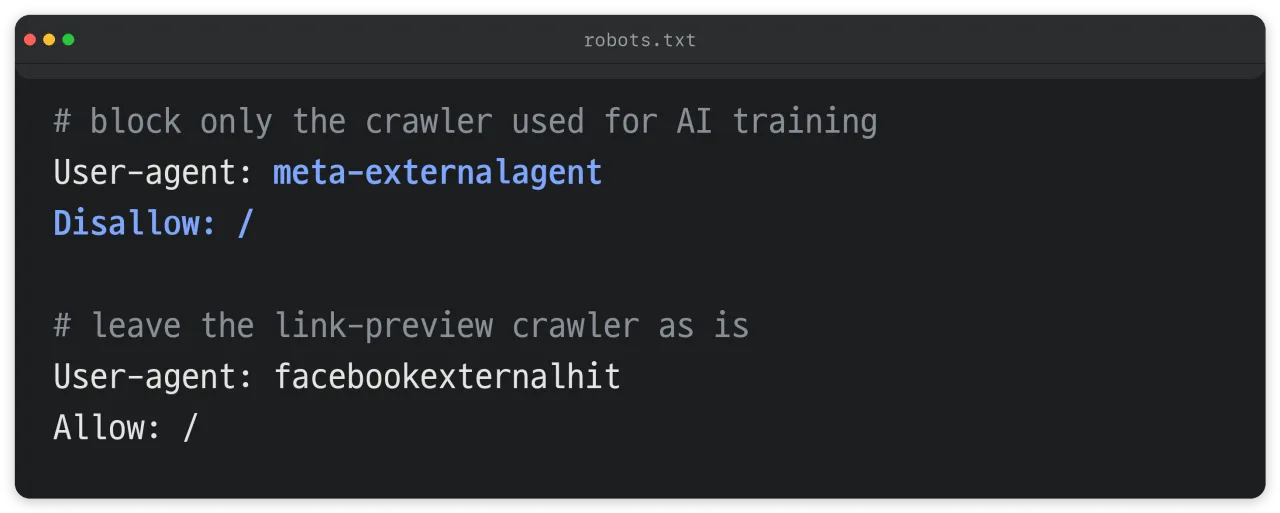 robots.txt example that blocks only meta-externalagent and allows the link-preview crawler — Source: self-rendered based on Meta developer documentation
If you also block FacebookExternalHit, previews of shared links may disappear
Meta states that robots.txt changes take up to 24 hours to take effect
The documentation itself says Meta-ExternalFetcher can bypass robots.txt!
That’s because it is the crawler that fetches links users request
The lawyers thought Meta could argue, based on agreement to the terms, that the contract takes precedence over robots.txt
robots.txt is a technical block, and whether the terms override it has not yet been decided
What businesses in Korea should check
In December 2025, Meta signed AI content deals with CNN, Fox News, Le Monde, and others
They are deals under which Meta AI links to those articles when answering news questions
Through the Commercial Terms, Meta also receives rights to use the content of linked sites
As of October 18, 2026, I couldn't find official positions from Korean press associations or government agencies
Businesses running Instagram ads, such as online shops, clinics, and private academies, receive the same terms
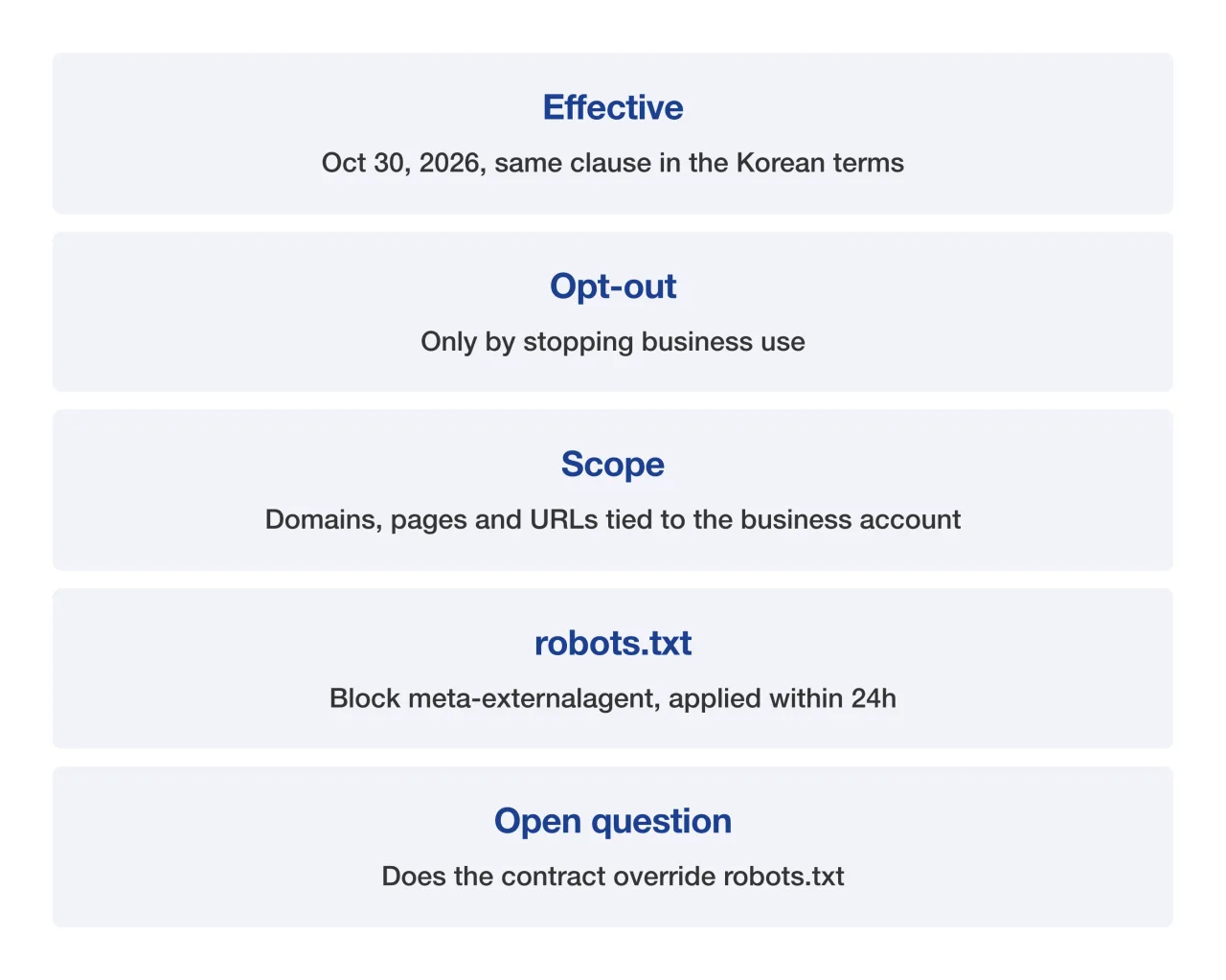 Summary card of the Meta Commercial Terms revision — Source: self-rendered based on Meta Commercial Terms and developer documentation
Sources
- [Meta] Commercial Terms revision preview (applies October 30, 2026, Korean version)
- [Meta for Developers] Meta web crawlers (five crawlers, robots.txt example)
- [Nieman Lab] Three lawyers’ readings of the clause and the Meta spokesperson’s reply (2026-10-15)
- [Relevant Audience] English clause wording and Andy Stone’s post (2026-10-17)
- [ZDNet Korea] Report on concerns from Korean news organizations (2026-10-17)
- [Reuters via MarketScreener] Meta’s AI content deals with news publishers (2025-12-05)
- Exchange rate: converted at $1 ≈ ₩1,400