111,052 school Google accounts used for remote classes have been compromised!! Through abnormal logins or unauthorized password changes, by the Ministry of Education’s October 18 count
The account owners’ names, grade and class, and school names may also have been exposed Whether anything was actually leaked outside has not been confirmed yet
 Concept shot of student account cards slipping out from between open lockers — Source: concept shot, self-generated with agy
Timeline
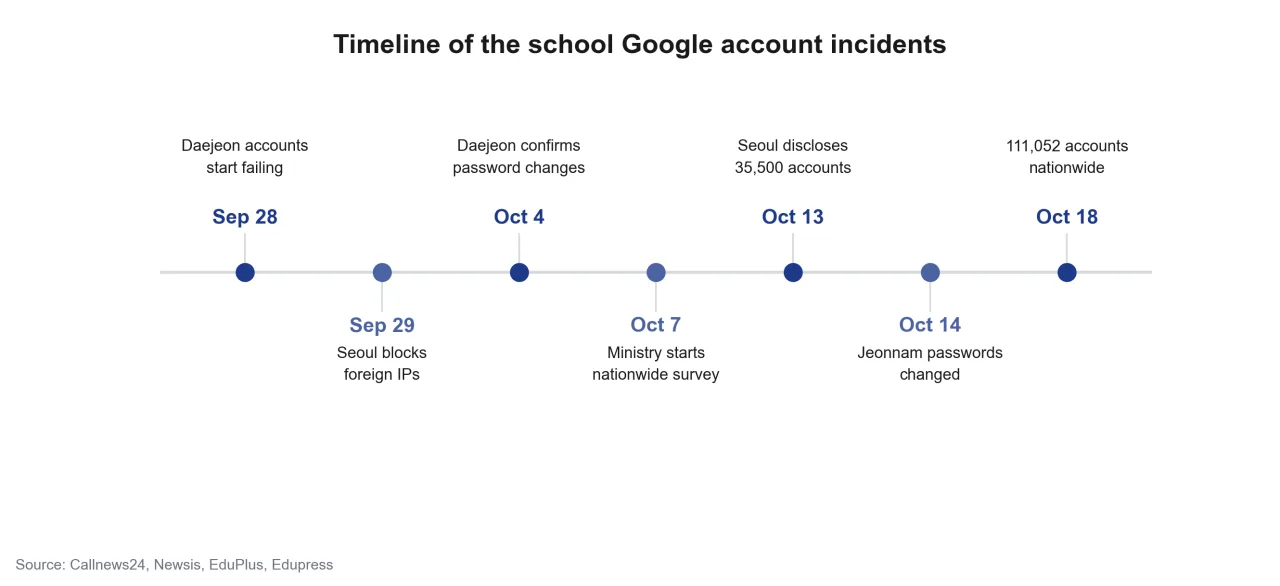 Timeline of the school Google account compromise from late September to October 18, 2026 — Source: self-rendered based on reports by Call News 24, Newsis, Education Plus, and Edupress
Account problems first appeared in Daejeon Account problems continued from September 28, and the education office confirmed on October 4 that passwords had been changed without authorization
On October 6, the Daejeon Office of Education said 74,246 accounts at 200 schools and institutions were affected
Seoul blocked access from overseas IPs on September 29 On the 13th, it was disclosed that about 35,500 accounts at 73 schools had been affected
On October 14, unauthorized password changes also occurred on school accounts in South Jeolla The Ministry of Education began a full survey on the 7th and, as of the 18th, counted 111,052 accounts in five regions nationwide
Scale of damage and scope of exposure
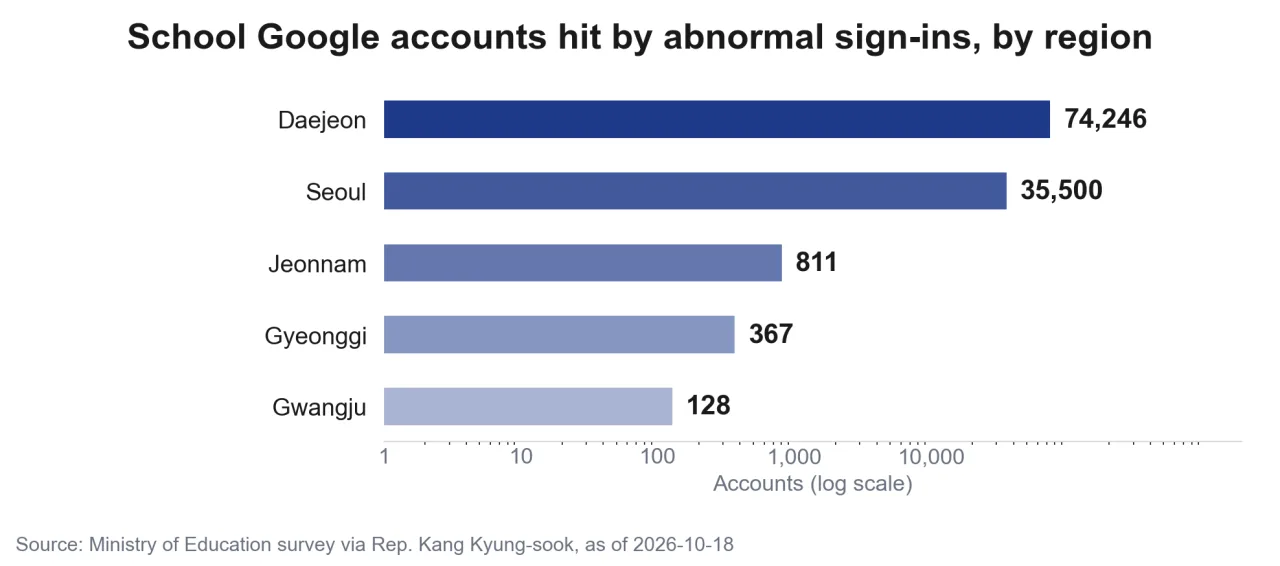 Horizontal bars of affected accounts by region: Daejeon, Seoul, South Jeolla, Gyeonggi, Gwangju — Source: self-rendered based on the Ministry of Education’s full survey (data submitted to lawmaker Kang Kyung-sook’s office)
Daejeon and Seoul together account for 98.8% of the total The remaining South Jeolla, Gyeonggi, and Gwangju come to 1,306 combined
📂 Information that may have been exposed, by region
The ministry’s data lists different information included in accounts depending on the region
| Region | Items possibly exposed |
|---|---|
| Seoul | Account, encrypted password |
| Daejeon | Account, password, name |
| Gyeonggi | Account, password, grade, class |
| South Jeolla, Gwangju | Account, password, school name, student name |
Material reachable through the accounts may also have been exposed The Daejeon Office of Education explained that viewing personal data with a hijacked account is technically possible
What was in class materials, submitted assignments, and mailboxes differs by account, and whether they were viewed is under log analysis
✅ Confirmed damage and unconfirmed matters
[Confirmed] Abnormal logins or unauthorized password changes, 111,052 accounts
[Not confirmed] Whether personal data was actually leaked outside, and the scope of access
[Not confirmed] How the accounts were taken over and who the attackers are
The conditions that made the takeover possible
The Seoul Office of Education believes passwords were changed after successfully logging in from overseas IPs with IDs and passwords Traces of repeated login attempts with automated tools were also found
Education office officials mentioned the possibility that IDs and passwords circulating on the dark web were used
It looks like credential stuffing, trying account details leaked elsewhere But that is not a confirmed cause
This method succeeds when passwords have already leaked outside and two-step verification is turned off
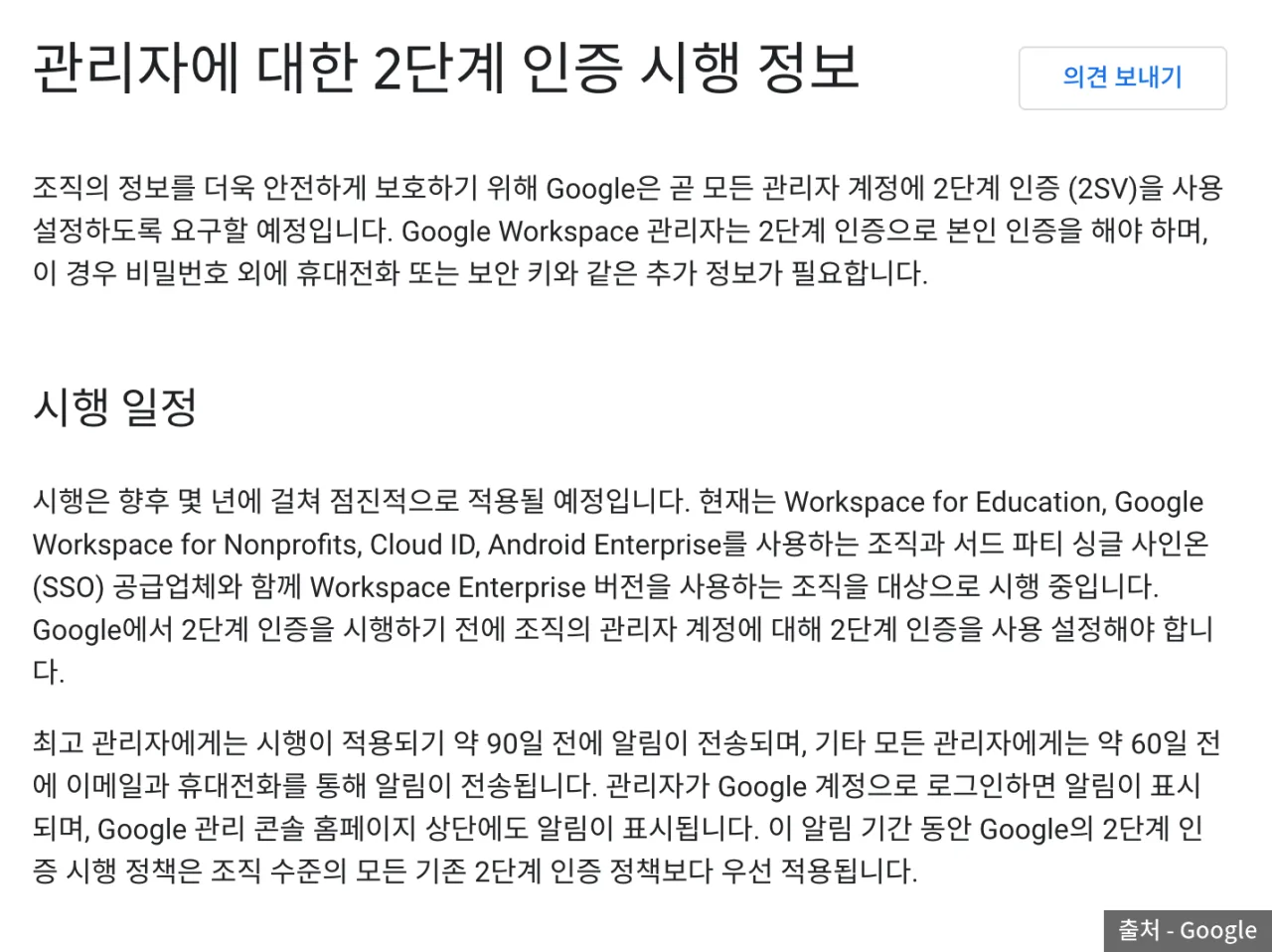 Google Workspace documentation on enforcing two-step verification for administrators — Source: Google
Google makes two-step verification mandatory for administrator accounts in Workspace for Education Student and teacher accounts aren’t covered by this requirement, so school administrators have to turn it on separately in the admin console
🗂️ Graduate accounts left behind
In Daejeon, accounts of graduates and retired staff had been kept rather than deleted There was no rule on when to delete accounts, so it was left to school administrators’ discretion
Long-unused accounts also go a long time without password changes, which can leave them exposed to attacks like this At a training session on October 8, the Daejeon Office of Education advised deactivating and deleting graduate accounts
Scale of school accounts and AIEP links
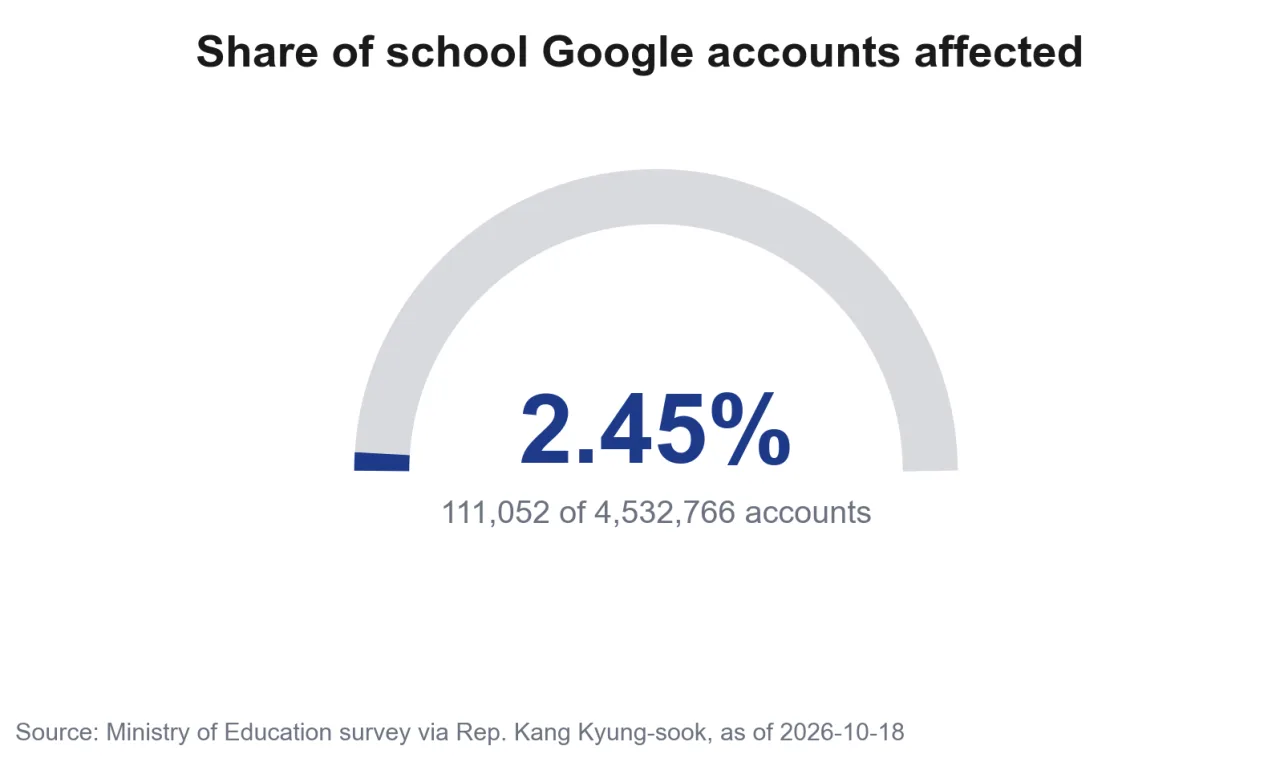 Gauge of the share of affected accounts among 4.53 million school Google accounts nationwide — Source: self-rendered based on the Ministry of Education’s full survey (data submitted to lawmaker Kang Kyung-sook’s office)
11,637 schools nationwide use 4,532,766 Google Workspace accounts The affected accounts are 2.45% of those
AIEP (AI-based personalized teaching and learning platform), run jointly by provincial education offices, is also linked to outside services such as Google
According to Education Plus, there are 1,855,349 AIEP-related Google accounts, used at 6,383 schools
No sign has been confirmed that AIEP accounts or the platform were directly compromised in this incident But because it logs in to outside services through unified authentication, there were calls for security checks of linked accounts
What to do now
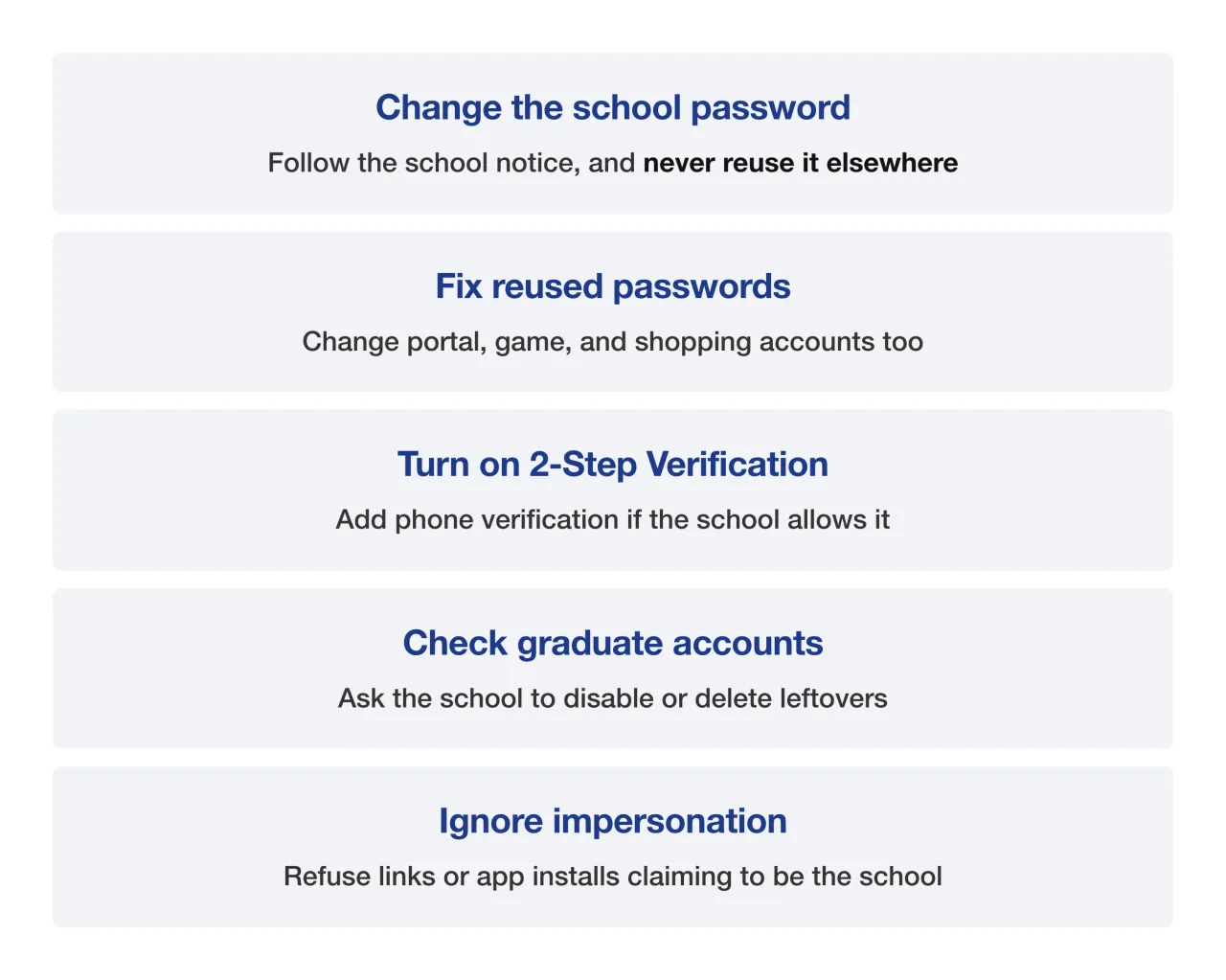 Five steps students, parents, and graduates should take now — Source: self-rendered based on the Ministry of Education’s official letter and Daejeon Office of Education guidance
The Ministry of Education sent all schools and institutions an official letter asking for a full password reset and two-step verification If your school sends instructions to change your password, just follow them
There is no way yet for individuals to check whether their data was leaked
The South Jeolla Office of Education said it will notify people again once the leaked items are confirmed Please check school text messages and letters home~
If you use the same password as your school account, your accounts on other services may also become targets of further attacks You can check whether your password is on a leak list with the method in the post below
🔗 Link - https://blog.naver.com/rottensweetpotato/224378507343
🏫 What schools and education offices should do
[Mandate two-step verification] Apply it in the admin console down to student and teacher organizational units
[Clean up dormant accounts] Set retention periods and deletion criteria for graduate and retiree accounts
[Login policy] Restrict overseas logins, review login records regularly
If you suspect personal data damage, you can consult the Personal Information Infringement Report Center (118, no area code)
🔗 Link - https://privacy.kisa.or.kr
What to watch next
- Results of the joint cause investigation by the Ministry of Education and Google
- Confirmation of the actual scope of the personal data leak and renewed notification
- Whether retention and deletion criteria for education accounts are set
- Results of security checks on AIEP-linked accounts
Lawmaker Kang Kyung-sook asked the Ministry of Education to establish the scope of the leak and the cause of the incident and to set up a security management system for education accounts
Sources
- [Edupress] 110,000 school Google accounts compromised nationwide (2026-10-19, affected accounts by region, items possibly exposed, 4.53 million accounts)
- [Education Plus] 110,000 school Google accounts hacked, red light for education security including AIEP (2026-10-19, 1.85 million AIEP-linked accounts, 11,637 schools)
- [Newsis, Nate News] 30,000 Seoul school Google passwords changed without authorization, overseas IPs blocked belatedly (2026-10-16, overseas IP logins, Ministry of Education letter)
- [Call News 24] There was no rule for deleting graduate accounts (2026-10-14, Daejeon timeline, graduate accounts)
- [Education Plus] Domino hacking of education Google accounts, from Daejeon and Seoul to South Jeolla (South Jeolla case)
- [Google Workspace Help Center] About two-step verification enforcement for administrators (mandatory for education administrator accounts)