Up through part 9, we looked at how datacenters get electricity from the grid, nuclear plants, or orbit This time it’s the side that generates power on site instead of waiting for a grid connection
🔗 Link - https://blog.naver.com/rottensweetpotato/224434111541
On October 13, Nikkei reported that NTT DATA will build a datacenter dedicated to Anthropic in Osaka Power intake is up to 500MW, and the two companies are in final negotiations
The report says that because a grid connection takes a long time, on-site generation and fuel cells are being considered first
 Anthropic and NTT DATA logos
What was reported
Reuters and others carried the Nikkei report, and both companies declined to comment Everything below is as reported
| Item | Reported details |
|---|---|
| Location | Osaka, Japan |
| Power intake | Up to 500MW |
| Construction cost | Up to ¥1 trillion (about ₩8.8 trillion) |
| Signing target | End of March 2027 |
| Partial operation | As early as 2028 |
The construction cost of about ¥1 trillion (₩8.8 trillion) does not include GPU servers Nikkei estimated that including servers, the total cost would reach several trillion yen
If it goes through, it will be Anthropic’s first dedicated datacenter in Japan Nikkei reported that Anthropic is also considering new datacenters in other Asian countries
How big 500MW is
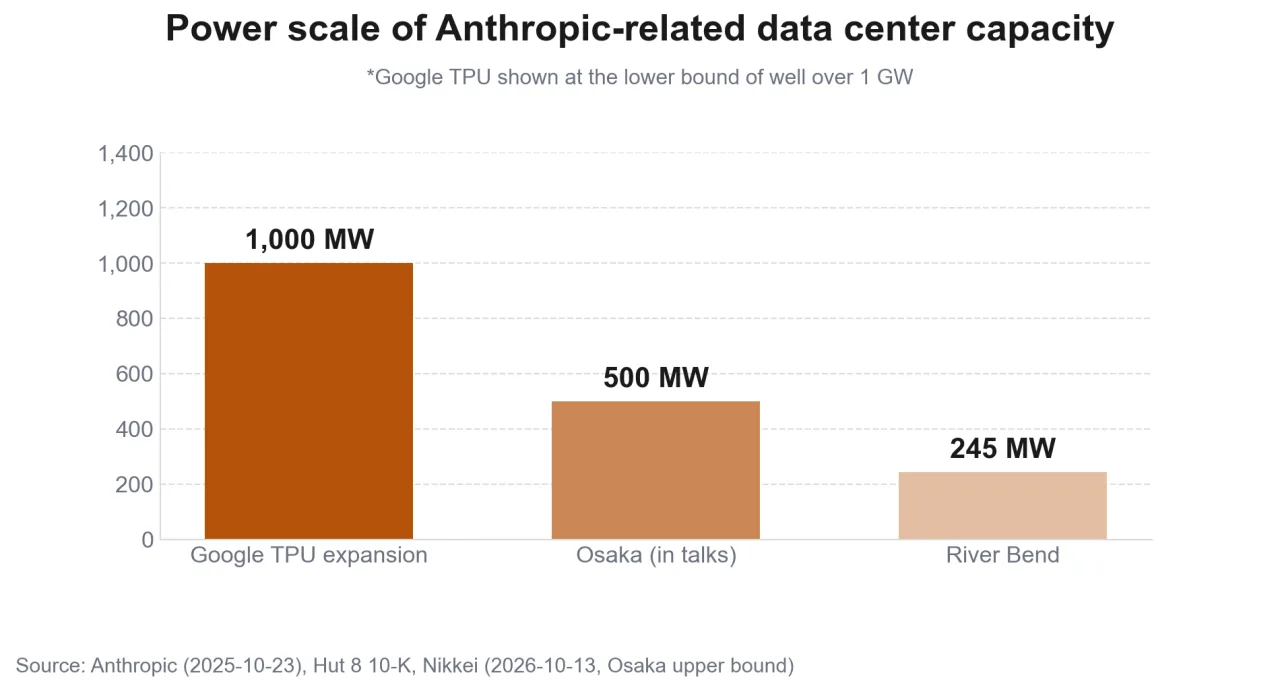 Bar chart comparing the power scale of the Google TPU expansion, Osaka, and River Bend — Source: self-rendered based on Anthropic, Hut 8, and Nikkei reports
In October 2025, Anthropic said it would expand its Google TPU capacity It’s a scale that brings more than 1GW online in 2026
In December of the same year, Hut 8 disclosed a 245MW lease at River Bend in Louisiana The tenant is Fluidstack, and the facility is used for Anthropic inference
Osaka’s 500MW is about twice River Bend
Mordor Intelligence estimated Japan’s datacenter power capacity at 3.57GW in 2026 The single Osaka site is 14% of that
On-site generation instead of the grid
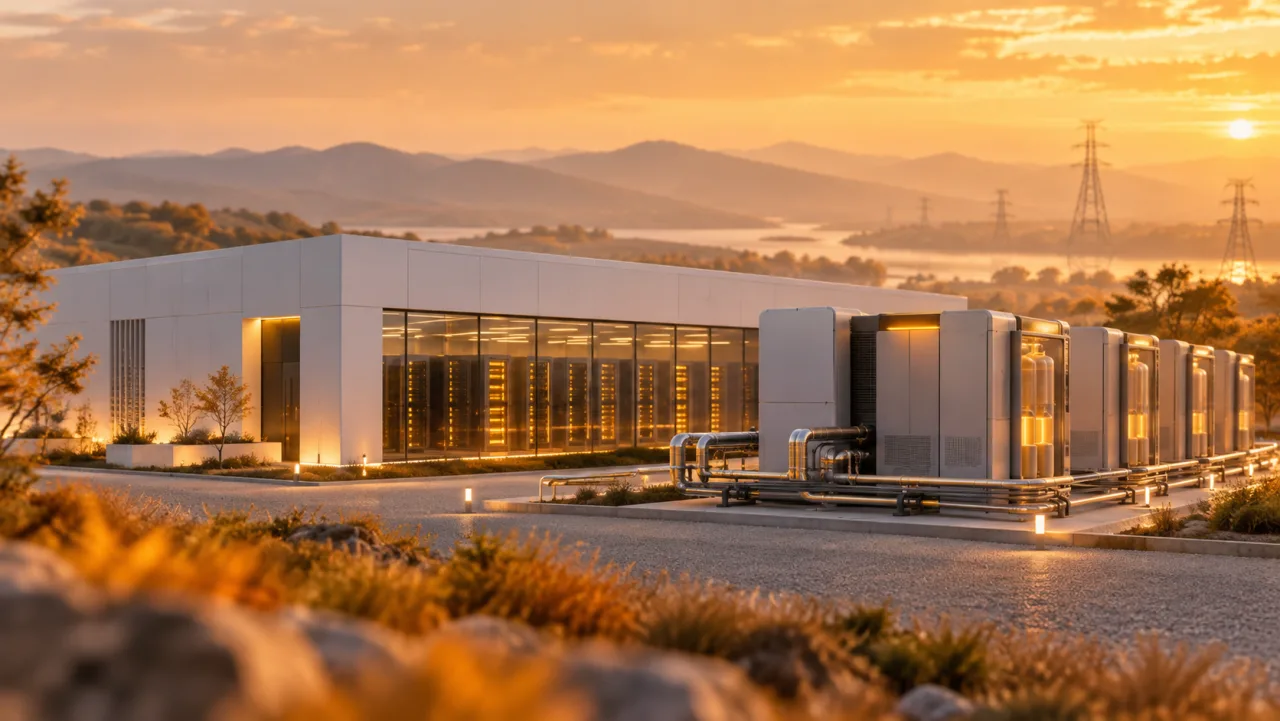 Concept shot of fuel cell modules lined up next to a datacenter — Source: concept shot, self-generated with agy
As we saw in part 1, connecting a large load to the grid means building new transmission lines and substations and waiting years
Nikkei reports that getting 500MW from the grid would take a long time So it said on-site generation and fuel cells are being considered first
Generating power on site like this, behind the grid meter, is called behind-the-meter US datacenters also use on-site generation
⚡ Fuel cell deal examples
In November 2024, the US utility AEP signed a deal with Bloom Energy for up to 1GW of fuel cells The first order was 100MW
The solid oxide fuel cells (SOFC) are placed on site to supply power until the grid connection
In October 2025, Bloom Energy also announced a partnership with Brookfield It commits up to $5 billion (₩7 trillion) to fuel cells for AI datacenters
These fuel cells mainly run on natural gas
They can come online faster than a grid connection, but it means placing fuel-burning generation next to the datacenter
How Korea differs
Anthropic opened its Seoul office in June 2026
With Claude, you can choose data residency in Korea through Amazon Bedrock and Vertex AI But Japan comes first for a dedicated Anthropic datacenter
I covered the grid impact assessment for Korean datacenters of 10MW or more in part 1
The AI Datacenter Special Act, passed by the National Assembly in May 2026, is set to take effect in February 2027 Datacenters below a certain size outside the capital region are exempt from this assessment
How far on-site generation can be used while waiting for a grid connection will be set in subordinate regulations
What to watch next
- Signing: target of end of March 2027, not yet officially confirmed by either company
- Power source: whether the on-site fuel is gas, and how large the fuel cells are
- More Asian sites: the other Asian countries Nikkei reported as under consideration
- Korea: special provisions for self-generation and direct power trading in the AI Datacenter Special Act’s subordinate regulations
🔗 Link - https://blog.naver.com/rottensweetpotato/224434111541
Sources
- [The Star, Reuters] NTT Data in final talks to build Anthropic’s first data centre in Japan, Nikkei reports (2026-10-13)
- [The Next Web] NTT Data reportedly nears deal to build Anthropic’s first Japan data centre (total cost including servers, power alternatives)
- [W.Media] NTT Data in talks with Anthropic (signing target, Japan datacenter power capacity estimate)
- [Anthropic] Expanding our use of Google Cloud TPUs (2025-10-23)
- [SEC] Hut 8 Corp. 10-K FY2025 (River Bend 245MW lease)
- [Utility Dive] AEP and Bloom Energy deal for up to 1GW of fuel cells (2024-11)
- [Data Center Dynamics] Bloom Energy’s $5 billion partnership with Brookfield (2025-10)
- [Anthropic] Regional data residency guide
- [Smart City] AI Datacenter Special Act passes plenary session, takes effect February 2027 (2026-05-08)
- Exchange rate: converted at $1 ≈ ₩1,400 and ¥1 trillion ≈ $6.3 billion (as converted in reports)