On October 5, 2026, OpenAI announced that it will embed textGrain, an invisible text watermark, in text generated by ChatGPT. The first region is the EU, and over the coming weeks it will apply to ChatGPT and Codex text outputs within the EU.
It’s a measure introduced because the EU AI Act requires machine-readable marking of generative AI outputs. It isn’t applied by default to Korean users’ ChatGPT output, and the detector isn’t released to the public.
 OpenAI’s October 5, 2026 notice, Our approach to EU text provenance rules — Source: OpenAI
What was announced
How it applies differs by region, and it covers text only.
- EU: watermark applied over several weeks to relevant text outputs of ChatGPT and Codex on all plans
- API: from October 5, customers worldwide can enable it themselves on some models; off by default
- Detector: only approved researchers and expert organizations can apply; not released publicly
- Optional application also planned within weeks for OpenAI models used through cloud partners
Images and audio already have separate systems. OpenAI embeds C2PA content credentials and SynthID watermarks in generated images and lets anyone check them at openai.com/verify, but said it won’t release a text detector because of the risk of false positives and false negatives.
How it works and how well it detects
textGrain ties the model’s choice of next word to random values derived from a secret key, embedding a statistical signal in word choice. According to the technical report released the same day, it links word choice to the key through an optimal transport problem using Gumbel values and KL regularization, and the signal strength depends on how much it reduces generation diversity (entropy). The detector needs only the text and the key, not the settings used at generation.
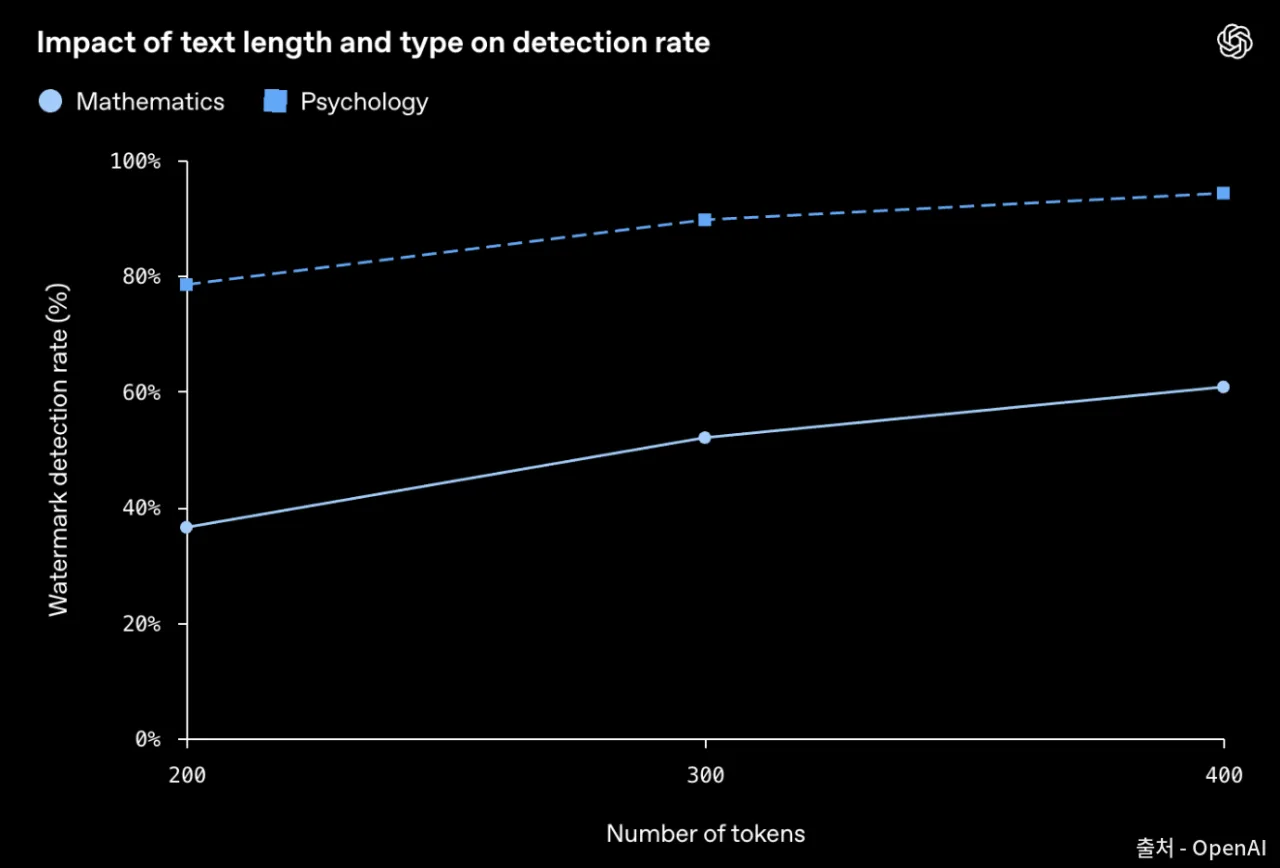 Graph of watermark detection rate by text length and type — Source: OpenAI
Performance was measured with the false positive rate — classifying human-written text as AI text — set to 1%. For explanatory writing such as psychology, it detected about 80% at 200 tokens and about 95% at 400 tokens. Math writing was much lower at the same lengths, around 60% even at 400 tokens. Text with set formulas and terms leaves little room to choose different words, so there are fewer chances to embed the signal.
OpenAI said that in its own evaluation textGrain matched or beat Google’s SynthID text, but didn’t publish the comparison table.
A signal that weakens with editing
Editing the text weakens the signal quickly. These are OpenAI’s results from replacing some words with synonyms in 400-token text.
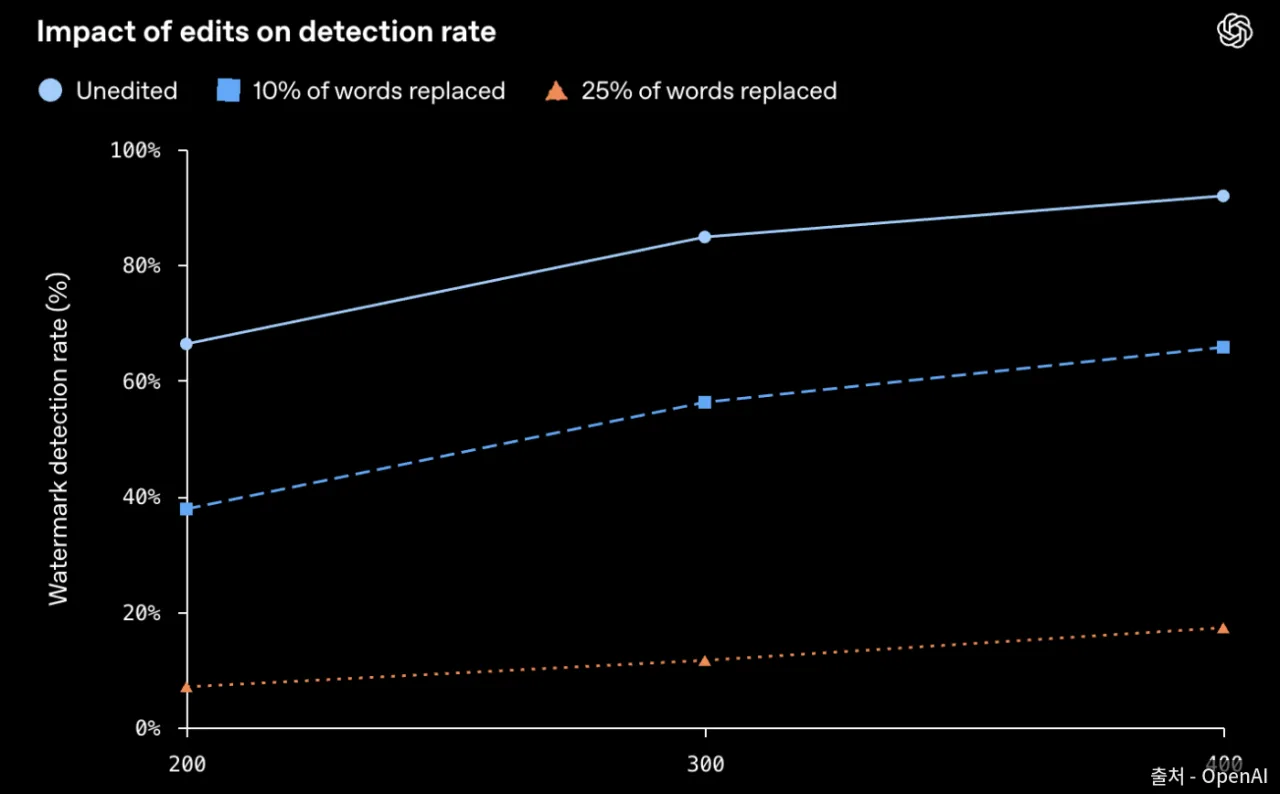 Graph of watermark detection rate by degree of editing — Source: OpenAI
Changing just 10% of words drops the detection rate from 92% to 66%, and changing 25% drops it to 17%. The notice says translated text and short text are also hard to detect. That’s why OpenAI itself points out that not detecting a watermark isn’t evidence that a person wrote the text.
The SynthID paper covered in the September 11 post reported about 87% detection at 400 tokens (Gemma 7B, 1% false positive rate) on the same ELI5 question set. The models and conditions differ, so the two figures can’t be compared directly, but both methods share the tendency for detection to rise with length and fall as wording choices narrow.
The Basis of Claude’s Watermark — An Analysis of Google’s SynthID Paper (in Korean)
Output quality
Running eight benchmarks with and without the watermark on the latest model, Astra (maximum setting), the differences were within about 3 percentage points, some up and some down.
| Benchmark | No watermark | With watermark |
|---|---|---|
| AA Intelligence Index | 49.57 | 49.76 |
| DeepSWE v1.1 | 72.80% | 71.68% |
| Terminal-Bench 4.0 | 53.90% | 56.06% |
| BrowseComp | 87.92% | 87.35% |
| GPQA Diamond | 94.44% | 93.94% |
| HealthBench Professional | 64.27% | 64.60% |
AutomationBench (34.09%→34.86%) and Terminal-Bench Science 0.1 (56.90%→60.00%), also included in the notice, go the same direction. These results come from single runs, so items where the watermarked score came out higher may just be run-to-run variance.
Does it apply in Korea
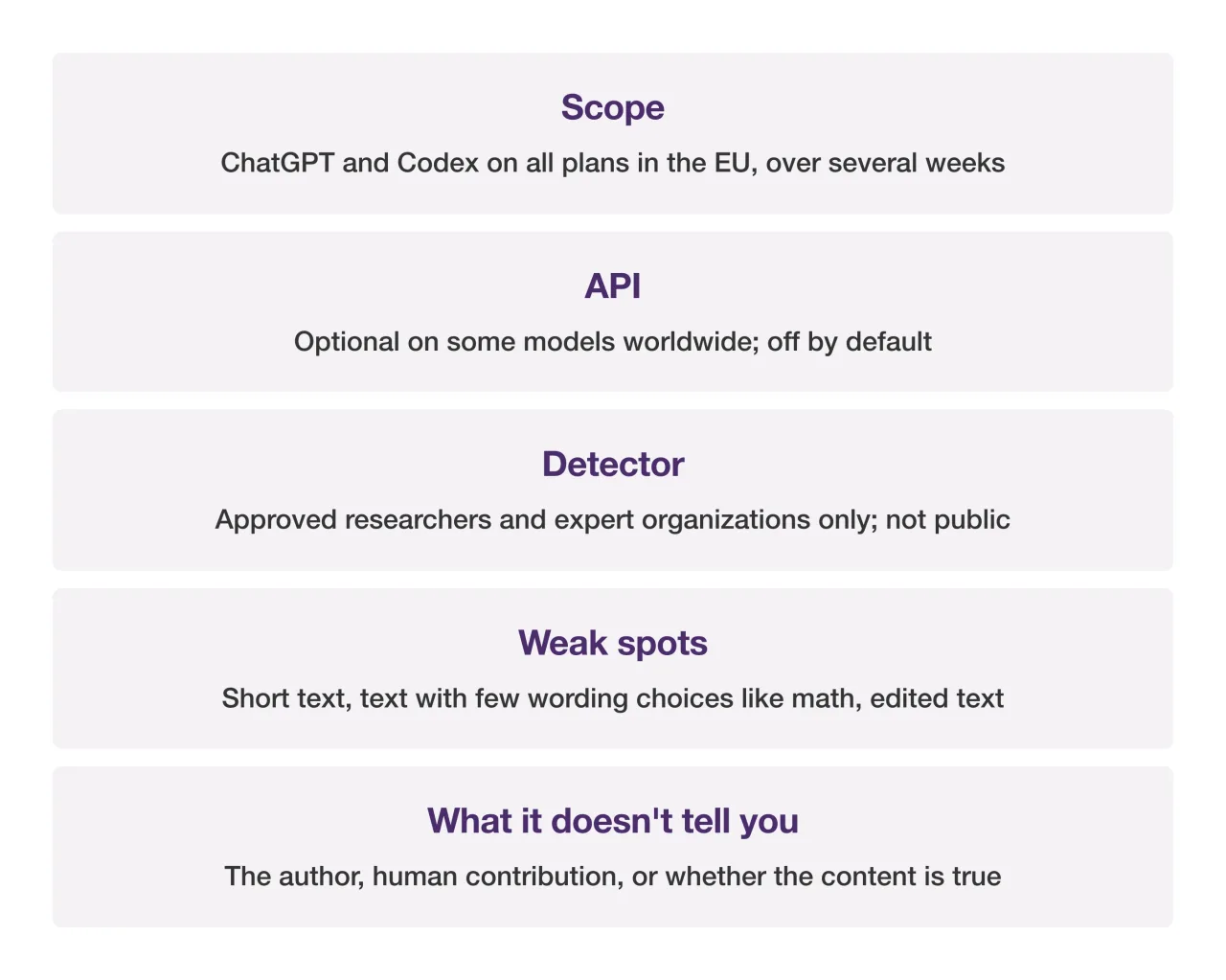 textGrain announcement summary card — Source: self-rendered from OpenAI’s notice
This default application is limited to the EU, so textGrain isn’t applied by default to text ChatGPT produces in Korea. Korean API customers can enable it themselves on some models.
Korea has a marking obligation too. Article 31 of the AI Framework Act, in force from January 22, 2026, requires generative AI providers to indicate that outputs were generated by AI, and the Ministry of Science and ICT has guided that watermarks invisible to the naked eye are an acceptable method. The government said it will have a grace period of at least a year focused on guidance rather than fines. OpenAI’s notice doesn’t specify how it will meet this obligation for text output in Korea.
On the EU side, the schedule began on August 2, 2026, when Article 50 of the AI Act took effect, and services launched before then are reportedly allowed until December 2 to put machine-readable marking in place. textGrain’s rollout over several weeks proceeds within that deadline.
What to watch next
- When the technical report is expanded and open-sourced (OpenAI said it would expand it within weeks)
- External evaluations after researchers gain detector access, especially detection rates for Korean text
- OpenAI’s response in Korea to the AI Framework Act’s subordinate notices
- Whether a cross-detection system emerges with other companies’ watermarks, such as Anthropic’s and Google’s
Sources
- [OpenAI] Our approach to EU text provenance rules (2026-10-05; source of 3 images in the body)
- [OpenAI] textGrain: Entropy-Calibrated Watermarking for Language Model Text (technical report)
- [European Commission] Code of Practice on AI-generated content
- [Baker Botts] EU AI Act Article 50 Transparency Obligations Go Live (2026-09, effective date and grace deadline)
- [Aju Business Daily] Ministry of Science and ICT enacts AI Framework Act subordinate rules, mandating generative AI watermarks (invisible watermarks allowed)
- [Digital Daily] AI Framework Act enforcement decree pre-announced, grace period for fines