On October 15, 2026, the world’s timekeeping rules changed
The General Conference on Weights and Measures resolved to abolish leap seconds
From May 20, 2027, no more seconds will be added to world standard time
It’s a rule the IT industry had long been asking to scrap, since leap seconds have caused server outages
 Concept shot of a one-second fragment slipping out between an atomic clock and the rotating Earth — Source: concept shot · self-generated with agy
What was decided
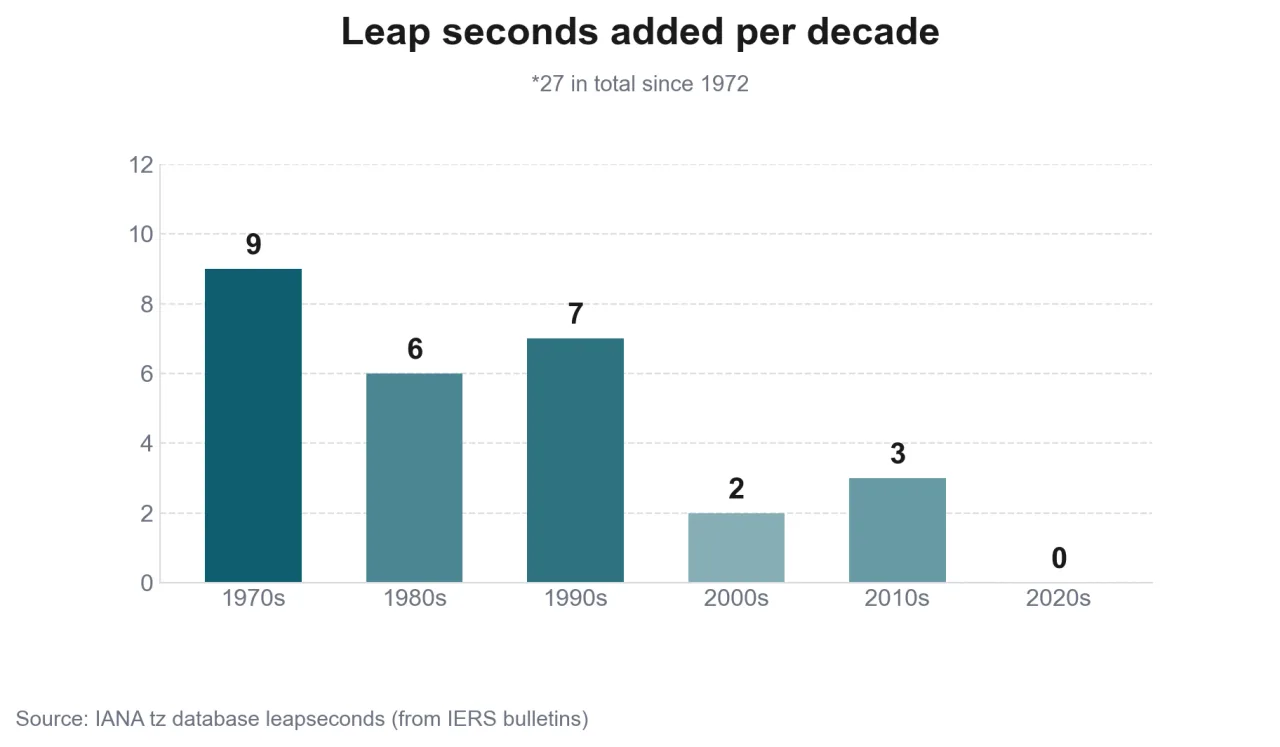 Bar chart of leap seconds added by decade — Source: self-rendered based on the IANA tz database
The decision was made at the 28th General Conference on Weights and Measures (CGPM) in Versailles, France
It meets every four years to set units such as the meter, kilogram, and second
| Item | Details |
|---|---|
| Resolution date | October 15, 2026 |
| Effective date | May 20, 2027 |
| Tolerance | 1 second → up to 3,600 seconds |
| Original target | By 2035 |
The decision allows the gap between UTC (Coordinated Universal Time) and time based on the Earth’s rotation to grow up to 1 hour
It’s expected to take more than 1,000 years for the gap to reach 1 hour
The leap seconds, added 27 times since the first in 1972, will no longer be added
Scientists had debated this issue for 30 years
How leap seconds work
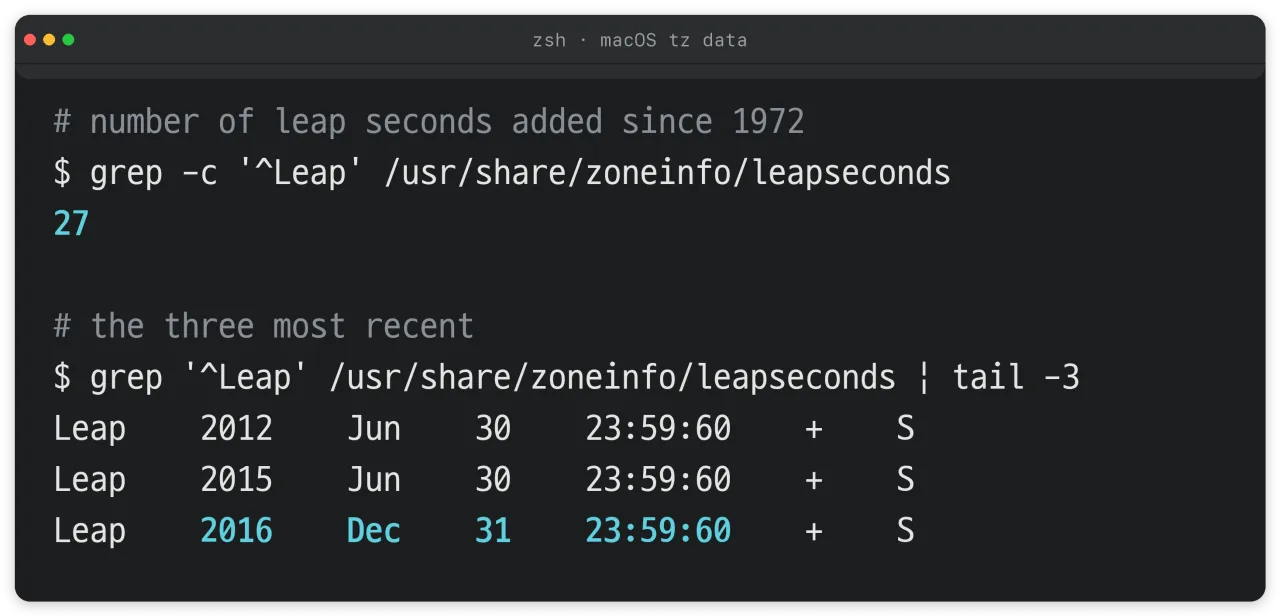 Number of leap seconds and the three most recent ones recorded in macOS tz data — Source: run on macOS IANA tz data
World standard time has adjusted for the gap between atomic time and time based on the Earth’s rotation
[Atomic time] The second measured by cesium atomic clocks, steady without wobble
[Astronomical time UT1] The time the Earth takes to rotate once, which varies a little every year
UTC follows atomic time but has added one second before its gap with UT1 exceeds 0.9 seconds
That second is the leap second
On a day a leap second is added, UTC clocks count 23:59:60 once more after 23:59:59
In Korean time, that’s 8:59:60 a.m. on January 1 or July 1
The last leap second was added on December 31, 2016 UTC, the morning of January 1, 2017 in Korean time
Outages caused by leap seconds
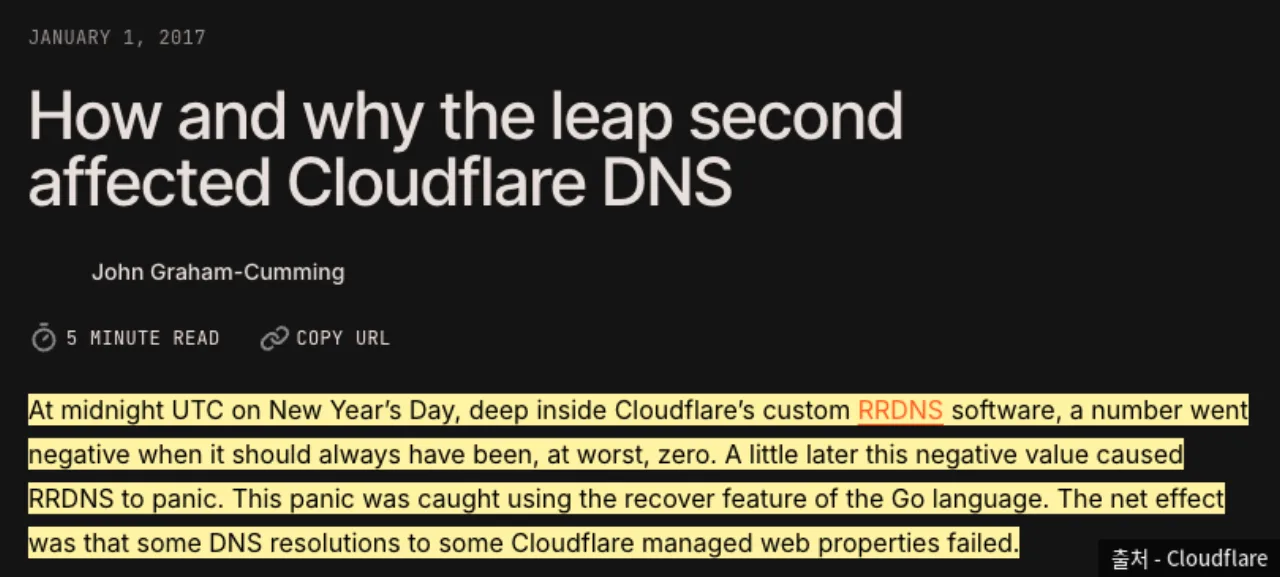 Title and cause paragraph of Cloudflare’s 2017 leap second outage write-up — Source: Cloudflare
Computers calculate time assuming a minute is 60 seconds
When a 61st second is added, it breaks that assumption
[Reddit, June 2012] An error in Linux high-resolution timer handling froze CPUs, site unreachable for 30–40 minutes
[Cloudflare, January 2017] Measured response times went negative, causing errors in DNS servers, up to 0.2% of queries failed
The Cloudflare outage began at 00:00 UTC on January 1 and lasted 6 hours and 45 minutes
The cause was a single line of code that assumed a time measurement could never be smaller than the previous one!
That’s why large companies have used leap smear, which spreads the one leap second over a day
| Company | Smear method |
|---|---|
| 24-hour linear, about 11.6μs per second | |
| Meta | 17 hours, quadratic function |
In a 2022 engineering blog post, Meta backed the move to stop adding leap seconds
It was an industry proposal to stop at 27
A leap second has caused errors because it doesn't fit code's assumption that time never goes backward
The negative leap second that moved the schedule up
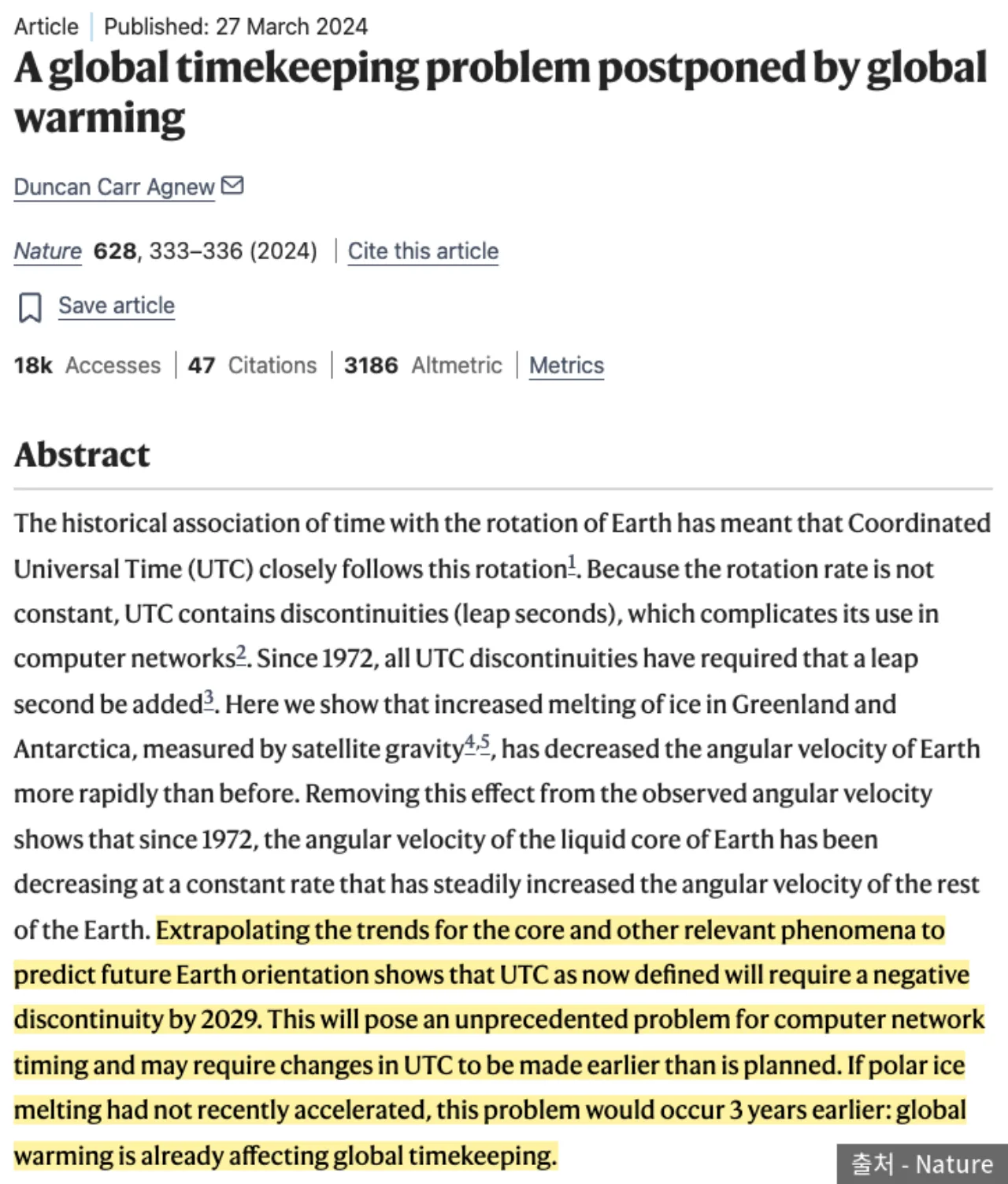 Title and abstract of Agnew’s 2024 Nature paper, with the 2029 negative leap second prediction highlighted — Source: Nature
The original abolition target was 2035
The reason it was moved up is the negative leap second
When the Earth’s rotation speeds up, a second has to be subtracted rather than added
UTC clocks would jump straight from 23:59:58 to midnight of the next day
It has never happened in the 54-year history of leap seconds, so software has never been tested for it!!
Duncan Carr Agnew of the Scripps Institution of Oceanography calculated when this would happen
It’s a paper published in Nature in March 2024
[Prediction] Under the current definition, a negative leap second would be needed by 2029
[Cause] As the rotation of the Earth’s liquid core slows, the rest of the Earth spins faster
[Ice] Melting ice in Greenland and Antarctica slowed the rotation; without it, it would have come three years earlier
The International Bureau of Weights and Measures (BIPM) put the probability of needing a negative leap second by 2035 at about 30%
Nick Stamatakos of the US Naval Observatory also cited avoiding a negative leap second as a major reason
What changes and what stays the same
Phone and PC clocks and Korean Standard Time stay the same
Korea keeps its system of being 9 hours ahead of UTC, and users don’t need to change any settings
What changes are places that use precise time synchronization
That includes telecom networks, datacenters, financial trading, and satellite navigation
But the existing 18-second gap between GPS time and UTC stays as it is
The Korea Research Institute of Standards and Science, which manages Korean standard time, distributes UTCk, a program that syncs PC clocks to standard time
As of October 18, 2026, I couldn’t find any official guidance from the institute on this decision
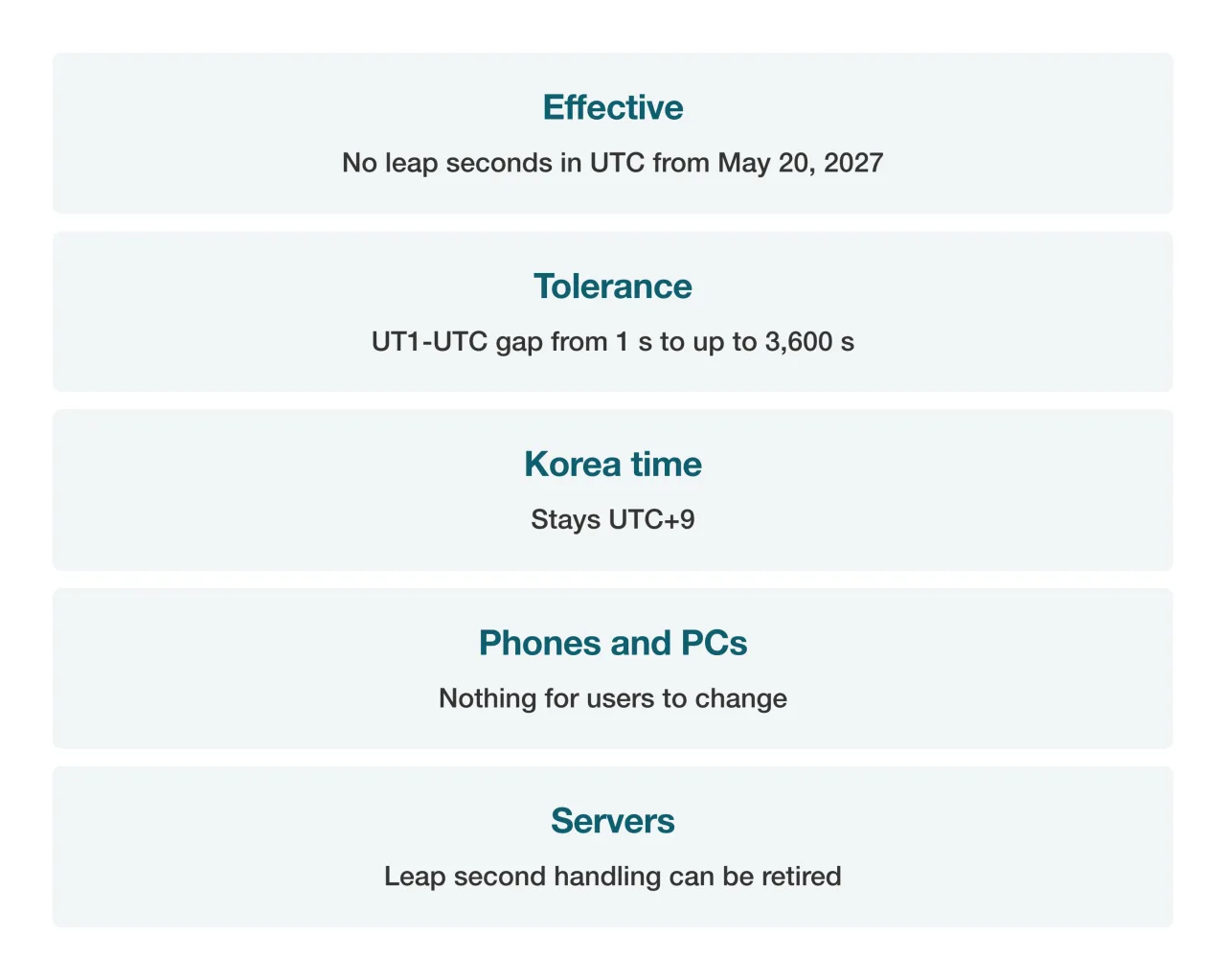 Summary card of what changes and what stays the same with the end of leap seconds — Source: self-rendered based on reports of the CGPM resolution
Sources
- [Scientific American] CGPM resolution to abolish leap seconds, effective date, tolerance, and officials’ remarks (2026-10-15)
- [ZDNet Korea] The end of leap seconds, why the 2035 target was moved up, and BIPM’s probability estimate (2026-10-16)
- [BIPM] Resolution 4 of the 27th CGPM, the 2035 target and request to redefine the tolerance (2022)
- [Nature] Agnew, A global timekeeping problem postponed by global warming (2024, source of an image in this post)
- [Cloudflare Blog] Write-up of the 2017 leap second DNS outage (2017-01-01)
- [Engineering at Meta] It’s time to leave the leap second in the past (2022-07-25)
- [Google Public NTP] Leap Smear method (24-hour linear)